
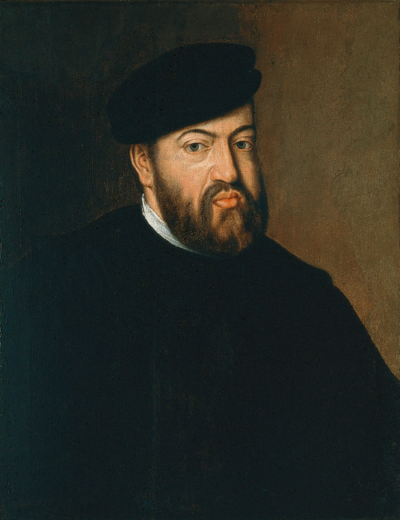
John III of Portugal
John III of Portugal was a King of Portugal (r. 1521-1557). Born June 6, 1502, in Castle of Saint George. Died June 11, 1557, in Ribeira Palace. Positions held include Monarch of Portugal (1521–1557) and Grand Master of the Order of the Tower and Sword. Awards include Knight of the Order of the Golden Fleece.
Facts
33 facts · 2 confirmed by two sources · 2 cited · 29 from one source
What’s different
- Born: we show June 6, 1502 (Confirmed). Wikidata also lists June 7, 1502
Where this comes from
Papalocal keeps its own record. It started from these sources; what each one said is kept here as it was copied, so a change on their side never changes this page by itself. Tap one to read its version.
What Wikidata says · copied November 16, 2026 · revision 2557966759
- Described as
- King of Portugal (r. 1521-1557)
- Other names
- John III., King John III. of Portugal, Don João III., John III. of Portugal, King João III., João III. of Portugal, João III., D. John III., João III. the Pious, King John III., Don João, John III the Pious
- Born
- June 6, 1502 · 1 reference; June 7, 1502 · 1 reference
- Died
- June 11, 1557 · 1 reference
- Born in
- Castle of Saint George · 1 reference
- Died in
- Ribeira Palace · 1 reference
- Buried in
- Jerónimos Monastery
- Cause of death
- cardioplegia
- Citizen of
- Kingdom of Portugal
- Occupation
- politician
- Positions held
- Monarch of Portugal (1521–1557); Grand Master of the Order of the Tower and Sword
- Awards
- Knight of the Order of the Golden Fleece
- Spouse
- Catherine of Austria, Queen of Portugal (1525–1557) · 1 reference
- Children
- Afonso, Prince of Portugal; Maria Manuela, Princess of Portugal; João Manuel, Prince of Portugal; Manuel, Prince of Portugal; Philip, Prince of Portugal; Dionisio de Portugal y Austria · 1 reference; António, Infante de Portugal; Eduardo de Portugal; Ana Chaves
- Father
- Manuel I of Portugal
- Mother
- Maria of Aragon
- Siblings
- Maria of Portugal, Duchess of Viseu; Isabella of Portugal; Beatrice of Portugal, Duchess of Savoy; Infante Ferdinand, Duke of Guarda and Trancoso; Henry I of Portugal; Infante Edward, 4th Duke of Guimarães; Luís of Portugal, Duke of Beja; Miguel da Paz, Prince of Portugal; Cardinal-Infante Afonso of Portugal
- Religion
- Catholicism
- Wikipedias with a page
- 56
Wikidata item Q216789 (wikidata.org/wiki/Q216789), public domain (CC0). Copied November 16, 2026.
What Wikipedia says · copied November 16, 2026 · revision 1385843125
John III (Portuguese: João III Portuguese pronunciation: [ʒuˈɐ̃w]; 6 June 1502 – 11 June 1557), nicknamed The Pious (Portuguese: o Piedoso), was the King of Portugal and the Algarve from 1521 until he died in 1557. He was the son of King Manuel I and Maria of Aragon, the third daughter of the Catholic Monarchs of Spain, Ferdinand II of Aragon and Isabella I of Castile. John succeeded his father in 1521 at the age of nineteen.
During his rule, Portuguese possessions were extended in Asia and the Americas through the Portuguese colonization of Brazil. John III's policy of reinforcing Portugal's bases in India, such as Goa, secured Portugal's monopoly over the spice trade of cloves and nutmeg from the Maluku Islands. On the eve of his death in 1557, the Portuguese Empire had a global dimension and spanned almost 4 million square kilometres (1.5 million square miles).
During his reign, the Portuguese became the first Europeans to contact Muromachi Japan. He abandoned Muslim territories in North Africa in favor of trade with India and investments in Brazil. In Europe, he improved relations with the Baltic region and the Rhineland, hoping that this would bolster Portuguese trade.
- Born, in its opening lines
- June 6, 1502
- Died, in its opening lines
- June 11, 1557
From the Wikipedia article “John III of Portugal” (en.wikipedia.org/wiki/John_III_of_Portugal), by its contributors, under CC BY-SA 4.0 (creativecommons.org/licenses/by-sa/4.0/). Copied November 16, 2026; not changed.
Confirmed Two sources agree. Cited One source, and it names where it got it. One source One source, without a reference of its own. Sources disagree The sources disagree. We show the best-supported value and keep theirs below.
