
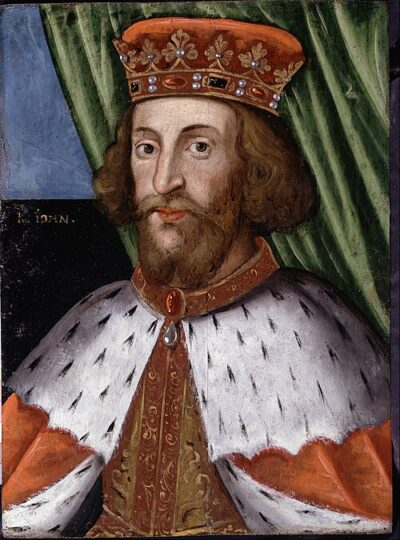
John, King of England
John, King of England was a King of England from 1199 to 1216. Born December 24, 1166, in Beaumont Palace. Died October 19, 1216, in Newark Castle. Positions held include Monarch of England (1199–1216), Duke of Normandy and Lord of Ireland (1199–1216).
Facts
38 facts · 0 confirmed by two sources · 24 cited · 14 from one source
Where this comes from
Papalocal keeps its own record. It started from these sources; what each one said is kept here as it was copied, so a change on their side never changes this page by itself. Tap one to read its version.
What Wikidata says · copied November 16, 2026 · revision 2558767294
- Described as
- King of England from 1199 to 1216
- Other names
- King John of England, John of England, John I Lackland, King John, John Lackland
- Born
- December 24, 1166 · 1 reference
- Died
- October 19, 1216
- Born in
- Beaumont Palace · 1 reference
- Died in
- Newark Castle · 2 references
- Buried in
- Worcester Cathedral · 1 reference
- Cause of death
- dysentery
- Citizen of
- Kingdom of England
- Occupation
- monarch · 1 reference
- Positions held
- Monarch of England (1199–1216); Duke of Normandy; Lord of Ireland (1199–1216); Count of Anjou
- Spouse
- Isabel, Countess of Gloucester (1189–1199) · 2 references; Isabella of Angoulême (1200–) · 2 references
- Children
- Henry III of England · 1 reference; Richard of Cornwall · 1 reference; Joan of England · 1 reference; Isabella of England · 1 reference; Eleanor of Leicester · 1 reference; Joan, Lady of Wales; Richard FitzRoy · 2 references; Oliver FitzRoy · 1 reference; Osbert Gifford · 1 reference; Geoffrey FitzRoy · 1 reference; John FitzJohn · 1 reference; Odo FitzRoy · 1 reference
- Father
- Henry II of England · 2 references
- Mother
- Eleanor of Aquitaine · 2 references
- Siblings
- Eleanor of England · 1 reference; Joan of England; Matilda of England, Duchess of Saxony · 1 reference; Alice of France; Marie of France, Countess of Champagne; William IX, Count of Poitiers; Henry the Young King · 1 reference; Richard I of England · 2 references; Geoffrey II; William Longespée, 3rd Earl of Salisbury
- Wikipedias with a page
- 93
Wikidata item Q129308 (wikidata.org/wiki/Q129308), public domain (CC0). Copied November 16, 2026.
What Wikipedia says · copied November 16, 2026 · revision 1384898729
John (Christmastide 1166/7 – 19 October 1216) was King of England from 1199 until his death in 1216. He lost the Duchy of Normandy and most of his other French lands to King Philip II of France, resulting in the collapse of the Angevin Empire and contributing to the subsequent growth in power of the French Capetian dynasty during the 13th century. The baronial revolt at the end of John's reign led to the sealing of Magna Carta, a document considered a foundational milestone in English and later British constitutional history.
John was the youngest son of King Henry II of England and Duchess Eleanor of Aquitaine. He was nicknamed John Lackland (Norman: Jean sans Terre, lit. 'John without land') because, as a younger son, he was not expected to inherit significant lands. He became Henry's favourite child after Henry faced a failed revolt from John's older brothers, Henry the Young King, Richard, and Geoffrey. Henry II appointed John Lord of Ireland in 1177 and gave him lands in England and on the continent. During the reign of his brother Richard I, John unsuccessfully attempted a rebellion against Richard's administrators while the King was participating in the Third Crusade, but he was proclaimed king after Richard died in 1199. Philip II of France agreed to recognise John's possession of the continental Angevin lands at the peace treaty of Le Goulet in 1200.
When war with France broke out again in 1202, John achieved early victories, but shortages of military resources and his treatment of Norman, Breton, and Anjou nobles resulted in the collapse of his empire in northern France in 1204. He spent much of the next decade attempting to regain these lands, raising huge revenues, reforming his armed forces and rebuilding continental alliances. His judicial reforms had a lasting effect on the English common law system, as well as providing an additional source of revenue. His dispute with Pope Innocent III over the election of Stephen Langton as Archbishop of Canterbury led Innocent to ban church services in England from 1208 until 1214 and excommunicate John from 1209 until 1213. John's attempt to defeat Philip in 1214 failed because of the French victory over John's allies at the Battle of Bouvines. When he returned to England, John faced a rebellion by many of his barons, who were unhappy with his fiscal policies and his treatment of powerful English nobles. John and the barons agreed to Magna Carta as a peace treaty in 1215. However, neither side complied with its conditions. Civil war erupted shortly afterwards, with the barons aided by Philip's son Louis, and soon descended into a stalemate. Amid the civil war, John died of dysentery in eastern England in late 1216; supporters of his son Henry III went on to achieve victory over Louis and the rebel barons the following year.
Contemporary chroniclers were mostly critical of John's performance as king, and his reign has since been the subject of significant debate and periodic revision by historians from the 16th century onwards. Historian Jim Bradbury has summarised the current historical opinion of John's positive qualities, observing that John is today usually considered a "hard-working administrator, an able man, an able general". Nonetheless, modern historians agree that he also had many faults as king, including what historian Ralph Turner describes as "distasteful, even dangerous personality traits", such as pettiness, spitefulness, and cruelty. These negative qualities provided extensive material for fiction writers in the Victorian era, and John remains a recurring character within Western popular culture, primarily as a villain in Robin Hood folklore.
From the Wikipedia article “John, King of England” (en.wikipedia.org/wiki/John,_King_of_England), by its contributors, under CC BY-SA 4.0 (creativecommons.org/licenses/by-sa/4.0/). Copied November 16, 2026; not changed.
Confirmed Two sources agree. Cited One source, and it names where it got it. One source One source, without a reference of its own. Sources disagree The sources disagree. We show the best-supported value and keep theirs below.
