
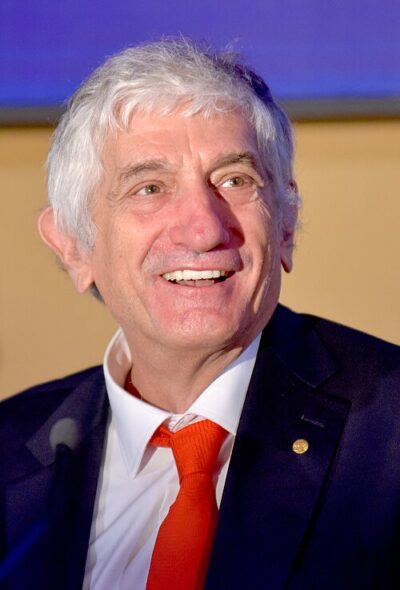
John M. Martinis
John M. Martinis is an American physicist. Born July 13, 1958, in Los Angeles. Educated at University of California, Berkeley. Awards include Fellow of the American Physical Society, Nature's 10 and Samuel Wesley Stratton Award.
Facts
18 facts · 0 confirmed by two sources · 10 cited · 8 from one source
Where this comes from
Papalocal keeps its own record. It started from these sources; what each one said is kept here as it was copied, so a change on their side never changes this page by itself. Tap one to read its version.
What Wikidata says · copied November 13, 2026 · revision 2563199625
- Described as
- American physicist (born 1958)
- Other names
- John Matthew Martinis, John Martinis, J M Martinis, J. M. Martinis, Martinis, John Matthew
- Born
- July 13, 1958 · 4 references
- Born in
- Los Angeles
- Citizen of
- United States
- Occupation
- physicist · 2 references
- Worked for
- University of California, Santa Barbara (2004–2014) · 1 reference; Quantum Artificial Intelligence Lab (2014–2020) · 1 reference; National Institute of Standards and Technology (–2004); Alternative Energies and Atomic Energy Commission · 1 reference
- Education
- University of California, Berkeley (–1985) · 1 reference
- Awards
- Fellow of the American Physical Society; Nature's 10 (2019) · 1 reference; Samuel Wesley Stratton Award (1996) · 1 reference; John Stewart Bell Prize (2021) · 1 reference; Nobel Prize in Physics (2025) · 1 reference; Fritz London Award (2014) · 1 reference; Grand Order of King Dmitar Zvonimir (2026) · 1 reference
- Field
- quantum computing
- Website
- http://www.physics.ucsb.edu/people/john-martinis
- Wikipedias with a page
- 48
Wikidata item Q28976188 (wikidata.org/wiki/Q28976188), public domain (CC0). Copied November 13, 2026.
What Wikipedia says · copied November 13, 2026 · revision 1385089853
John Matthew Martinis (born 1958) is an American physicist and Professor of Physics at the University of California, Santa Barbara. He led a team to develop a superconducting quantum computer at the Quantum AI Lab. With the Sycamore processor, the team claimed the first evidence of quantum supremacy in 2019. He shared the 2025 Nobel Prize in Physics with John Clarke and Michel Devoret for joint work on macroscopic quantum phenomena in superconductors.
From the Wikipedia article “John M. Martinis” (en.wikipedia.org/wiki/John_M._Martinis), by its contributors, under CC BY-SA 4.0 (creativecommons.org/licenses/by-sa/4.0/). Copied November 13, 2026; not changed.
Confirmed Two sources agree. Cited One source, and it names where it got it. One source One source, without a reference of its own. Sources disagree The sources disagree. We show the best-supported value and keep theirs below.
