
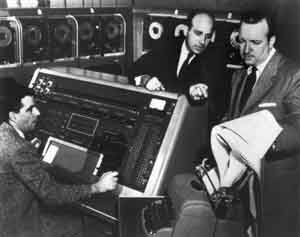
John Mauchly
John Mauchly was an American physicist. Born August 30, 1907, in Cincinnati. Died January 8, 1980, in Ambler. Positions held include chairperson (2 times) (1949–1956). Educated at Johns Hopkins University and McKinley Technology High School. Awards include Harold Pender Award, IEEE Emanuel R. Piore Award and Howard N. Potts Medal.
Facts
28 facts · 2 confirmed by two sources · 21 cited · 5 from one source
Where this comes from
Papalocal keeps its own record. It started from these sources; what each one said is kept here as it was copied, so a change on their side never changes this page by itself. Tap one to read its version.
What Wikidata says · copied November 15, 2026 · revision 2560675344
- Described as
- American physicist (1907-1980)
- Other names
- John William Mauchly
- Born
- August 30, 1907 · 7 references
- Died
- January 8, 1980 · 7 references
- Born in
- Cincinnati · 1 reference
- Died in
- Ambler · 2 references
- Buried in
- Rose Hill Cemetery · 1 reference
- Citizen of
- United States
- Occupation
- physicist · 1 reference; inventor; statistician; computer scientist · 1 reference
- Positions held
- chairperson (2 times) (1949–1956) · 1 reference
- Worked for
- Ursinus College (1933–1941) · 2 references; Johns Hopkins University (1932–1933) · 1 reference; Moore School of Electrical Engineering (1941–1946) · 1 reference; Eckert–Mauchly Computer Corporation (1948–1950) · 1 reference; Remington Rand (1950–1955) · 1 reference; Sperry Rand (1955–1959) · 1 reference
- Education
- Johns Hopkins University (1925–1932) · 1 reference; McKinley Technology High School
- Member of
- National Academy of Engineering (1967–) · 1 reference
- Awards
- Harold Pender Award (1973) · 1 reference; IEEE Emanuel R. Piore Award (1978) · 1 reference; Howard N. Potts Medal (1949) · 1 reference; National Inventors Hall of Fame (2002) · 1 reference; Harry H. Goode Memorial Award (1966) · 1 reference; John Scott Award (1961) · 1 reference
- Field
- computer science
- Spouse
- Kathleen Antonelli (1948–1980) · 1 reference
- Wikipedias with a page
- 26
Wikidata item Q522162 (wikidata.org/wiki/Q522162), public domain (CC0). Copied November 15, 2026.
What Wikipedia says · copied November 15, 2026 · revision 1383241026
John William Mauchly ( MAWK-lee; August 30, 1907 – January 8, 1980) was an American physicist who, along with J. Presper Eckert, designed ENIAC, the first general-purpose electronic digital computer, as well as EDVAC, BINAC and UNIVAC I, the first commercial computer made in the United States.
Together, Mauchly and Eckert started the first computer company, the Eckert–Mauchly Computer Corporation (EMCC), which allowed them to further the development of fundamental computer concepts originally conceived by members of the 1945-46 ENIAC programming team, notably Jean Bartik and Kay McNulty, including subroutines, nesting, and the first low-level assembler. They also popularized the concept of the stored program, which was formalized in John von Neumann's widely-read First Draft of a Report on the EDVAC (1945) and disseminated through the Moore School Lectures (1946). These publications influenced an explosion of computer development around the world in the late 1940s.
- Born, in its opening lines
- August 30, 1907
- Died, in its opening lines
- January 8, 1980
From the Wikipedia article “John Mauchly” (en.wikipedia.org/wiki/John_Mauchly), by its contributors, under CC BY-SA 4.0 (creativecommons.org/licenses/by-sa/4.0/). Copied November 15, 2026; not changed.
Confirmed Two sources agree. Cited One source, and it names where it got it. One source One source, without a reference of its own. Sources disagree The sources disagree. We show the best-supported value and keep theirs below.
