
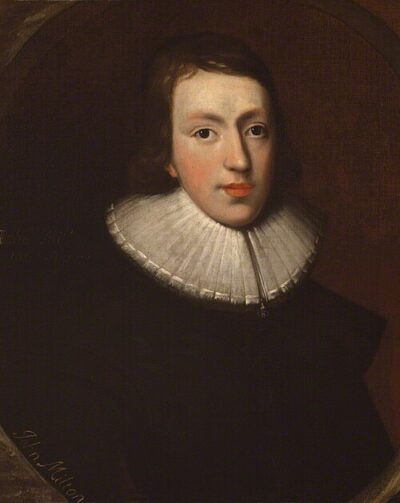
John Milton
John Milton was an English poet and civil servant. Born December 9, 1608, in Cheapside. Died November 8, 1674, in St Luke's. Known for Paradise Lost and Areopagitica. Educated at Christ's College and St Paul's School.
Facts
30 facts · 2 confirmed by two sources · 15 cited · 13 from one source
Where this comes from
Papalocal keeps its own record. It started from these sources; what each one said is kept here as it was copied, so a change on their side never changes this page by itself. Tap one to read its version.
What Wikidata says · copied November 16, 2026 · revision 2567316387
- Described as
- English poet and civil servant (1608–1674)
- Born
- December 9, 1608 · 3 references
- Died
- November 8, 1674 · 3 references
- Born in
- Cheapside · 1 reference
- Died in
- St Luke's
- Buried in
- St Giles-without-Cripplegate
- Cause of death
- kidney failure
- Citizen of
- Kingdom of England
- Occupation
- poet · 1 reference; writer · 2 references; politician
- Education
- Christ's College; St Paul's School; Jesus College
- Known for
- Paradise Lost; Areopagitica
- Field
- fiction · 1 reference
- Spouse
- Mary Powell · 1 reference; Elizabeth Minshull · 1 reference; Katherine Woodcock · 1 reference
- Children
- Anne Milton · 1 reference; Deborah Milton · 1 reference; Mary Milton · 1 reference; John Milton · 1 reference; Katherine Milton · 1 reference
- Father
- John Milton · 1 reference
- Mother
- Sara Jeffrey · 1 reference
- Siblings
- Christopher Milton · 1 reference; Anne Milton · 1 reference
- Religion
- Anglicanism
- Lived in
- Chalfont St Giles (1665–)
- Wikipedias with a page
- 156
Wikidata item Q79759 (wikidata.org/wiki/Q79759), public domain (CC0). Copied November 16, 2026.
What Wikipedia says · copied November 16, 2026 · revision 1385566528
John Milton (9 December 1608 – 8 November 1674) was an English poet, polemicist, and civil servant. His 1667 epic poem Paradise Lost was written in blank verse and included 12 books, written in a time of immense religious flux and political upheaval. It addressed the fall of man, including the temptation of Adam and Eve by the fallen angel Satan, and God's expulsion of them from the Garden of Eden. Paradise Lost elevated Milton's reputation as one of history's greatest poets. He also served as a civil servant for the Commonwealth of England under its Council of State and later under Oliver Cromwell.
Milton achieved fame and recognition during his lifetime. His celebrated Areopagitica (1644), condemning pre-publication censorship, is among history's most influential and impassioned defences of freedom of speech and freedom of the press. His desire for freedom extended beyond his philosophy and was reflected in his style, which included his introduction of new words to the English language, coined from Latin and Ancient Greek. He was the first modern writer to employ unrhymed verse outside the theatre or translations.
Milton is described as the "greatest English author" by his biographer William Hayley, and he remains generally regarded "as one of the preeminent writers in the English language", though critical reception has oscillated in the centuries since his death, often on account of his republicanism. Samuel Johnson praised Paradise Lost as "a poem which ... with respect to design may claim the first place, and with respect to performance, the second, among the productions of the human mind", though he (a Tory) described Milton's politics as those of an "acrimonious and surly republican". Milton was revered by poets such as William Blake, William Wordsworth, and Thomas Hardy.
Phases of Milton's life parallel the major historical and political divisions in Stuart England at the time. In his early years, Milton studied at Christ's College at the University of Cambridge, and then travelled, wrote poetry mostly for private circulation, and launched a career as pamphleteer and publicist under Charles I's increasingly autocratic rule and Britain's breakdown into constitutional confusion and ultimately civil war. He was once considered dangerously radical and heretical, but he contributed to a seismic shift in accepted public opinions during his life that ultimately elevated him to public office in England. The Restoration of 1660 and his loss of vision later deprived Milton of much of his public platform, but he used the period to develop many of his major works.
Milton's views developed from extensive reading, travel, and experience that began with his days as a student at the University of Cambridge in the 1620s and continued through the English Civil War, which started in 1642 and continued until 1651. By the time of his death in 1674, Milton was impoverished and on the margins of English intellectual life but famous throughout Europe and unrepentant for political choices that placed him at odds with governing authorities.
Milton is widely regarded as one of the greatest poets in English literature, though his oeuvre has drawn criticism from notable figures, including T. S. Eliot. According to some scholars, Milton was second in influence to none but William Shakespeare. In one of his books, Johnson praised him for having the power of "displaying the vast, illuminating the splendid, enforcing the awful, darkening the gloomy and aggravating the dreadful".
- Born, in its opening lines
- December 9, 1608
- Died, in its opening lines
- November 8, 1674
From the Wikipedia article “John Milton” (en.wikipedia.org/wiki/John_Milton), by its contributors, under CC BY-SA 4.0 (creativecommons.org/licenses/by-sa/4.0/). Copied November 16, 2026; not changed.
Confirmed Two sources agree. Cited One source, and it names where it got it. One source One source, without a reference of its own. Sources disagree The sources disagree. We show the best-supported value and keep theirs below.
