
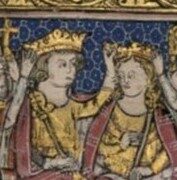
John of Brienne
John of Brienne was a King of Jerusalem and Emperor of Latin Empire of Constantinople (c.1170-1237). Born 1158, in Brienne-le-Château. Died March 23, 1237, in Constantinople. Positions held include king.
Facts
20 facts · 0 confirmed by two sources · 9 cited · 9 from one source · 2 where the sources disagree
What’s different
- Born: we show 1158 (Sources disagree). Wikidata also lists 1170
- Buried in: we show Basilica of San Francesco d'Assisi (Sources disagree). Wikidata also lists Foucarmont Abbey
Where this comes from
Papalocal keeps its own record. It started from these sources; what each one said is kept here as it was copied, so a change on their side never changes this page by itself. Tap one to read its version.
What Wikidata says · copied November 16, 2026 · revision 2557977242
- Described as
- King of Jerusalem and Emperor of Latin Empire of Constantinople (c.1170-1237)
- Other names
- Jean de Brienne, Eastern Roman Emperor 1231-1237 (Latin Empire), Jean de Brienne
- Born
- 1158 · 1 reference; 1170 · 1 reference
- Died
- March 23, 1237
- Born in
- Brienne-le-Château · 1 reference
- Died in
- Constantinople · 1 reference
- Buried in
- Basilica of San Francesco d'Assisi; Foucarmont Abbey
- Citizen of
- Kingdom of Jerusalem · 1 reference
- Occupation
- King of Jerusalem
- Positions held
- king
- Spouse
- Maria of Montferrat (1210–) · 2 references; Berengaria of León (1223–) · 2 references; Stephanie of Armenia (1214–) · 1 reference
- Children
- Isabella II of Jerusalem · 1 reference; Marie of Brienne; John II of Brienne; Louis of Brienne · 1 reference; Alphonso of Brienne · 2 references
- Father
- Erard II, Count of Brienne · 1 reference
- Mother
- Agnès of Montfaucon · 1 reference
- Siblings
- William of Brienne; Walter III, Count of Brienne
- Wikipedias with a page
- 40
Wikidata item Q332704 (wikidata.org/wiki/Q332704), public domain (CC0). Copied November 16, 2026.
What Wikipedia says · copied November 16, 2026 · revision 1379033039
John of Brienne (c. 1170 – 19–23 March 1237) was the king of Jerusalem from 1210 to 1225 and Latin emperor of Constantinople from 1229 to 1237. He was the youngest son of Erard II of Brienne, a wealthy nobleman in Champagne. John, originally destined for an ecclesiastical career, became a knight and owned small estates in Champagne around 1200. After the death of his brother Walter III, he ruled the County of Brienne on behalf of his minor nephew Walter IV, who lived in Italy.
The barons of the Kingdom of Jerusalem proposed that John marry Maria, the heir to the kingdom. With the consent of Philip II of France and Pope Innocent III, he left France for the Holy Land; in 1210, he married Maria and they were crowned king and queen. After Maria's death in 1212, John administered the kingdom as regent for their infant daughter, Isabella II. Maria's influential uncle, John of Ibelin, attempted to depose him. King John was a leader of the Fifth Crusade. Although his claim of supreme command of the crusader army was never unanimously acknowledged, his right to rule Damietta (in Egypt) was confirmed shortly after the city fell to the crusaders in 1219. He claimed the Armenian Kingdom of Cilicia on behalf of his second wife, Stephanie, in 1220. After Stephanie and their infant son died that year, John returned to Egypt. The Fifth Crusade ended in failure (including the recovery of Damietta by the Egyptians) in 1221.
John was the first king of Jerusalem to visit Europe (Italy, France, England, León, Castile and Germany) to seek assistance for the Holy Land. He gave his daughter in marriage to Holy Roman Emperor Frederick II in 1225, and Frederick ended John's rule of the Kingdom of Jerusalem. Although the popes tried to persuade Frederick to restore the kingdom to John, the Jerusalemite barons regarded Frederick as their lawful ruler. John administered papal domains in Tuscany, became the podestà of Perugia and was a commander of Pope Gregory IX's army during Gregory's war against Frederick in 1228 and 1229.
John was elected emperor of the Latin Empire in 1229 as the senior co-ruler of Baldwin II, and he was crowned in Constantinople in 1231. John III of Nicaea and Ivan Asen II of Bulgaria occupied the last Latin territories in Thrace and Asia Minor, besieging Constantinople in early 1235. John directed the defence of his capital during the months-long siege, with the besiegers withdrawing only after Geoffrey II of Achaea and united fleets from Italian towns defeated their fleet in 1236. The following year, John died as a Franciscan friar.
From the Wikipedia article “John of Brienne” (en.wikipedia.org/wiki/John_of_Brienne), by its contributors, under CC BY-SA 4.0 (creativecommons.org/licenses/by-sa/4.0/). Copied November 16, 2026; not changed.
Confirmed Two sources agree. Cited One source, and it names where it got it. One source One source, without a reference of its own. Sources disagree The sources disagree. We show the best-supported value and keep theirs below.
