
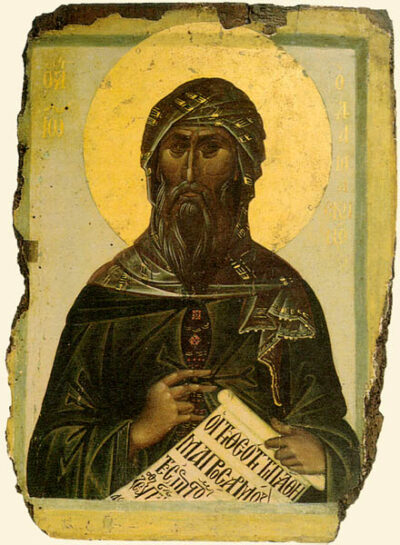
John of Damascus
John of Damascus was a Christian monk, priest, hymnographer and apologist (675/6-749). Born 675, in Damascus. Died December 4, 749, in Holy Lavra of Saint Sabbas. Known for Trojeručica.
Facts
17 facts · 0 confirmed by two sources · 5 cited · 12 from one source
Where this comes from
Papalocal keeps its own record. It started from these sources; what each one said is kept here as it was copied, so a change on their side never changes this page by itself. Tap one to read its version.
What Wikidata says · copied November 16, 2026 · revision 2569880730
- Described as
- Christian monk, priest, hymnographer and apologist (675/6-749)
- Other names
- Saint John of Damascus, John Damascene, Ioannes Damascenus, Joannus Damascenus, Johannes van Damascus
- Born
- 675 · 2 references
- Died
- December 4, 749 · 2 references
- Born in
- Damascus · 1 reference
- Died in
- Holy Lavra of Saint Sabbas
- Citizen of
- Umayyad Caliphate
- Occupation
- theologian · 2 references; writer · 1 reference; cleric; philosopher · 1 reference; astronomer · 1 reference; composer · 1 reference
- Known for
- Trojeručica
- Field
- theology; iconodule
- Father
- Sarjun ibn Mansur
- Siblings
- Cosmas of Maiuma
- Religion
- Catholicism
- Wikipedias with a page
- 80
Wikidata item Q51884 (wikidata.org/wiki/Q51884), public domain (CC0). Copied November 16, 2026.
What Wikipedia says · copied November 16, 2026 · revision 1373353599
John of Damascus or John Damascene, born Yūḥana ibn Manṣūr ibn Sarjūn, was a Christian monk, priest, hymnographer, and apologist. He was born and raised in Damascus c. AD 675 or AD 676; the precise date and place of his death is not known, though tradition places it at his monastery, Mar Saba, near Jerusalem, on 4 December AD 749. A polymath whose fields of interest and contribution included law, theology, philosophy, and music, he was given the by-name of Chrysorroas (Χρυσορρόας, literally "streaming with gold", i.e. "the golden speaker"). He wrote works expounding the Christian faith, and composed hymns which are still used both liturgically in Eastern Christian practice throughout the world as well as in western Lutheranism at Easter.
He is one of the Fathers of the Eastern Orthodox Church and is best known for his strong defence of icons. The Catholic Church regards him as a Doctor of the Church, often referred to as the Doctor of the Assumption due to his writings on the Assumption of Mary. He was also a prominent exponent of perichoresis, and employed the concept as a technical term to describe both the interpenetration of the divine and human natures of Christ and the relationship between the hypostases of the Trinity. John is at the end of the Patristic period of dogmatic development, and his contributions are the last ones in the series of theological developments before the medieval period. In Catholic theology, he is therefore known as the "last of the Greek Fathers".
From the Wikipedia article “John of Damascus” (en.wikipedia.org/wiki/John_of_Damascus), by its contributors, under CC BY-SA 4.0 (creativecommons.org/licenses/by-sa/4.0/). Copied November 16, 2026; not changed.
Confirmed Two sources agree. Cited One source, and it names where it got it. One source One source, without a reference of its own. Sources disagree The sources disagree. We show the best-supported value and keep theirs below.
