
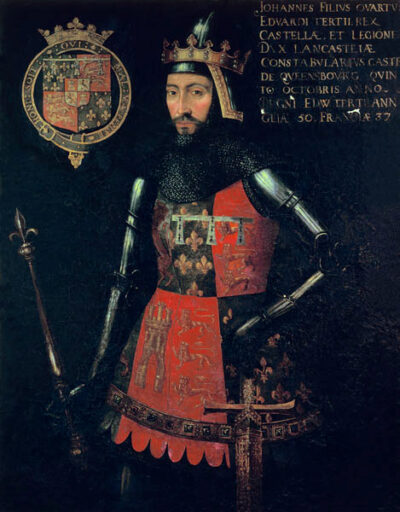
John of Gaunt
John of Gaunt was an English magnate of the House of Plantagenet. Born June 24, 1340, in Ghent. Died February 3, 1399, in Leicester Castle. Positions held include Lord High Steward (1362–1399) and pretender to the Castilian throne. Awards include Knight of the Garter.
Facts
35 facts · 1 confirmed by two sources · 22 cited · 11 from one source · 1 where the sources disagree
What’s different
- Born: we show June 24, 1340 (Sources disagree). Wikipedia says March 6, 1340
Where this comes from
Papalocal keeps its own record. It started from these sources; what each one said is kept here as it was copied, so a change on their side never changes this page by itself. Tap one to read its version.
What Wikidata says · copied November 16, 2026 · revision 2563081085
- Described as
- English magnate of the House of Plantagenet (1340-1399)
- Other names
- John of Gaunt, 1st Duke of Lancaster
- Born
- June 24, 1340
- Died
- February 3, 1399 · 1 reference
- Born in
- Ghent · 1 reference
- Died in
- Leicester Castle
- Buried in
- Old St Paul's Cathedral
- Occupation
- politician; royalty
- Positions held
- Lord High Steward (1362–1399); pretender to the Castilian throne
- Awards
- Knight of the Garter (1361)
- Spouse
- Blanche of Lancaster (1359–) · 2 references; Constance of Castile, Duchess of Lancaster (1371–) · 2 references; Katherine Swynford (1396–) · 2 references
- Children
- Philippa of Lancaster · 1 reference; Elizabeth of Lancaster, Duchess of Exeter · 2 references; Henry IV of England · 1 reference; Catherine of Lancaster · 1 reference; John Beaufort, 1st Earl of Somerset · 1 reference; Joan Beaufort, Countess of Westmorland · 1 reference; Blanche Plantagenet · 1 reference; John of Lancaster · 1 reference; Edward Planatagenet · 1 reference; John Plantagenet · 1 reference; Henry Beaufort · 2 references; Thomas Beaufort, Duke of Exeter · 3 references
- Father
- Edward III of England · 1 reference
- Mother
- Philippa of Hainault · 1 reference
- Siblings
- Mary of Waltham; Isabella de Coucy; Margaret, Countess of Pembroke; Joan of England; Edward, the Black Prince · 1 reference; Edmund of Langley, 1st Duke of York · 1 reference; Lionel of Antwerp, 1st Duke of Clarence · 1 reference; Thomas of Woodstock, 1st Duke of Gloucester · 1 reference
- Wikipedias with a page
- 55
Wikidata item Q193752 (wikidata.org/wiki/Q193752), public domain (CC0). Copied November 16, 2026.
What Wikipedia says · copied November 16, 2026 · revision 1384783368
John of Gaunt, Duke of Lancaster (6 March 1340 – 3 February 1399), was an English prince, military leader and statesman. He was the fourth son (third surviving) of King Edward III, and the father of King Henry IV. Because of Gaunt's royal origin, advantageous marriages and some generous land grants, he was one of the richest men of his era and an influential figure during the reigns of both his father and his nephew, Richard II. As Duke of Lancaster, he was the founder of the royal House of Lancaster, whose members ascended the throne after his death. His birthplace, Ghent in Flanders, then known in English as Gaunt, was the origin of his name.
John's early career was spent in France and Spain fighting in the Hundred Years' War. He made an abortive attempt to enforce a claim to the Crown of Castile that came through his second wife, Constance of Castile, and for a time styled himself as King of Castile. When Edward the Black Prince, Gaunt's elder brother and heir apparent to the ageing Edward III, became incapacitated by poor health, Gaunt assumed control of many government functions and rose to become one of the most powerful political figures in England. He was faced with military difficulties abroad and political divisions at home, and disagreements as to how to deal with these crises led to tensions between Gaunt, the English Parliament and the ruling class, making him an unpopular figure for a time. He helped forge the 1386 Anglo-Portuguese alliance, secured through the marriage of his daughter Philippa to John I of Portugal, which is still in force today.
John exercised great influence over the English throne during the minority of King Richard II (Edward the Black Prince's son) and the ensuing periods of political strife. He mediated between the king and a group of rebellious nobles, which included Gaunt's own son and heir-apparent, Henry Bolingbroke. Following Gaunt's death in 1399, the Lancastrian estates and titles were declared forfeit to the Crown, and the now disinherited son, Bolingbroke, was branded a traitor and ordered into exile. Henry did not stay in exile; he raised an army to reclaim his inheritance and depose Richard. He reigned as King Henry IV (1399–1413), the first of the descendants of John of Gaunt to hold the English throne.
John cultivated an extensive network of retainers, known as the "Lancastrian affinity", which became the cornerstone of his political power and was later inherited by his eldest surviving son, Henry, the future King Henry IV. All English monarchs from Henry IV onwards are descended from John of Gaunt. His direct male line, the House of Lancaster, ruled England from 1399 until the Wars of the Roses. Gaunt fathered additional children surnamed Beaufort (from the name of one of Lancaster's fiefs in France), by Katherine Swynford, his long-term mistress. After he married Swynford (his third marriage), his Beaufort children were later legitimised by royal and papal decrees. Through his daughter Joan Beaufort, Countess of Westmorland, he was an ancestor of the Yorkist kings Edward IV, Edward V and Richard III. Through his great-granddaughter Lady Margaret Beaufort he was also an ancestor of Henry VII, who married Edward IV's daughter Elizabeth of York, and all subsequent monarchs are descendants of their marriage. Two of John's daughters married into continental royal houses (those of Portugal and Castile). Through them, many royal families of Europe can trace lineage to him.
- Born, in its opening lines
- March 6, 1340
- Died, in its opening lines
- February 3, 1399
From the Wikipedia article “John of Gaunt” (en.wikipedia.org/wiki/John_of_Gaunt), by its contributors, under CC BY-SA 4.0 (creativecommons.org/licenses/by-sa/4.0/). Copied November 16, 2026; not changed.
Confirmed Two sources agree. Cited One source, and it names where it got it. One source One source, without a reference of its own. Sources disagree The sources disagree. We show the best-supported value and keep theirs below.
