
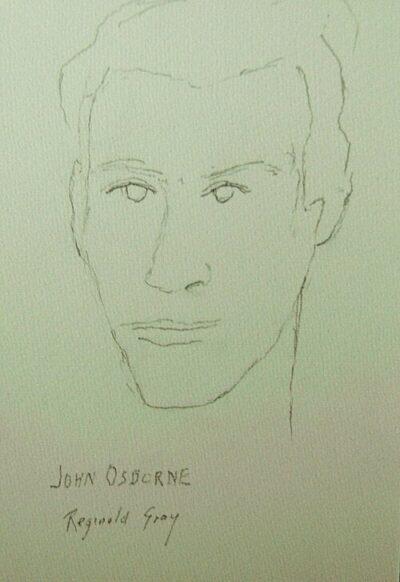
John Osborne
John Osborne was an English playwright. Born December 12, 1929, in London. Died December 24, 1994, in Clun. Known for Look Back in Anger and Inadmissible Evidence. Awards include Academy Award for Best Writing, Adapted Screenplay, Ackerley Prize and BAFTA Award for Best British Screenplay.
Facts
24 facts · 2 confirmed by two sources · 10 cited · 12 from one source
Where this comes from
Papalocal keeps its own record. It started from these sources; what each one said is kept here as it was copied, so a change on their side never changes this page by itself. Tap one to read its version.
What Wikidata says · copied November 16, 2026 · revision 2557996595
- Described as
- English playwright (1929-1994)
- Other names
- John James Osborne
- Born
- December 12, 1929 · 14 references
- Died
- December 24, 1994 · 12 references
- Born in
- London · 3 references
- Died in
- Clun · 1 reference
- Cause of death
- diabetes
- Name at birth
- John James Osborne
- Citizen of
- United Kingdom
- Occupation
- actor · 1 reference; playwright · 1 reference; screenwriter; writer · 1 reference; film actor · 1 reference
- Known for
- Look Back in Anger; Inadmissible Evidence
- Awards
- Academy Award for Best Writing, Adapted Screenplay (1964) · 1 reference; Ackerley Prize; BAFTA Award for Best British Screenplay (1964) · 1 reference; Tony Award for Best Play (1964) · 1 reference
- Field
- literature · 1 reference; acting · 1 reference
- Spouse
- Mary Ure (1957–1963); Penelope Gilliatt; Jill Bennett (1968–1978)
- Religion
- Anglicanism
- Wikipedias with a page
- 50
Wikidata item Q313841 (wikidata.org/wiki/Q313841), public domain (CC0). Copied November 16, 2026.
What Wikipedia says · copied November 16, 2026 · revision 1385185468
John James Osborne (12 December 1929 – 24 December 1994) was an English playwright, screenwriter, actor, and entrepreneur, who is regarded as one of the most influential figures in post-war theatre. Born in London, he briefly worked as a journalist before starting out in theatre as a stage manager and actor. He lived in poverty for several years before his third produced play, Look Back in Anger (1956), brought him national fame.
Based on Osborne's volatile relationship with his first wife, Pamela Lane, it is considered the first work of kitchen sink realism, initiating a movement which made use of social realism and domestic settings to address disillusion with British society in the waning years of the Empire. The phrase “angry young man”, coined by George Fearon (press officer for the Royal Court Theatre) to describe Osborne when promoting the play, came to embody the predominantly working class and left-wing writers within this movement. Osborne was considered its leading figure due to his often controversial left-wing politics, though critics nevertheless noted a conservative strain even in his early writing.
The Entertainer (1957), Luther (1961), and Inadmissable Evidence (1964) were also well-received, Luther winning the 1964 Tony Award for Best Play, though reception to his later plays was less favourable. During this period Osborne began writing and acting for television and appearing in films, most notably as crime boss Cyril Kinnear in Get Carter (1971).
In 1958, Osborne joined Look Back in Anger director Tony Richardson and film producer Harry Saltzman to form Woodfall Film Productions, in order to produce Richardson's 1959 film adaptation of Anger and other works of kitchen sink realism, spearheading the British New Wave. This included Osborne-penned adaptations of The Entertainer (1960) (co-written by Nigel Kneale), and Inadmissible Evidence (1968), as well as the period comedy Tom Jones (1963), for which he won the Academy Award for Best Adapted Screenplay and BAFTA Award for Best British Screenplay.
Osborne was married five times, but the first four were troubled by affairs and his mistreatment of his partners. In 1978 he married Helen Dawson, and from 1986 they lived in rural Shropshire. He wrote two volumes of autobiography, A Better Class of Person (1981) and Almost a Gentleman (1991), and a collection of his non-fiction writing, Damn You, England, was published in 1994. He died from complications of diabetes on 24 December of that year at the age of 65.
- Born, in its opening lines
- December 12, 1929
- Died, in its opening lines
- December 24, 1994
From the Wikipedia article “John Osborne” (en.wikipedia.org/wiki/John_Osborne), by its contributors, under CC BY-SA 4.0 (creativecommons.org/licenses/by-sa/4.0/). Copied November 16, 2026; not changed.
Confirmed Two sources agree. Cited One source, and it names where it got it. One source One source, without a reference of its own. Sources disagree The sources disagree. We show the best-supported value and keep theirs below.
