
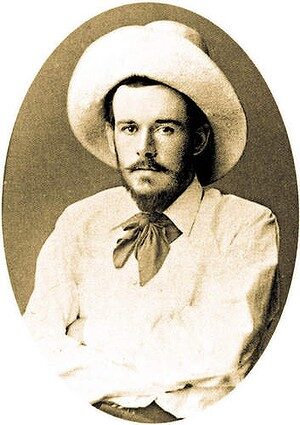
John Peter Russell
John Peter Russell was an Australian artist. Born June 16, 1858, in Darlinghurst. Died April 30, 1930, in Randwick. Educated at Slade School of Fine Art.
Facts
10 facts · 2 confirmed by two sources · 3 cited · 5 from one source
What’s different
- Born: we show June 16, 1858 (Confirmed). Wikidata also lists July 16, 1858
- Died: we show April 30, 1930 (Confirmed). Wikidata also lists April 22, 1930
Where this comes from
Papalocal keeps its own record. It started from these sources; what each one said is kept here as it was copied, so a change on their side never changes this page by itself. Tap one to read its version.
What Wikidata says · copied November 18, 2026 · revision 2550639640
- Described as
- Australian artist (1858-1930)
- Other names
- John Russell
- Born
- June 16, 1858 · 2 references; July 16, 1858
- Died
- April 22, 1930 · 2 references; April 30, 1930 · 1 reference
- Born in
- Darlinghurst · 1 reference
- Died in
- Randwick · 1 reference
- Citizen of
- Australia
- Occupation
- painter · 1 reference
- Education
- Slade School of Fine Art
- Genre
- portrait; landscape painting
- Spouse
- Marianna Mattiocco
- Wikipedias with a page
- 22
Wikidata item Q1365633 (wikidata.org/wiki/Q1365633), public domain (CC0). Copied November 18, 2026.
What Wikipedia says · copied November 18, 2026 · revision 1365346688
John Peter Russell (16 June 1858 – 30 April 1930) was an Australian impressionist painter.
Born and raised in Sydney, Russell moved to Europe in his late teenage years to attend art school. There, he befriended fellow pupil Vincent van Gogh and, in 1886, painted the first oil portrait of the artist, now held at the Van Gogh Museum. That same year, Russell painted with Claude Monet at Belle Île. Russell moved there soon after with his wife, Marianna Russell, one of sculptor Auguste Rodin's favourite models. Henri Matisse visited Russell at Belle Île in the 1890s, and later credited the Australian with introducing him to impressionist techniques and colour theory.
Despite painting prolifically and maintaining close ties with the European avant-garde, Russell rarely exhibited his works and, having received a large inheritance from his father, showed no interest in making money from art. After his wife died in 1908, Russell, grief-stricken, destroyed hundreds of his paintings. He returned to Sydney in old age where he died in relative obscurity. His cousin, Australian artist Thea Proctor, did much to posthumously promote Russell's art, and by the late 20th-century, a number of biographies and exhibitions had helped to restore his reputation as a significant artist. Today his works are held in major galleries in his home country and in Europe, including the Musée d'Orsay and the Musée Rodin in Paris.
While in Europe, Russell maintained correspondence with Australian impressionist painter Tom Roberts, updating him on developments in French impressionism. Since he remained in Europe for much of his career and descended into obscurity after his death, Russell became known as Australia's "lost impressionist".
- Born, in its opening lines
- June 16, 1858
- Died, in its opening lines
- April 30, 1930
From the Wikipedia article “John Russell (Australian painter)” (en.wikipedia.org/wiki/John_Russell_(Australian_painter)), by its contributors, under CC BY-SA 4.0 (creativecommons.org/licenses/by-sa/4.0/). Copied November 18, 2026; not changed.
Confirmed Two sources agree. Cited One source, and it names where it got it. One source One source, without a reference of its own. Sources disagree The sources disagree. We show the best-supported value and keep theirs below.
