
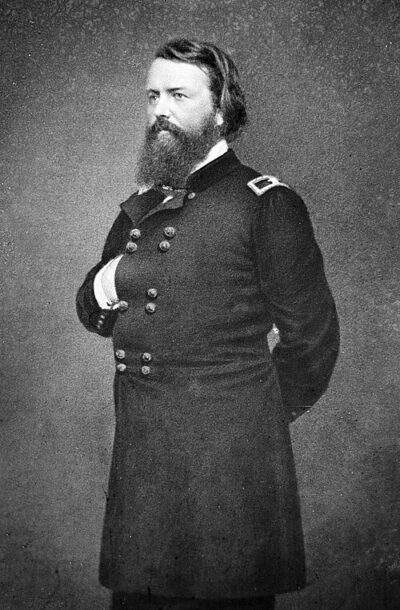
John Pope
John Pope was an Union United States Army general. Born March 16, 1822, in Louisville. Died September 23, 1892, in Sandusky. Educated at United States Military Academy.
Facts
14 facts · 2 confirmed by two sources · 5 cited · 7 from one source
Where this comes from
Papalocal keeps its own record. It started from these sources; what each one said is kept here as it was copied, so a change on their side never changes this page by itself. Tap one to read its version.
What Wikidata says · copied November 15, 2026 · revision 2565551751
- Described as
- Union United States Army general (1822–1892)
- Born
- March 16, 1822 · 4 references
- Died
- September 23, 1892 · 5 references
- Born in
- Louisville · 1 reference
- Died in
- Sandusky · 1 reference
- Buried in
- Bellefontaine Cemetery · 1 reference
- Citizen of
- United States
- Occupation
- military officer; major general · 1 reference
- Education
- United States Military Academy
- Father
- Nathaniel Pope · 1 reference
- Siblings
- Penelope Pope Allen
- Military branch
- Union Army; United States Army
- Military rank
- general
- Wikipedias with a page
- 25
Wikidata item Q465291 (wikidata.org/wiki/Q465291), public domain (CC0). Copied November 15, 2026.
What Wikipedia says · copied November 15, 2026 · revision 1379817525
John Pope (March 16, 1822 – September 23, 1892) was a career United States Army officer and Union general in the American Civil War. He had a brief successful stint in the Western Theater, but he is best known for his defeat at the Second Battle of Bull Run (Second Manassas) in the East.
John Pope was a graduate of the United States Military Academy in 1842. He served in the Mexican–American War and had numerous assignments as a topographical engineer and surveyor in Florida, New Mexico, and Minnesota. He spent much of the last decade before the Civil War surveying possible southern routes for the proposed first transcontinental railroad. He was an early appointee as a Union brigadier general of volunteers and served initially under Maj. Gen. John C. Frémont. He achieved initial success against Brig. Gen. Sterling Price in Missouri, then led a successful campaign that captured Island No. 10 on the Mississippi River. This inspired the Lincoln administration to bring him to the Eastern Theater to lead the newly formed Army of Virginia.
He initially alienated many of his officers and men by publicly denigrating their record in comparison to his Western command. He launched an offensive against the Confederate army of General Robert E. Lee, in which he fell prey to a strategic turning movement into his rear areas by Maj. Gen. Stonewall Jackson. At Second Bull Run, he concentrated his attention on attacking Jackson while the other Confederate corps led by Maj. Gen. James Longstreet attacked his flank and routed his army.
Following Manassas, Pope was banished far from the Eastern Theater to the Department of the Northwest in Minnesota, where he commanded U.S. Forces in the Dakota War of 1862. He was appointed to command the Department of the Missouri in 1865 and was a prominent and activist commander during Reconstruction in Atlanta. For the rest of his military career, he fought in the Indian Wars, particularly against the Apache and Sioux.
- Born, in its opening lines
- March 16, 1822
- Died, in its opening lines
- September 23, 1892
From the Wikipedia article “John Pope (general)” (en.wikipedia.org/wiki/John_Pope_(general)), by its contributors, under CC BY-SA 4.0 (creativecommons.org/licenses/by-sa/4.0/). Copied November 15, 2026; not changed.
Confirmed Two sources agree. Cited One source, and it names where it got it. One source One source, without a reference of its own. Sources disagree The sources disagree. We show the best-supported value and keep theirs below.
