
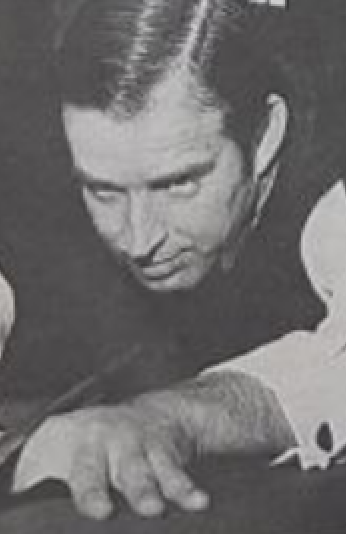
John Spencer
John Spencer was an English snooker player. Born September 18, 1935, in Radcliffe. Died July 11, 2006, in Bury. Awards include Snooker Hall of Fame.
Facts
13 facts · 2 confirmed by two sources · 1 cited · 10 from one source
Where this comes from
Papalocal keeps its own record. It started from these sources; what each one said is kept here as it was copied, so a change on their side never changes this page by itself. Tap one to read its version.
What Wikidata says · copied November 18, 2026 · revision 2515363170
- Described as
- English snooker player (1935–2006)
- Born
- September 18, 1935
- Died
- July 11, 2006 · 1 reference
- Born in
- Radcliffe
- Died in
- Bury · 3 references
- Cause of death
- stomach cancer
- Citizen of
- United Kingdom
- Occupation
- snooker player · 1 reference; sports journalist; functionary
- Sport
- snooker · 1 reference
- Awards
- Snooker Hall of Fame
- Nickname
- Spenny; Gentleman John
- Wikipedias with a page
- 23
Wikidata item Q935875 (wikidata.org/wiki/Q935875), public domain (CC0). Copied November 18, 2026.
What Wikipedia says · copied November 18, 2026 · revision 1380503132
John Spencer (18 September 1935 – 11 July 2006) was an English professional snooker player. One of the most dominant players of the 1970s, he won the World Snooker Championship three times, in 1969, 1971 and 1977. He worked as a snooker commentator for the BBC from 1978 to 1998 and served for 25 years on the board of the sport's governing body, the World Professional Billiards and Snooker Association (WPBSA), including a stint as chairman from 1990 until his retirement from the board in 1996.
Born in Radcliffe, Lancashire, Spencer started playing snooker on a full-sized table at age 14 and compiled his first century break aged 15. He was conscripted for National Service at age 18 and lost interest in playing snooker for over ten years before taking it up again in 1964. He reached the final of the English Amateur Championship for three years in a row, claiming the title at his third attempt in 1966. He turned professional in 1967—the same year as his amateur rivals Gary Owen and Ray Reardon—and won the world title as a debutant at the 1969 World Snooker Championship, which was staged as a knockout tournament for the first time since 1957, following a series of challenge matches from 1964 to 1968. Spencer defeated Owen 37–24 in the final to become the first World Champion of snooker's modern era. His title defence in 1970 ended with a 33–37 loss in the semi-finals to Reardon, the eventual winner.
He secured his second world title at the 1971 World Championship in Sydney, Australia, defeating Warren Simpson 37–29 in the final to become the first player to win the world title at a knockout event staged overseas. He reached the final again in 1972 but lost 31–37 to Alex Higgins. He won his third world title in 1977, beating Cliff Thorburn 25–21 in the final to become the first player to win the World Championship at Sheffield's Crucible Theatre, where the tournament has been staged annually ever since. Spencer's other notable victories include the inaugural Masters in 1975, where he defeated Reardon on a re-spotted black in the deciding frame of the final, the inaugural Irish Masters in 1978 and three editions of the BBC's Pot Black series. In 1979, he became the first player to compile a maximum break at a professional tournament, although it was not recorded as an official maximum because the pockets on the table had not been measured against the required specifications.
One of the first major professional players to use a two-piece cue, Spencer was noted for his unusual cue action and immense cue power. His later career was severely affected by the ocular version of myasthenia gravis, which was first diagnosed in 1985 and had symptoms including double vision. He made his last Crucible appearance at the 1986 World Championship, losing 7–10 to Higgins in the first round. His last notable achievement in professional play was reaching the quarter-finals of the 1987 British Open at age 51, where he lost 3–5 to Jimmy White. He retired from professional competition in 1992 because of ill health, but continued to perform in exhibition matches and served as chairman of the WPBSA for another four years. Diagnosed with stomach cancer in 2003, he died in a hospice near Bolton on 11 July 2006, aged 70. The trophy for the World Seniors Masters tournament was named in his memory in 2018.
- Born, in its opening lines
- September 18, 1935
- Died, in its opening lines
- July 11, 2006
From the Wikipedia article “John Spencer (snooker player)” (en.wikipedia.org/wiki/John_Spencer_(snooker_player)), by its contributors, under CC BY-SA 4.0 (creativecommons.org/licenses/by-sa/4.0/). Copied November 18, 2026; not changed.
Confirmed Two sources agree. Cited One source, and it names where it got it. One source One source, without a reference of its own. Sources disagree The sources disagree. We show the best-supported value and keep theirs below.
