
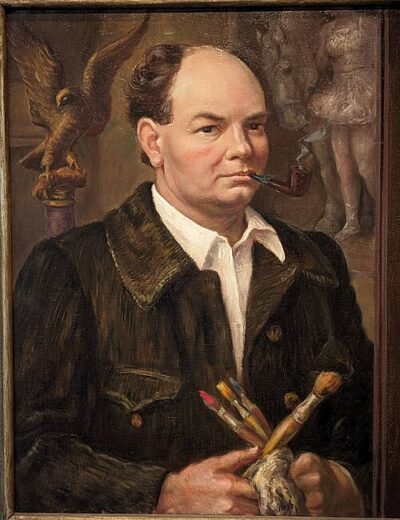
John Steuart Curry
John Steuart Curry was an American painter. Born November 14, 1897, in Dunavant. Died August 29, 1946, in Madison. Known for Erosion and Dust. Educated at Kansas City Art Institute and School of the Art Institute of Chicago.
Facts
15 facts · 2 confirmed by two sources · 6 cited · 7 from one source
Where this comes from
Papalocal keeps its own record. It started from these sources; what each one said is kept here as it was copied, so a change on their side never changes this page by itself. Tap one to read its version.
What Wikidata says · copied November 18, 2026 · revision 2558015355
- Described as
- American painter (1897-1946)
- Other names
- John Curry, John Stewart Curry, John-Stuart Curry, John Stuart Curry, Curry
- Born
- November 14, 1897 · 8 references
- Died
- August 29, 1946 · 8 references
- Born in
- Dunavant
- Died in
- Madison · 2 references
- Buried in
- Reformed Presbyterian Church Cemetery · 1 reference
- Cause of death
- myocardial infarction · 1 reference
- Citizen of
- United States · 1 reference
- Occupation
- painter · 1 reference; lithographer · 2 references
- Education
- Kansas City Art Institute; School of the Art Institute of Chicago · 1 reference; Geneva College · 1 reference
- Member of
- American Academy of Arts and Letters
- Known for
- Erosion and Dust
- Field
- painting · 1 reference
- Wikipedias with a page
- 17
Wikidata item Q3290532 (wikidata.org/wiki/Q3290532), public domain (CC0). Copied November 18, 2026.
What Wikipedia says · copied November 18, 2026 · revision 1364546438
John Steuart Curry (November 14, 1897 – August 29, 1946) was an American painter whose career spanned the years from 1924 until his death. He was noted for his paintings depicting rural life in his home state, Kansas. Along with Thomas Hart Benton and Grant Wood, he was hailed as one of the three great painters of American Regionalism of the first half of the twentieth century. Curry's artistic production was varied, including paintings, book illustrations, prints, and posters.
Curry was Kansas's best-known painter, but his works were not popular with Kansans, who felt that he did not portray the state positively. Curry's paintings often depicted farm life and animals, tornadoes, prairie fires, and the violent Bleeding Kansas period (featuring abolitionist John Brown, who at the time was derided as a fanatical traitor) – subjects that Kansans did not want to be representative of the state. Curry was commissioned to create murals for the Kansas State Capitol, and he completed two: Kansas Pastoral, and his most famous and controversial work, Tragic Prelude, which he considered his greatest. Reaction was so negative that the Kansas Legislature passed a measure to keep them, or future works of his, from being hung on the capitol walls. As a result, Curry did not sign the works, which were not hung during his lifetime. He left Topeka in disgust; his planned eight smaller murals for the Capitol rotunda on the first floor never went beyond sketches, now held by the Kansas Museum of History.
Curry's works were painted with movement, which was conveyed by the free brush work and energized forms that characterized his style. His control over brushstrokes created excited emotions such as fear and despair in his paintings. His fellow Regionalists, who also painted action and movement, influenced Curry's style.
- Born, in its opening lines
- November 14, 1897
- Died, in its opening lines
- August 29, 1946
From the Wikipedia article “John Steuart Curry” (en.wikipedia.org/wiki/John_Steuart_Curry), by its contributors, under CC BY-SA 4.0 (creativecommons.org/licenses/by-sa/4.0/). Copied November 18, 2026; not changed.
Confirmed Two sources agree. Cited One source, and it names where it got it. One source One source, without a reference of its own. Sources disagree The sources disagree. We show the best-supported value and keep theirs below.
