
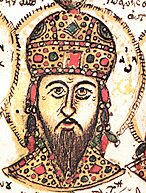
John VII Palaiologos
John VII Palaiologos was a Byzantine emperor. Born 1370, in Constantinople. Died September 22, 1408, in Thessaloniki. Positions held include Byzantine emperor (1390).
Facts
13 facts · 2 confirmed by two sources · 3 cited · 8 from one source
Where this comes from
Papalocal keeps its own record. It started from these sources; what each one said is kept here as it was copied, so a change on their side never changes this page by itself. Tap one to read its version.
What Wikidata says · copied November 16, 2026 · revision 2569045832
- Described as
- Byzantine emperor
- Other names
- John VII Palaeologus, Emperor of Constantinople
- Born
- 1370 · 4 references
- Died
- September 22, 1408
- Born in
- Constantinople
- Died in
- Thessaloniki
- Citizen of
- Byzantine Empire
- Occupation
- regent
- Positions held
- Byzantine emperor (1390)
- Field
- government · 1 reference; politics · 1 reference
- Spouse
- Irene Gattilusio
- Children
- Andronikos V Palaiologos
- Father
- Andronikos IV Palaiologos · 1 reference
- Mother
- Keratsa of Bulgaria
- Wikipedias with a page
- 50
Wikidata item Q37074 (wikidata.org/wiki/Q37074), public domain (CC0). Copied November 16, 2026.
What Wikipedia says · copied November 16, 2026 · revision 1384683078
John VII Palaiologos or Palaeologus (Greek: Ἰωάννης Παλαιολόγος, romanized: Iōánnēs Palaiológos; 1370 – 22 September 1408) was Byzantine emperor for five months in 1390, from 14 April to 17 September. A handful of sources suggest that John VII sometimes used the name Andronikos (Greek: Ἀνδρόνικος, romanized: Andrónikos), possibly to honour the memory of his father, Andronikos IV Palaiologos, though he reigned under his birth name.
Andronikos IV was the firstborn son of Emperor John V Palaiologos (r. 1341–1391), and had thus been the heir to the throne. After a failed rebellion in 1373, Andronikos IV was imprisoned and partially blinded, the same punishment possibly being carried out on John VII, then only three years old. Andronikos IV escaped in 1376 and successfully took Constantinople, ruling as emperor until 1379. John VII served as co-emperor during this time, possibly being appointed in 1377. Though deposed in 1379 by his brother Manuel II Palaiologos and their father John V, Andronikos IV never renounced his claims. To prevent further conflict, it was agreed in 1381 that Andronikos IV was to succeed John V, making John VII second-in-line to the throne.
Upon Andronikos IV's death in 1385, John VII inherited his claims. Despite the previous agreement, Manuel was seen by John V as the favoured successor. John VII rebelled against John V and successfully seized Constantinople in 1390. After just five months, Manuel succeeded in deposing his nephew with the help of the Ottomans and the Knights Hospitaller. Upon John V's death in 1391, Manuel succeeded him as emperor. Still possessing a powerful network of allies, John VII never surrendered his claim to be the legitimate emperor, and the tense relationship between him and his uncle brought the empire close to civil war several times. Though they were only honoured to a limited extent by Manuel, several agreements in regards to status and the line of succession were made between the two in order to avoid conflict, certifying that John VII remained co-emperor and was to succeed Manuel upon his death.
In 1394, the Ottoman sultan Bayezid I besieged Constantinople. Manuel left the city in 1399 to travel around Western Europe in search for military aid, and entrusted John VII with serving as regent in Constantinople, overseeing its defense. Despite allegations of conspiring with the Ottomans, John VII held the city loyally for the entire duration of Manuel's three and a half years-long journey, refusing to surrender it to Bayezid. The threat to Constantinople ended with Bayezid's defeat against the Timurids at the Battle of Ankara in 1402. In the aftermath of this battle, John VII negotiated a favourable treaty with one of Bayezid's sons, Süleyman Çelebi, which ensured that the important city of Thessalonica, lost to the Ottomans in 1387 due to the actions of Manuel, was returned to imperial control. Despite John VII's loyal service, Manuel sent him away in disgrace once he returned in 1403, and the two were once more enemies. This feud proved to be brief, as they were reconciled a few months later and a new agreement was made, in which John VII was allowed to take possession of Thessalonica and was acknowledged with the full imperial title. From 1403 until his death in 1408, John VII thus ruled in Thessalonica as "Emperor of All Thessaly", with his own separate imperial court. The Thessalonians considered him an able ruler, and his work with local church affairs and improving the city's defensive structures garnered him a positive remembrance.
- Born, in its opening lines
- 1370
- Died, in its opening lines
- September 22, 1408
From the Wikipedia article “John VII Palaiologos” (en.wikipedia.org/wiki/John_VII_Palaiologos), by its contributors, under CC BY-SA 4.0 (creativecommons.org/licenses/by-sa/4.0/). Copied November 16, 2026; not changed.
Confirmed Two sources agree. Cited One source, and it names where it got it. One source One source, without a reference of its own. Sources disagree The sources disagree. We show the best-supported value and keep theirs below.
