
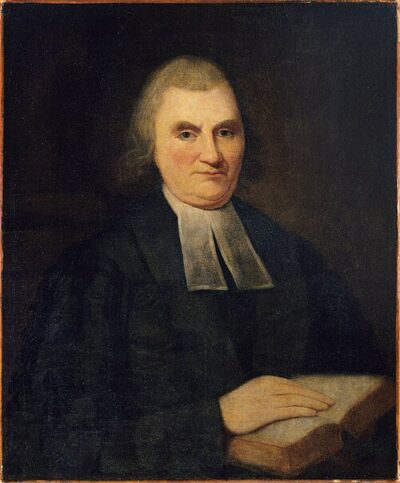
John Witherspoon
John Witherspoon was a Scottish-American Presbyterian minister and Founding Father of the United States. Born February 5, 1723, in Gifford. Died November 15, 1794, in Tusculum. Positions held include minister. Educated at University of Edinburgh.
Facts
16 facts · 2 confirmed by two sources · 5 cited · 9 from one source
Where this comes from
Papalocal keeps its own record. It started from these sources; what each one said is kept here as it was copied, so a change on their side never changes this page by itself. Tap one to read its version.
What Wikidata says · copied November 14, 2026 · revision 2550191015
- Described as
- Scottish-American Presbyterian minister and Founding Father of the United States (1723–1794)
- Other names
- John Knox Witherspoon
- Born
- February 5, 1723 · 4 references
- Died
- November 15, 1794 · 4 references
- Born in
- Gifford
- Died in
- Tusculum
- Buried in
- Princeton Cemetery · 1 reference
- Citizen of
- United States; Kingdom of Great Britain
- Occupation
- politician; theologian; writer · 1 reference
- Positions held
- minister · 1 reference
- Education
- University of Edinburgh
- Member of
- American Philosophical Society (1789–)
- Children
- Ann Witherspoon · 1 reference
- Religion
- Presbyterianism · 1 reference
- Lived in
- President's House (1768–1779)
- Wikipedias with a page
- 18
Wikidata item Q1246390 (wikidata.org/wiki/Q1246390), public domain (CC0). Copied November 14, 2026.
What Wikipedia says · copied November 14, 2026 · revision 1382116407
John Witherspoon (February 5, 1723 – November 15, 1794) was a Scottish-American Presbyterian minister, educator, farmer, and a Founding Father of the United States. Along with Christianity, Witherspoon also embraced various concepts of Scottish common sense realism, and while president of the College of New Jersey (1768–1794; now Princeton University) became an influential figure in the development of the United States' national character. Politically active, Witherspoon was a delegate from New Jersey to the Second Continental Congress and a signatory to the July 4, 1776, Declaration of Independence. He was the only active clergyman and the only college president to sign the Declaration.
Later, he signed the Articles of Confederation and supported ratification of the Constitution of the United States. In 1789 he was convening moderator of the First General Assembly of the Presbyterian Church in the United States of America. As one of the first national leaders of American Presbyterianism, he promoted theological and civic ideas adjacent to John Calvin, John Knox, and Samuel Rutherford, particularly the concept that resistance to tyranny is obedience to God. was born in Yester, Scotland, documented in the Old Parish Register as the eldest child of the Reverend James Alexander Witherspoon and Anne Walker, a descendant of John Welsh of Ayr and John Knox. This latter claim of Knox descent though ancient in origin is long disputed and without primary documentation. He attended the Haddington Grammar School and obtained a Master of Arts from the University of Edinburgh in 1739. He remained at the university to study divinity. In 1764, he was awarded an honorary doctoral degree in divinity by the University of St Andrews.
Witherspoon was a staunch Protestant, nationalist, and supporter of republicanism. Consequently, he was opposed to the Roman Catholic Legitimist Jacobite rising of 1745–46. Following the Jacobite victory at the Battle of Falkirk, he was briefly imprisoned at Doune Castle, which had a long-term effect on his health.
He became a Church of Scotland (Presbyterian) minister at Beith, Ayrshire (1745–1758), where he married Elizabeth Montgomery of Craighouse. They had ten children, with five surviving to adulthood.
From 1758 to 1768, he was minister of the Laigh Kirk, Paisley (Low Kirk). Witherspoon became prominent within the Church as an Evangelical opponent of the Moderate Party. During his two pastorates he wrote three well-known works on theology, notably the satire "Ecclesiastical Characteristics" (1753) about the Inverkeithing Case of 1752, which opposed the philosophical influence of Francis Hutcheson.
- Born, in its opening lines
- February 5, 1723
- Died, in its opening lines
- November 15, 1794
From the Wikipedia article “John Witherspoon” (en.wikipedia.org/wiki/John_Witherspoon), by its contributors, under CC BY-SA 4.0 (creativecommons.org/licenses/by-sa/4.0/). Copied November 14, 2026; not changed.
Confirmed Two sources agree. Cited One source, and it names where it got it. One source One source, without a reference of its own. Sources disagree The sources disagree. We show the best-supported value and keep theirs below.
