
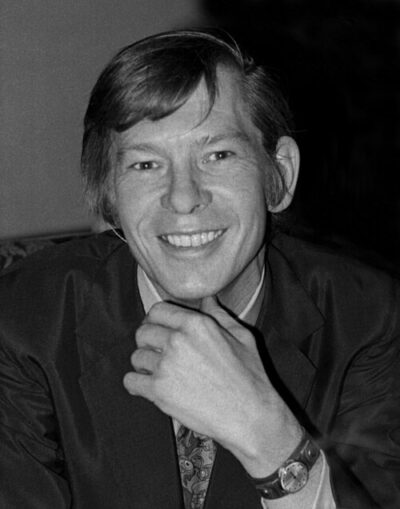
Johnnie Ray
Johnnie Ray was an American singer and pianist. Born January 10, 1927, in Dallas. Died February 24, 1990, in Los Angeles. Educated at Franklin High School. Awards include star on Hollywood Walk of Fame.
Facts
22 facts · 2 confirmed by two sources · 3 cited · 16 from one source · 1 where the sources disagree
What’s different
- Cause of death: we show liver failure (Sources disagree). Wikidata also lists hepatic encephalopathy
Where this comes from
Papalocal keeps its own record. It started from these sources; what each one said is kept here as it was copied, so a change on their side never changes this page by itself. Tap one to read its version.
What Wikidata says · copied November 16, 2026 · revision 2563857038
- Described as
- American singer and pianist (1927–1990)
- Other names
- John Alvin Ray
- Born
- January 10, 1927 · 3 references
- Died
- February 24, 1990 · 3 references
- Born in
- Dallas
- Died in
- Los Angeles
- Buried in
- Oregon
- Cause of death
- liver failure; hepatic encephalopathy
- Citizen of
- United States
- Occupation
- singer · 1 reference; songwriter; composer; television actor; film actor; musician · 2 references; pianist · 1 reference
- Education
- Franklin High School · 1 reference
- Genre
- pop music
- Instrument
- piano; voice
- Record label
- OKeh Records; Columbia Records; Philips Records
- Awards
- star on Hollywood Walk of Fame · 1 reference
- Wikipedias with a page
- 24
Wikidata item Q1198056 (wikidata.org/wiki/Q1198056), public domain (CC0). Copied November 16, 2026.
What Wikipedia says · copied November 16, 2026 · revision 1384364655
John Alvin Ray (January 10, 1927 – February 24, 1990) was an American singer, songwriter, and pianist. Highly popular for most of the 1950s, Ray has been cited by critics as a major precursor to what became rock and roll, for his jazz and blues-influenced music, and his animated stage personality. Tony Bennett called Ray the "father of rock and roll", and historians have noted him as a pioneering figure in the development of the genre.
Born and raised in Dallas, Oregon, Ray, who was partially deaf, began singing professionally at age 15 on Portland radio stations. He gained a local following singing at small, predominantly African-American nightclubs in Detroit, where he was discovered in 1949. In 1951, he signed a contract with Okeh Records, a subsidiary of Columbia Records. On the Billboard charts, he rose quickly from obscurity with the release of his debut album Johnnie Ray (1952), as well as with a 78 rpm single, both of whose sides reached the Billboard magazine's record sales chart, "Cry" and "The Little White Cloud That Cried".
In 1954, Ray made his first film, There's No Business Like Show Business, as part of an ensemble cast that included Ethel Merman and Marilyn Monroe. His career in the music business in his native United States began to decline in 1957, and his American record label dropped him in 1960. He never regained a strong following there and rarely appeared on American television after 1973. Ray's last television appearance in the United States was on a 1977 recorded-for-syndication episode of Sha Na Na. His fanbases in the United Kingdom and Australia remained strong until his final global concert tour in 1989.
British Hit Singles & Albums noted that Ray was "a sensation in the 1950s; the heart-wrenching vocal delivery of 'Cry' ... influenced many acts including Elvis, and was the prime target for teen hysteria in the pre-Presley days." Ray's dramatic stage performances and melancholic songs have been credited by music historians as precursors to the work of later performers ranging from Leonard Cohen to Morrissey.
- Born, in its opening lines
- January 10, 1927
- Died, in its opening lines
- February 24, 1990
From the Wikipedia article “Johnnie Ray” (en.wikipedia.org/wiki/Johnnie_Ray), by its contributors, under CC BY-SA 4.0 (creativecommons.org/licenses/by-sa/4.0/). Copied November 16, 2026; not changed.
Confirmed Two sources agree. Cited One source, and it names where it got it. One source One source, without a reference of its own. Sources disagree The sources disagree. We show the best-supported value and keep theirs below.
