
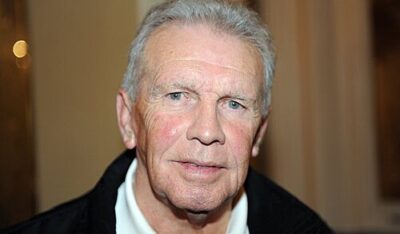
Johnny Giles
Johnny Giles was an Irish professional footballer and manager, born in 1940. He is widely recognized for his impactful career as a midfielder, particularly during his tenure with Leeds United in the 1960s and 1970s. Giles also represented the Republic of Ireland internationally.
Following his playing career, Giles transitioned into management. After retiring from coaching in 1985, he embarked on a long career as a football analyst for RTÉ Sport, a role he held for three decades. His contributions to the sport were acknowledged when he was nominated for the Ballon d'Or in 1972 and later named the greatest Irish player of the preceding 50 years by the FAI in 2004.
Facts
16 facts · 1 confirmed by two sources · 3 cited · 12 from one source
Where this comes from
Papalocal keeps its own record. It started from these sources; what each one said is kept here as it was copied, so a change on their side never changes this page by itself. Tap one to read its version.
What Wikidata says · copied November 13, 2026 · revision 2555452666
- Described as
- Irish soccer player and manager
- Other names
- Michael John Giles
- Born
- November 6, 1940 · 1 reference
- Born in
- Dublin
- Citizen of
- Ireland
- Occupation
- association football player · 1 reference; journalist; association football coach · 1 reference
- Teams
- Manchester United F.C. (1957–1963); Philadelphia Fury (1978); Leeds United F.C. (1963–1975); West Bromwich Albion F.C. (1975–1977); Shamrock Rovers F.C. (1977–1983); Philadelphia Fury (1978); Republic of Ireland men's national association football team (1959–1979)
- Sport
- association football · 1 reference
- Awards
- English Football Hall of Fame
- Height
- 1.70 m (5 ft 7 in)
- Wikipedias with a page
- 28
Wikidata item Q444329 (wikidata.org/wiki/Q444329), public domain (CC0). Copied November 13, 2026.
What Wikipedia says · copied November 13, 2026 · revision 1381397097
Michael John Giles (born 6 November 1940) is an Irish former association football player and manager best remembered for his time as a midfielder with Leeds United in the 1960s and 1970s. After retiring from management in 1985, Giles served as the senior analyst on RTÉ Sport's coverage of association football from 1986 until 2016. He was nominated for the 1972 Ballon d'Or and the FAI voted Giles as the greatest Irish player of the last 50 years at the UEFA Jubilee Awards in 2004.
After winning an FA Cup winner's medal under Matt Busby at Manchester United, Giles moved to Leeds in 1963 where he played in midfield alongside captain Billy Bremner. The duo formed a central midfield partnership which was one of the best in English and European club football. Their pairing helped yield several major trophies in the most successful era in Leeds' history. Giles and Bremner both scored 115 goals for the club.
In his later years in football, Giles pursued a managerial career which saw him installed as player-manager and manager of, among others, West Bromwich Albion, the Republic of Ireland, Vancouver Whitecaps and Shamrock Rovers. Despite having an outstanding knowledge of the game, Giles personally never liked being a manager. He became disillusioned with aspects of the job, such as suffering at the hands of non-committal boardrooms, and left management permanently in 1985. He later declared that he had no regrets about quitting managerial life.
After repeated encouragement from childhood friend Eamon Dunphy, Giles inadvertently entered the world of football punditry in 1986 and became a senior analyst on RTÉ Sport until 2016. In December 2019, he was employed as an analyst for Premier Sports' live coverage of the English Premier League matches. Also, he writes two columns per week for the Irish Evening Herald newspaper, and offers his opinions about the game on radio station Newstalk 106.
- Born, in its opening lines
- November 6, 1940
From the Wikipedia article “Johnny Giles” (en.wikipedia.org/wiki/Johnny_Giles), by its contributors, under CC BY-SA 4.0 (creativecommons.org/licenses/by-sa/4.0/). Copied November 13, 2026; not changed.
Confirmed Two sources agree. Cited One source, and it names where it got it. One source One source, without a reference of its own. Sources disagree The sources disagree. We show the best-supported value and keep theirs below.
