
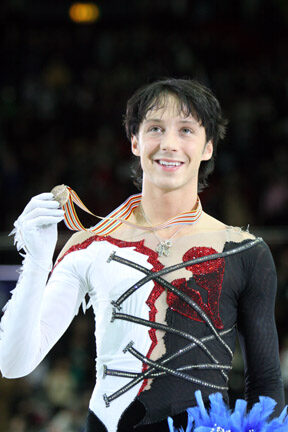
Johnny Weir
Johnny Weir is an American figure skater and television commentator. Born July 2, 1984, in Coatesville. Educated at University of Delaware and Newark High School.
Facts
9 facts · 1 confirmed by two sources · 0 cited · 8 from one source
Where this comes from
Papalocal keeps its own record. It started from these sources; what each one said is kept here as it was copied, so a change on their side never changes this page by itself. Tap one to read its version.
What Wikidata says · copied November 15, 2026 · revision 2529580363
- Described as
- American figure skater and television commentator
- Other names
- John Garvin Weir
- Born
- July 2, 1984
- Born in
- Coatesville
- Citizen of
- United States
- Occupation
- figure skater · 1 reference; actor
- Education
- University of Delaware; Newark High School
- Sport
- figure skating · 1 reference
- Height
- 1.75 m (5 ft 9 in) · 1 reference
- Wikipedias with a page
- 29
Wikidata item Q352193 (wikidata.org/wiki/Q352193), public domain (CC0). Copied November 15, 2026.
What Wikipedia says · copied November 15, 2026 · revision 1376211617
John Garvin Weir (; born July 2, 1984) is an American television commentator and retired figure skater. He is a two-time Olympian (2006 and 2010 Winter Olympics), the 2008 World bronze medalist, a two-time Grand Prix Final bronze medalist, the 2001 World Junior Champion, and a three-time U.S. National champion (2004–2006). He was the youngest U.S. National champion since 1991, in 2006 the first skater to win U.S. Nationals three times in a row since Brian Boitano in the late 1980s, and the first American to win Cup of Russia in 2007.
Weir was raised in Quarryville, Pennsylvania, winning several equestrian competitions before switching to figure skating at the age of 12. Priscilla Hill was his first coach. He became eligible to compete in the Junior Grand Prix during the 1999–2000 season and won the 2001 Junior World Championship. The following season (2000–2001), Weir competed as a senior for the first time, coming in sixth place at the U.S. Nationals. The 2003–2004 season was "the turning point" for Weir, when he trained with Tatiana Tarasova and won his first national title at age 19.
At the 2006 U.S. Nationals, Weir was the first male skater to win three consecutive U.S. titles since Brian Boitano almost 20 years previously. He finished third at the 2007 U.S. Nationals and replaced his long-time coach, Priscilla Hill, with Galina Zmievskaya for the 2007–2008 season. At the 2008 U.S. Nationals, he tied for first place with Evan Lysacek, both with a combined score of 244.77 points, but Lysacek was named the U.S. champion because, following ISU regulations, he won the free skate. Weir finished fifth place at the 2009 U.S. Nationals, the first time since 2003 that Weir did not qualify to compete at the World Championships. He was ready to quit figure skating before the 2009–2010 season, but ended up qualifying for the 2010 Winter Olympics by winning bronze at the 2010 U.S. Nationals. Weir retired from competitive figure skating in 2013. He joined NBC as a commentator beginning at the Sochi Olympics in 2014. He was teamed with sports commentator Terry Gannon and fellow figure skater Tara Lipinski; also in 2014, they became NBC's primary figure skating analysts, commentating for skating in four Olympics (Sochi, 2014; PyeongChang, 2018; Beijing, 2022; Milano Cortino, 2026).
Weir had a classical skating style and was known for being "a very lyrical skater" and "an entertaining artisan". He often designed his own costumes or worked extensively with his designers and later was known for his fashion choices as a broadcaster. His costume choices and outspokenness caused conflicts with U.S. Figure Skating, the governing body of the sport in the U.S., throughout his skating career. Television commentators would bring up his sexual orientation during his performances, causing him to publicly address homophobic remarks by commentators during the 2010 Olympics. He came out in early 2011 and has been involved in LGBTQ activism.
- Born, in its opening lines
- July 2, 1984
From the Wikipedia article “Johnny Weir” (en.wikipedia.org/wiki/Johnny_Weir), by its contributors, under CC BY-SA 4.0 (creativecommons.org/licenses/by-sa/4.0/). Copied November 15, 2026; not changed.
Confirmed Two sources agree. Cited One source, and it names where it got it. One source One source, without a reference of its own. Sources disagree The sources disagree. We show the best-supported value and keep theirs below.
