
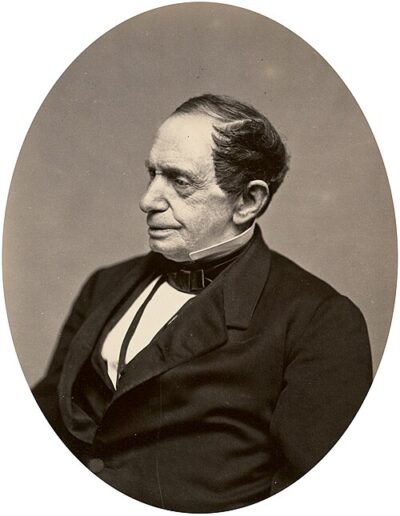
Johns Hopkins
Johns Hopkins was an American entrepreneur, philanthropist, and abolitionist. Born May 19, 1795, in Gambrills. Died December 24, 1873, in Baltimore.

Facts
10 facts · 2 confirmed by two sources · 3 cited · 5 from one source
Where this comes from
Papalocal keeps its own record. It started from these sources; what each one said is kept here as it was copied, so a change on their side never changes this page by itself. Tap one to read its version.
What Wikidata says · copied November 15, 2026 · revision 2566756115
- Described as
- American entrepreneur, philanthropist, and abolitionist (1795–1873)
- Born
- May 19, 1795 · 4 references
- Died
- December 24, 1873 · 4 references
- Born in
- Gambrills
- Died in
- Baltimore
- Buried in
- Green Mount Cemetery
- Citizen of
- United States
- Occupation
- entrepreneur · 1 reference; philanthropist
- Father
- Samuel Hopkins · 1 reference
- Mother
- Hannah Hopkins · 1 reference
- Wikipedias with a page
- 32
Wikidata item Q380418 (wikidata.org/wiki/Q380418), public domain (CC0). Copied November 15, 2026.
What Wikipedia says · copied November 15, 2026 · revision 1381924375
Johns Hopkins (May 19, 1795 – December 24, 1873) was an American merchant, investor, and philanthropist best known for funding the establishment of Johns Hopkins University and Johns Hopkins Hospital, which have since become leading institutions for scientific research and medical advancements. At the time of his death, his donation was the largest philanthropic bequest ever made to an American educational institution.
Born on a plantation in Anne Arundel County, Maryland, Hopkins left his home to start a career at the age of seventeen, and settled in Baltimore, Maryland, where he remained for most of his life. He accumulated his fortune primarily through investing in the Baltimore and Ohio Railroad (B&O), for which he later served as finance director. He was also president of Baltimore-based Merchants' National Bank.
A Quaker, Hopkins strongly backed Abraham Lincoln and the Union during the American Civil War and was described as holding "antislavery political views." In 2020, new archival research prompted renewed scholarly debate over Hopkins’s relationship to slavery and his long-standing reputation as a staunch abolitionist. Researchers affiliated with Johns Hopkins University reported evidence suggesting that he may have owned or employed enslaved people earlier in his life, while other scholars have disputed these findings and emphasized his documented opposition to slavery and philanthropic support for Black education and social welfare.
- Born, in its opening lines
- May 19, 1795
- Died, in its opening lines
- December 24, 1873
From the Wikipedia article “Johns Hopkins” (en.wikipedia.org/wiki/Johns_Hopkins), by its contributors, under CC BY-SA 4.0 (creativecommons.org/licenses/by-sa/4.0/). Copied November 15, 2026; not changed.
Confirmed Two sources agree. Cited One source, and it names where it got it. One source One source, without a reference of its own. Sources disagree The sources disagree. We show the best-supported value and keep theirs below.
