
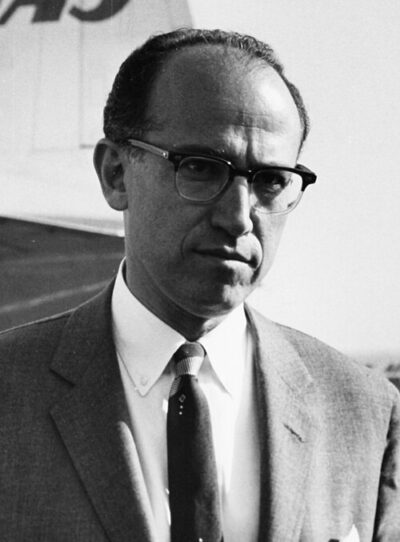
Jonas Salk
Jonas Salk was a Jewish-American inventor of polio vaccine. Born October 28, 1914, in New York City. Died June 23, 1995, in La Jolla. Educated at University of Michigan and City College of New York. Awards include Jawaharlal Nehru Award for International Understanding, Presidential Medal of Freedom and Humanist of the Year.
Facts
41 facts · 2 confirmed by two sources · 8 cited · 31 from one source
Where this comes from
Papalocal keeps its own record. It started from these sources; what each one said is kept here as it was copied, so a change on their side never changes this page by itself. Tap one to read its version.
What Wikidata says · copied November 13, 2026 · revision 2568291486
- Described as
- Jewish-American inventor of polio vaccine (1914–1995)
- Other names
- Jonas Edward Salk
- Born
- October 28, 1914 · 9 references
- Died
- June 23, 1995 · 9 references
- Born in
- New York City · 2 references
- Died in
- La Jolla · 1 reference
- Buried in
- Los Angeles
- Cause of death
- heart failure
- Name at birth
- Jonas Salk
- Citizen of
- United States
- Occupation
- physician · 1 reference; epidemiologist; inventor; virologist; immunologist · 1 reference
- Worked for
- University of Pittsburgh
- Education
- University of Michigan; City College of New York; New York University; Grossman School of Medicine; Fanny Edel Falk Laboratory School
- Member of
- American Academy of Arts and Sciences; Phi Beta Kappa Society; American Association for the Advancement of Science · 1 reference
- Awards
- Jawaharlal Nehru Award for International Understanding (1975) · 1 reference; Presidential Medal of Freedom (1977) · 1 reference; Humanist of the Year (1976); Lasker-DeBakey Clinical Medical Research Award (1956); Congressional Gold Medal (1975); California Hall of Fame (2007); Distinguished Americans series (2006); Robert Koch Prize (1962) · 2 references; Meritorious Civilian Service Award (1955); Howard Taylor Ricketts Prize (1957) · 1 reference; John Scott Award (1957) · 1 reference; Grand Officer of the Order of Merit of the Italian Republic (1981)
- Field
- virology; epidemiology
- Spouse
- Françoise Gilot (1970–1995) · 1 reference
- Children
- Peter L. Salk; Darrell Salk; Jonathan Salk
- Lived in
- United States · 1 reference
- Wikipedias with a page
- 90
Wikidata item Q200101 (wikidata.org/wiki/Q200101), public domain (CC0). Copied November 13, 2026.
What Wikipedia says · copied November 13, 2026 · revision 1383779208
Jonas Edward Salk (; born Jonas Salk; October 28, 1914 – June 23, 1995) was an American virologist and medical researcher who developed one of the first successful polio vaccines. He was born in New York City and attended the City College of New York and New York University School of Medicine.
In 1947, Salk accepted a professorship at the University of Pittsburgh School of Medicine, where he undertook a project beginning in 1948 to determine the number of different types of poliovirus. For the next seven years, Salk devoted himself to developing a vaccine against polio.
Salk was immediately hailed as a "miracle worker" when the vaccine's success was first made public in April 1955, and chose to not patent the vaccine or seek any profit from it in order to maximize its global distribution. The National Foundation for Infantile Paralysis and the University of Pittsburgh looked into patenting the vaccine after deciding not to profit from it, but determined the techniques used to make the vaccine were likely not novel enough to patent. An immediate rush to vaccinate began in the United States and around the world. Many countries began polio immunization campaigns using Salk's vaccine, including Canada, Sweden, Denmark, Norway, West Germany, the Netherlands, Switzerland, and Belgium. By 1959, the Salk vaccine had reached about 90 countries. An attenuated live oral polio vaccine was developed by Albert Sabin, coming into commercial use in 1961. Less than 25 years after the release of Salk's vaccine, domestic transmission of polio had been eliminated in the United States.
In 1963, Salk founded the Salk Institute for Biological Studies in La Jolla, California, which is today a center for medical and scientific research. He continued to conduct research and publish books in his later years, focusing in his last years on the search for a vaccine against HIV. Salk campaigned vigorously for mandatory vaccination throughout the rest of his life, calling the universal vaccination of children against disease a "moral commitment". Salk's personal papers are today stored in the Geisel Library at the University of California, San Diego.
- Born, in its opening lines
- October 28, 1914
- Died, in its opening lines
- June 23, 1995
From the Wikipedia article “Jonas Salk” (en.wikipedia.org/wiki/Jonas_Salk), by its contributors, under CC BY-SA 4.0 (creativecommons.org/licenses/by-sa/4.0/). Copied November 13, 2026; not changed.
Confirmed Two sources agree. Cited One source, and it names where it got it. One source One source, without a reference of its own. Sources disagree The sources disagree. We show the best-supported value and keep theirs below.
