
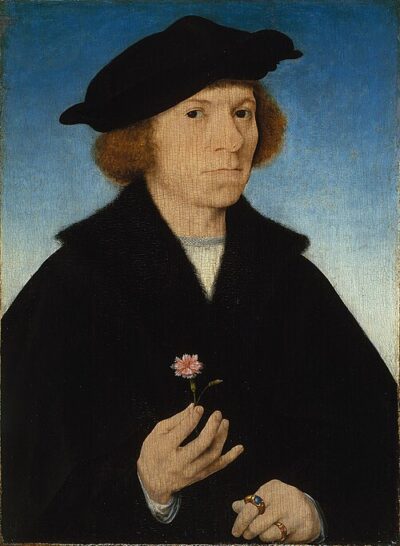
Joos van Cleve
Joos van Cleve was a Flemish painter. Born 1485, in Kleve. Died November 10, 1540, in Antwerp. Known for Portrait of a man, Portrait of an Unknown Man and Portrait of a man and his wife.
Facts
14 facts · 1 confirmed by two sources · 6 cited · 6 from one source · 1 where the sources disagree
What’s different
- Born: we show 1485 (Confirmed). Wikidata also lists 1475
- Died: we show November 10, 1540 (Sources disagree). Wikipedia says 1490
Where this comes from
Papalocal keeps its own record. It started from these sources; what each one said is kept here as it was copied, so a change on their side never changes this page by itself. Tap one to read its version.
What Wikidata says · copied November 17, 2026 · revision 2568062125
- Described as
- Flemish painter (1485–1540)
- Other names
- Joos van Kleef, Joos Van Cleve, Joos van der Beke Cleef, Joos van der Beke, Sotte Cleeff, Sotte Cleef, Joos van der Beke Cleve, Joos van der Beke van Cleve, Joos van Cleef, Joos Van Cleef, Joos van, the elder Cleve, Joos van der Beken
- Born
- 1485 · 6 references; 1475 · 1 reference
- Died
- November 10, 1540 · 1 reference
- Born in
- Kleve · 1 reference
- Died in
- Antwerp · 1 reference
- Citizen of
- Habsburg Netherlands
- Occupation
- painter · 4 references
- Genre
- portrait
- Known for
- Portrait of a man; Portrait of an Unknown Man; Portrait of a man and his wife
- Field
- painting · 1 reference; portrait painting · 1 reference
- Children
- Cornelis van Cleve · 1 reference
- Father
- Willem van Cleve the Elder
- Wikipedias with a page
- 26
Wikidata item Q153472 (wikidata.org/wiki/Q153472), public domain (CC0). Copied November 17, 2026.
What Wikipedia says · copied November 17, 2026 · revision 1382513651
Joos van Cleve (; also Joos van der Beke; c. 1485–1490 – 1540/1541) was a leading painter active in Antwerp from his arrival there around 1511 until his death in 1540 or 1541. Within Dutch and Flemish Renaissance painting, he combines the traditional techniques of Early Netherlandish painting with influences of more contemporary Renaissance painting styles.
An active member and co-deacon of the Guild of Saint Luke of Antwerp, he is known mostly for his religious works and portraits, some of royalty. He ran a large workshop, with at least five pupils and other assistants, which produced paintings in a variety of styles over his career. As a skilled technician, his art shows sensitivity to color and a unique solidarity of figures. His style is highly eclectic: he was one of the first to introduce broad world landscapes in the backgrounds of his paintings, sometimes collaborating with Joachim Patinir, which would become a popular technique of sixteenth century northern Renaissance paintings. Some works reflect the popular style of Antwerp Mannerism, while others are variations on early Netherlandish masters of two or more generations before, or reflect recent Italian painting.
Four of his more important paintings have the monogram "JB", presumably for Joos van der Beke, rather inconspicuously placed. In three other works a self-portrait is placed among the minor figures. From the seventeenth to the nineteenth centuries, the name of Joos van Cleve as an artist was lost. Some of the paintings now attributed to Joos van Cleve were, at that time, known as the works of the "Master of the Death of the Virgin", after the triptych in the Wallraf-Richartz-Museum in Cologne. In 1894 it was discovered that the monogram on the back of the triptych was that of Joos van der Beke, the real name of Joos van Cleve. His oeuvre was reconstructed in the 1920s and 1930s by Ludwig von Baldass and Max Jakob Friedländer. Now over 300 works are generally attributed to him or his workshop, which vary considerably in both quality and style.
He was the father of Cornelis van Cleve (1520–1567) who also became a painter, and inherited the workshop. Cornelis became mentally ill during a residence in England and was therefore referred to as 'Sotte Cleef' (mad Cleef).
- Born, in its opening lines
- 1485
- Died, in its opening lines
- 1490
From the Wikipedia article “Joos van Cleve” (en.wikipedia.org/wiki/Joos_van_Cleve), by its contributors, under CC BY-SA 4.0 (creativecommons.org/licenses/by-sa/4.0/). Copied November 17, 2026; not changed.
Confirmed Two sources agree. Cited One source, and it names where it got it. One source One source, without a reference of its own. Sources disagree The sources disagree. We show the best-supported value and keep theirs below.
