
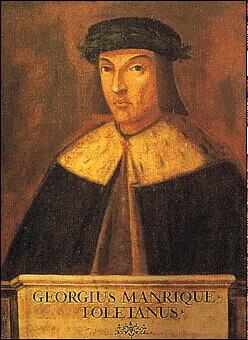
Jorge Manrique
Jorge Manrique was a Spanish poet. Born 1440, in Paredes de Nava. Died April 24, 1479, in Santa María del Campo Rus. Known for Coplas por la muerte de su padre and Cancionero. Awards include Master of the Order of Santiago.
Facts
16 facts · 2 confirmed by two sources · 5 cited · 8 from one source · 1 where the sources disagree
What’s different
- Born in: we show Paredes de Nava (Sources disagree). Wikidata also lists Segura de la Sierra
Where this comes from
Papalocal keeps its own record. It started from these sources; what each one said is kept here as it was copied, so a change on their side never changes this page by itself. Tap one to read its version.
What Wikidata says · copied November 16, 2026 · revision 2568762636
- Described as
- Spanish poet (1440–1479)
- Other names
- Jorge Manrique de Lara, Señor de Belmontejo
- Born
- 1440 · 6 references
- Died
- April 24, 1479 · 2 references
- Born in
- Segura de la Sierra · 5 references; Paredes de Nava · 7 references
- Died in
- Santa María del Campo Rus · 3 references
- Citizen of
- Crown of Castile
- Occupation
- poet · 2 references; military personnel · 1 reference
- Known for
- Coplas por la muerte de su padre; Cancionero
- Awards
- Master of the Order of Santiago
- Spouse
- Guiomar de Meneses Ayala
- Children
- Luisa Manrique de Lara · 1 reference
- Father
- Rodrigo Manrique de Lara · 1 reference
- Mother
- Mencía de Figueroa · 1 reference
- Siblings
- Leonor Manrique de Lara
- Military rank
- Sergeant · 1 reference
- Wikipedias with a page
- 37
Wikidata item Q389233 (wikidata.org/wiki/Q389233), public domain (CC0). Copied November 16, 2026.
What Wikipedia says · copied November 16, 2026 · revision 1293353741
Jorge Manrique (c. 1440 – 24 April 1479) was a major Castilian poet, whose main work, the Coplas por la muerte de su padre (Verses on the death of Don Rodrigo Manrique, his Father), is still read today. He was a supporter of the queen Isabel I of Castile, and actively participated on her side in the civil war that broke out against her half-brother, Enrique IV, when the latter attempted to make his daughter, Juana, crown princess. Jorge died in 1479 during an attempt to take the castle of Garcimuñoz, defended by the Marquis of Villena (a staunch enemy of Isabel), after Isabel gained the crown.
Manrique was a great-nephew of Iñigo López de Mendoza (marquis of Santillana), a descendant of Pero López de Ayala, chancellor of Castile, and a nephew of Gómez Manrique, corregidor of Toledo, all important poets of the late fourteenth and fifteenth centuries. He was, therefore, a member of a noble family of great literary consequence. The topic of his work was the tempus fugit.
- Born, in its opening lines
- c. 1440
- Died, in its opening lines
- April 24, 1479
From the Wikipedia article “Jorge Manrique” (en.wikipedia.org/wiki/Jorge_Manrique), by its contributors, under CC BY-SA 4.0 (creativecommons.org/licenses/by-sa/4.0/). Copied November 16, 2026; not changed.
Confirmed Two sources agree. Cited One source, and it names where it got it. One source One source, without a reference of its own. Sources disagree The sources disagree. We show the best-supported value and keep theirs below.
