
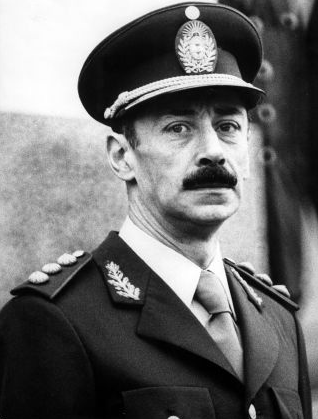
Jorge Rafael Videla
Jorge Rafael Videla was an Argentina de facto president. Born August 2, 1925, in Mercedes. Died May 17, 2013, in Marcos Paz, Buenos Aires. Positions held include President of Argentina (1976–1981), commander-in-chief (1975–1978) and Governor of Tucumán Province (1970). Educated at Nation Military College and Western Hemisphere Institute for Security Cooperation. Awards include Collar of the Order of Isabella the Catholic, Order of the Liberator General San Martín and Order of the Sun of Peru.
Facts
32 facts · 2 confirmed by two sources · 8 cited · 22 from one source
Where this comes from
Papalocal keeps its own record. It started from these sources; what each one said is kept here as it was copied, so a change on their side never changes this page by itself. Tap one to read its version.
What Wikidata says · copied November 16, 2026 · revision 2560535234
- Described as
- Argentina de facto president (1925–2013)
- Other names
- Jorge Videla, Jorge R. Videla, Jorge Rafael Videla Redondo
- Born
- August 2, 1925 · 6 references
- Died
- May 17, 2013 · 8 references
- Born in
- Mercedes · 1 reference
- Died in
- Marcos Paz, Buenos Aires · 1 reference
- Cause of death
- cardiac arrest
- Name at birth
- Jorge Rafael Videla · 4 references
- Citizen of
- Argentina
- Occupation
- politician · 1 reference; military officer
- Positions held
- President of Argentina (1976–1981) · 1 reference; commander-in-chief (1975–1978); Governor of Tucumán Province (1970); director (1971–1973); Chief of the Army General Staff (1973–1975); executive officer (1968–); Chief of the Joint Staff of the Armed Forces (1975) · 1 reference
- Political party
- military party
- Education
- Nation Military College (1942–1944); Western Hemisphere Institute for Security Cooperation; Army War Academy (1952–1954)
- Member of
- Military Junta
- Awards
- Collar of the Order of Isabella the Catholic (1979) · 1 reference; Order of the Liberator General San Martín; Order of the Sun of Peru; Order of May; Grand Cross of the Cross of Military Merit with White Decoration (1979) · 1 reference
- Spouse
- Alicia Hartridge · 1 reference
- Religion
- Catholicism
- Military branch
- Argentine Army · 1 reference
- Military rank
- lieutenant general (1975–1985) · 1 reference; divisional general (1975) · 1 reference; brigadier general (1971–1975)
- Wikipedias with a page
- 76
Wikidata item Q75853 (wikidata.org/wiki/Q75853), public domain (CC0). Copied November 16, 2026.
What Wikipedia says · copied November 16, 2026 · revision 1382962746
General Jorge Rafael Videla ( vid-EL-ə; Spanish: [ˈxoɾxe rafaˈel βiˈðela]; 2 August 1925 – 17 May 2013) was an Argentine general, politician and dictator who served as the president of Argentina from 1976 to 1981 during the National Reorganization Process.
He came to power in a March 1976 coup d'état that deposed Isabel Perón. His rule, which occurred during the Dirty War (1974–1983), was among the most infamous in Latin America during the Cold War due to widespread human rights abuses including murder, abduction, torture of activists and political opponents along with their families at secret concentration camps. In addition, the children of female prisoners were systematically kidnapped. An estimated 13,000 to 30,000 political dissidents were killed or disappeared during this period. Videla relinquished power to Roberto Viola in March 1981.
In 1985, two years after the return of a representative democratic government, he was prosecuted in the Trial of the Juntas and convicted for large-scale human rights abuses and crimes against humanity during his rule. He was released in 1990, following a pardon from President Carlos Menem.
Videla was arrested again in 1998 after he was found guilty of the kidnapping of children. He remained under house arrest until 10 October 2008, when he was sent to a military prison. On 5 July 2010, Videla took full responsibility for his army's actions during his rule. Following a new trial, on 22 December 2010, Videla was sentenced to life in a civilian prison for the deaths of 31 prisoners following his coup. On 5 July 2012, Videla was sentenced to 50 years in civilian prison for the systematic kidnapping of children during his tenure. The following year, Videla died in the Marcos Paz civilian prison five days after falling in a shower.
- Born, in its opening lines
- August 2, 1925
- Died, in its opening lines
- May 17, 2013
From the Wikipedia article “Jorge Rafael Videla” (en.wikipedia.org/wiki/Jorge_Rafael_Videla), by its contributors, under CC BY-SA 4.0 (creativecommons.org/licenses/by-sa/4.0/). Copied November 16, 2026; not changed.
Confirmed Two sources agree. Cited One source, and it names where it got it. One source One source, without a reference of its own. Sources disagree The sources disagree. We show the best-supported value and keep theirs below.
