
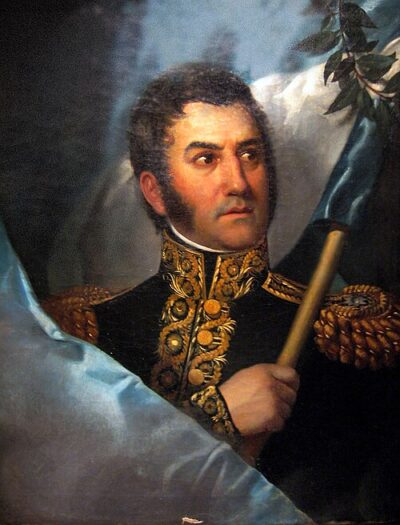
José de San Martín
José de San Martín was an Argentine general and independence leader. Born February 25, 1778, in Yapeyú. Died August 17, 1850, in Boulogne-sur-Mer. Positions held include President of Peru (1821–1822), Government of Mendoza (1814–1816) and Commander-in-Chief of the Chilean Army. Educated at Royal Seminary of Nobles of Madrid. Awards include Order of the Sun of Peru and honorary doctorate of the National University of San Marcos.
Facts
33 facts · 2 confirmed by two sources · 8 cited · 23 from one source
Where this comes from
Papalocal keeps its own record. It started from these sources; what each one said is kept here as it was copied, so a change on their side never changes this page by itself. Tap one to read its version.
What Wikidata says · copied November 16, 2026 · revision 2567283716
- Described as
- Argentine general and independence leader (1778–1850)
- Other names
- Don José de San Martín, José Francisco de San Martín y Matorra, Libertador General San Martín, General San Martín, San Martín, José Francisco de San Martín y Matorras
- Born
- February 25, 1778 · 8 references
- Died
- August 17, 1850 · 10 references
- Born in
- Yapeyú · 1 reference
- Died in
- Boulogne-sur-Mer · 1 reference
- Buried in
- Buenos Aires Cathedral
- Name at birth
- José Francisco de San Martín y Matorras
- Citizen of
- Argentina
- Occupation
- military personnel; politician; soldier · 1 reference
- Positions held
- President of Peru (1821–1822); Government of Mendoza (1814–1816); Commander-in-Chief of the Chilean Army
- Political party
- Patriot
- Education
- Royal Seminary of Nobles of Madrid
- Awards
- Order of the Sun of Peru; honorary doctorate of the National University of San Marcos
- Field
- military affairs · 1 reference; politics · 1 reference
- Spouse
- María de los Remedios de Escalada (1812–1823) · 1 reference
- Children
- Mercedes Tomasa San Martín y Escalada
- Father
- Juan D' San Martin y Gómez · 1 reference
- Mother
- Gregoria Matorras · 1 reference
- Siblings
- Juan Fermín de San Martín; Jerónima San Martín de Buchardo y de Herrera
- Military rank
- generalissimo; general · 1 reference; captain general · 1 reference
- Lived in
- Buenos Aires; Madrid; London (1811–1812); Lima (1821–1822); Paris
- Wikipedias with a page
- 89
Wikidata item Q134160 (wikidata.org/wiki/Q134160), public domain (CC0). Copied November 16, 2026.
What Wikipedia says · copied November 16, 2026 · revision 1381652547
José Francisco de San Martín y Matorras (Spanish pronunciation: [xoˈse ðe sam maɾˈtin] ; 25 February 1778 – 17 August 1850), nicknamed "the Liberator of Argentina, Chile and Peru", was an Argentine general and the primary leader of the southern and central parts of South America's successful struggle for independence from the Spanish Empire who served as the Protector of Peru. Born in Yapeyú, Corrientes, in modern-day Argentina, he left the Viceroyalty of the Río de la Plata at the early age of seven to study in Málaga, Spain.
In 1808, after taking part in the Peninsular War against France, San Martín contacted South American supporters of independence from Spain in London. In 1812, he set sail for Buenos Aires and offered his services to the United Provinces of the Río de la Plata, present-day Argentina and other countries. After the Battle of San Lorenzo and time commanding the Army of the North during 1814, he organized a plan to defeat the Spanish forces that menaced the United Provinces from the north, using an alternative path to the Viceroyalty of Peru. This objective first involved the establishment of a new army, the Army of the Andes, in Cuyo Province, Argentina. From there, he led the Crossing of the Andes to Chile, and triumphed at the Battle of Chacabuco and the Battle of Maipú (1818), thus liberating Chile from royalist rule. Then he sailed to attack the Spanish stronghold of Lima, Peru.
On 12 July 1821, after seizing partial control of Lima, San Martín was appointed Protector of Peru, and Peruvian independence was officially declared on 28 July. On 26 July 1822, after a closed-door meeting with fellow libertador Simón Bolívar at Guayaquil, Ecuador, Bolívar took over the task of fully liberating Peru. San Martín unexpectedly left the country and resigned the command of his army, excluding himself from politics and the military, and moved to France in 1824. The details of that meeting would be a subject of debate by later historians.
San Martín is regarded as a national hero of Argentina, Chile, and Peru, a great military commander, and one of the Liberators of Spanish South America. The Order of the Liberator General San Martín (Orden del Libertador General San Martín), created in his honor, is the highest decoration conferred by the Argentine government.
- Born, in its opening lines
- February 25, 1778
- Died, in its opening lines
- August 17, 1850
From the Wikipedia article “José de San Martín” (en.wikipedia.org/wiki/José_de_San_Martín), by its contributors, under CC BY-SA 4.0 (creativecommons.org/licenses/by-sa/4.0/). Copied November 16, 2026; not changed.
Confirmed Two sources agree. Cited One source, and it names where it got it. One source One source, without a reference of its own. Sources disagree The sources disagree. We show the best-supported value and keep theirs below.
