
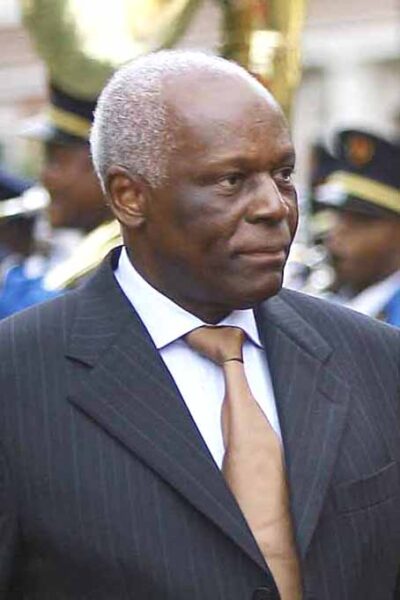
José Eduardo dos Santos
José Eduardo dos Santos was a President of Angola from 1979 to 2017. Born August 28, 1942, in Luanda. Died July 8, 2022, in Barcelona. Positions held include President of Angola (1979–2017), Minister of External Relations (1975–1977) and Member of the National Assembly of Angola. Educated at Azerbaijan State Oil and Industrial University. Awards include Order of Honour, Order of Agostinho Neto and Grand Collar of the Military Order of Saint James of the Sword.
Facts
36 facts · 2 confirmed by two sources · 16 cited · 18 from one source
Where this comes from
Papalocal keeps its own record. It started from these sources; what each one said is kept here as it was copied, so a change on their side never changes this page by itself. Tap one to read its version.
What Wikidata says · copied November 16, 2026 · revision 2569159258
- Described as
- President of Angola from 1979 to 2017
- Other names
- Jose Eduardo dos Santos, José Eduardo Van-Dúnem dos Santos
- Born
- August 28, 1942 · 6 references
- Died
- July 8, 2022 · 2 references
- Born in
- Luanda · 1 reference
- Died in
- Barcelona · 1 reference
- Buried in
- Luanda · 1 reference
- Cause of death
- heart failure
- Name at birth
- José Eduardo Van Dunen
- Citizen of
- Angola
- Occupation
- politician · 1 reference; engineer; minister · 1 reference
- Positions held
- President of Angola (1979–2017); Minister of External Relations (1975–1977); Member of the National Assembly of Angola · 1 reference
- Political party
- People's Movement for the Liberation of Angola
- Education
- Azerbaijan State Oil and Industrial University
- Awards
- Order of Honour (2012) · 1 reference; Order of Agostinho Neto (1991) · 1 reference; Grand Collar of the Military Order of Saint James of the Sword (1996) · 1 reference; Order of the Companions of O. R. Tambo (2010) · 1 reference; Order of José Martí · 1 reference; Order of Friendship (2006) · 1 reference; Grand Collar of the Order of Prince Henry (1988) · 1 reference; honorary doctor of the Peoples' Friendship University of Russia (1998) · 1 reference; Military Order of Saint James of the Sword · 1 reference; Order of Prince Henry · 1 reference; Order of the Republic of Serbia · 1 reference; Order of the Equatorial Star · 1 reference
- Spouse
- Ana Paula dos Santos (1991–2022); Tatiana Kukanova (1966–1980)
- Children
- Isabel dos Santos · 1 reference; José Filomeno dos Santos · 1 reference; Coréon Dú · 1 reference; Welwitschia dos Santos · 1 reference
- Religion
- Catholicism
- Military rank
- general of the army
- Wikipedias with a page
- 85
Wikidata item Q57313 (wikidata.org/wiki/Q57313), public domain (CC0). Copied November 16, 2026.
What Wikipedia says · copied November 16, 2026 · revision 1385013933
José Eduardo Van-Dúnem dos Santos (Portuguese pronunciation: [ʒuˈzɛ eˈðwaɾðu ðuʃ ˈsɐ̃tuʃ]; 28 August 1942 – 8 July 2022) was an Angolan politician and military officer who served as the second president of Angola from 1979 to 2017. As president, dos Santos was also the commander-in-chief of the Angolan Armed Forces (FAA) and president of the People's Movement for the Liberation of Angola (MPLA), the party that has ruled Angola since it won independence in 1975. By the time he stepped down in 2017, he was the second-longest-serving president in Africa, surpassed only by Teodoro Obiang Nguema Mbasogo of Equatorial Guinea.
Dos Santos joined the MPLA, then an anti-colonial movement, while still in school, and earned degrees in petroleum engineering and radar communications while studying in the Soviet Union. Following the Angolan War of Independence, Angola was constituted in 1975 as a Marxist–Leninist one-party state led by the MPLA. Dos Santos held several positions, including Minister of Foreign Affairs in the government of independent Angola's first president, Agostinho Neto.
After Neto's death in 1979, dos Santos was elected by the MPLA as the country's new president, supported by the Soviet Union and inheriting a civil war against Western-backed anti-communist rebels, most notably UNITA. By 1991, his government agreed with rebels to introduce a multi-party system, while changing the MPLA's ideology from communism to social democracy. He was elected president in the 1992 Angolan general election over UNITA leader Jonas Savimbi, and presided over free-market economic liberalisation and the development of Angola's oil sector. In 1997, he contributed to a rebel invasion of neighboring Zaire during the First Congo War, leading to the overthrow of Congolese UNITA ally Mobutu Sese Seko and the installation of Laurent-Désiré Kabila as President of the Democratic Republic of the Congo later that year. During the Second Congo War from 1998 to 2003, he supported Kabila's government and later that of his son Joseph against several rebel groups loosely allied with UNITA. The MPLA achieved victory in the civil war by 2002 following Savimbi's death. After winning a second presidential term in the 2012 election, he retired from the presidency in 2017, succeeded by party-mate João Lourenço as president.
A controversial figure, dos Santos received many international awards for his commitment to anti-colonialism and promotion of peace negotiations with rebels to end wars, and was praised for attracting significant foreign investment to Angola's economy. He was criticised as having been a dictator and was accused of creating one of the most corrupt regimes in Africa, with a deeply-entrenched patronage network.
- Born, in its opening lines
- August 28, 1942
- Died, in its opening lines
- July 8, 2022
From the Wikipedia article “José Eduardo dos Santos” (en.wikipedia.org/wiki/José_Eduardo_dos_Santos), by its contributors, under CC BY-SA 4.0 (creativecommons.org/licenses/by-sa/4.0/). Copied November 16, 2026; not changed.
Confirmed Two sources agree. Cited One source, and it names where it got it. One source One source, without a reference of its own. Sources disagree The sources disagree. We show the best-supported value and keep theirs below.
