
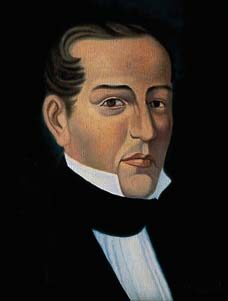
José María Heredia y Heredia
José María Heredia y Heredia was a Cuban poet. Born December 31, 1803, in Santiago de Cuba. Died May 7, 1839, in Mexico City.
Facts
22 facts · 2 confirmed by two sources · 14 cited · 5 from one source · 1 where the sources disagree
What’s different
- Died in: we show Mexico City (Sources disagree). Wikidata also lists Toluca de Lerdo
Where this comes from
Papalocal keeps its own record. It started from these sources; what each one said is kept here as it was copied, so a change on their side never changes this page by itself. Tap one to read its version.
What Wikidata says · copied November 18, 2026 · revision 2567870632
- Described as
- Cuban poet (1803–1839)
- Other names
- José María de Heredia, Jose Maria Heredia y Heredia, Jose Maria de Heredia
- Born
- December 31, 1803 · 4 references
- Died
- May 7, 1839 · 3 references
- Born in
- Santiago de Cuba · 1 reference
- Died in
- Toluca de Lerdo; Mexico City · 1 reference
- Cause of death
- tuberculosis
- Citizen of
- Kingdom of Spain; Mexico; New Spain
- Occupation
- poet · 1 reference; writer · 1 reference; literary critic · 1 reference; translator · 2 references; jurist · 1 reference; journalist · 1 reference; historian · 1 reference; playwright · 1 reference
- Worked for
- Antonio López de Santa Anna · 1 reference; Instituto Literario de Toluca (1833–) · 1 reference
- Field
- poetry · 1 reference; literary criticism · 1 reference
- Father
- José Francisco Heredia · 1 reference
- Lived in
- Cuba
- Wikipedias with a page
- 22
Wikidata item Q609805 (wikidata.org/wiki/Q609805), public domain (CC0). Copied November 18, 2026.
What Wikipedia says · copied November 18, 2026 · revision 1377194035
José María Heredia y Heredia, also known as José María Heredia y Campuzano (December 31, 1803 – May 7, 1839) was a Cuban-born poet considered by many to be the first romantic poet of the Americas and the initiator of Latin American romanticism. More recently, this view has been qualified, highlighting Heredia's roots in Neoclassicism and the aesthetics of eighteenth-century Sensibility. He is known as "El Cantor del Niagara" and regarded as one of the most important poets in the Spanish language. He has also been named National Poet of Cuba.
Heredia studied at the University of Havana, and received a law degree in 1823. In the autumn of 1823 he was arrested on a charge of conspiracy against the Spanish government for participating in pro-independence activities against the Spanish authorities, and was sentenced to banishment for life. To avoid the sentence, Heredia fled to the United States and spent two years in New York City when he was 19. He then took refuge in Mexico in 1825.
For a few months he was one of the editors of the literary magazine El Iris.
He became naturalized as a citizen of Mexico and obtained a post as magistrate.
Many of his earlier pieces are merely clever translations from French, English and Italian; but his originality is placed beyond doubt by such poems as the Himno del desterrado, the epistle to Emilia, Desengaños, and the celebrated ode to Niágara. One of his most celebrated poems was called "En El Teocalli de Cholula," which explores the universality of nature and immense beauty of indigenous ruins. In common with a number of Spanish and Latin American Romantics, his intellectual formation was in Neoclassicism, and indeed his poetry is notable for its perfection of form as well as (often) the sincerity and depth of his feelings. Heredia published a first edition of his poems (Poesías) during his stay in New York, in 1825, to great acclaim both in the Americas and in Western Europe. Andrés Bello (from his exile in London) and Alberto Lista (from Spain) acknowledged the precociousness of Heredia, praising the originality and freshness of his poetry. A significantly expanded second collection, that included revised versions of many of the poems found in the earlier edition, saw the light in Toluca in 1832, also published by Heredia himself. In 1836 he obtained permission to visit Cuba for two months to reunite with his mother. Disappointed in his political ambitions, and broken in health, Heredia returned to Mexico in January 1837, and died in Mexico City on 7 May 1839.
- Born, in its opening lines
- December 31, 1803
- Died, in its opening lines
- May 7, 1839
From the Wikipedia article “José María Heredia y Heredia” (en.wikipedia.org/wiki/José_María_Heredia_y_Heredia), by its contributors, under CC BY-SA 4.0 (creativecommons.org/licenses/by-sa/4.0/). Copied November 18, 2026; not changed.
Confirmed Two sources agree. Cited One source, and it names where it got it. One source One source, without a reference of its own. Sources disagree The sources disagree. We show the best-supported value and keep theirs below.
