
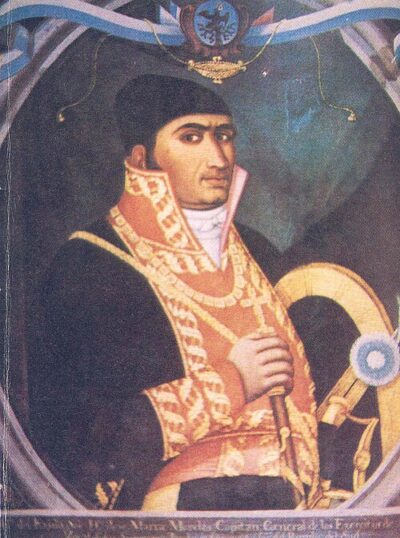
José María Morelos
José María Morelos was a Mexican priest and rebel leader Me War in the notice Independence. Born September 30, 1765, in Morelia. Died December 22, 1815, in Ecatepec de Morelos. Educated at Universidad Michoacana de San Nicolás de Hidalgo.
Facts
14 facts · 2 confirmed by two sources · 4 cited · 8 from one source
Where this comes from
Papalocal keeps its own record. It started from these sources; what each one said is kept here as it was copied, so a change on their side never changes this page by itself. Tap one to read its version.
What Wikidata says · copied November 16, 2026 · revision 2567367971
- Described as
- Mexican priest and rebel leader Me War in the notice Independence (1765–1815)
- Other names
- José María Teclo Morelos Pavón y Pérez, José María Morelos y Pavón
- Born
- September 30, 1765 · 6 references
- Died
- December 22, 1815 · 6 references
- Born in
- Morelia · 1 reference
- Died in
- Ecatepec de Morelos
- Buried in
- Mexico City
- Cause of death
- gunshot wound
- Occupation
- Catholic priest · 1 reference; military personnel; politician · 1 reference; freedom fighter · 1 reference
- Education
- Universidad Michoacana de San Nicolás de Hidalgo · 1 reference
- Children
- Juan Almonte
- Religion
- Catholicism
- Military rank
- generalissimo
- Wikipedias with a page
- 45
Wikidata item Q378420 (wikidata.org/wiki/Q378420), public domain (CC0). Copied November 16, 2026.
What Wikipedia says · copied November 16, 2026 · revision 1384006758
José María Teclo Morelos Pérez y Pavón (Spanish: [xosemaˈɾi.a ˈteklo moˈɾelos ˈpeɾes i paˈβon] ; 30 September 1765 – 22 December 1815) was a Mexican Catholic priest, statesman, and military leader who led the Mexican War of Independence movement, assuming its leadership after the execution of Miguel Hidalgo y Costilla in 1811.
Born in Valladolid, Michoacán, Morelos studied at Colegio de San Nicolás and was appointed priest of Carácuaro in 1799. He joined Miguel Hidalgo's Cry of Dolores, soon becoming an insurgency leader. Aided by local peoples, along with revolutionary leaders Mariano Matamoros and Ignacio López Rayón, Morelos occupied territories in southern and central New Spain, leading the Siege of Cuautla and capturing Acapulco, New Spain's main port in the Pacific Ocean. His campaigns galvanized regional insurgencies against Spanish rule, which made him the royalist army's main rival.
In 1813, Morelos wrote Sentimientos de la Nación, a document influenced by the Constitution of Cádiz where he outlined his program for the Mexican nation. Under his leadership, the Congress of Anáhuac was installed in Chilpancingo, and on 6 November 1813 declared the independence of Mexico. On 22 October 1814, the Constitution of Apatzingán drafted by Congress declared that Mexico would be a Republic.
After a series of defeats, Morelos was captured by the royalist army in Temalaca, Puebla. He was tried by the Inquisition, defrocked as a cleric, and executed by civil authorities in San Cristóbal Ecatepec on 22 December 1815. Morelos is considered a national hero in Mexico, who despite not having a military background became a successful insurgency leader, credited with organizing and bolstering the War of Independence. The Mexican state of Morelos and city of Morelia are named after him.
- Born, in its opening lines
- September 30, 1765
- Died, in its opening lines
- December 22, 1815
From the Wikipedia article “José María Morelos” (en.wikipedia.org/wiki/José_María_Morelos), by its contributors, under CC BY-SA 4.0 (creativecommons.org/licenses/by-sa/4.0/). Copied November 16, 2026; not changed.
Confirmed Two sources agree. Cited One source, and it names where it got it. One source One source, without a reference of its own. Sources disagree The sources disagree. We show the best-supported value and keep theirs below.
