
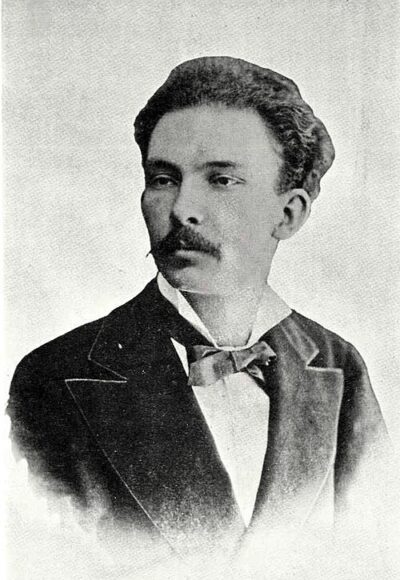
José Martí
José Martí was a Cuban poet, philosopher and nationalist. Born January 28, 1853, in Havana. Died May 19, 1895, in Dos Rios, Cuba. Positions held include consul (1887–1892). Known for Ismaelillo, Simple verses and Nuestra América. Educated at University of Zaragoza.
Facts
27 facts · 2 confirmed by two sources · 8 cited · 17 from one source
Where this comes from
Papalocal keeps its own record. It started from these sources; what each one said is kept here as it was copied, so a change on their side never changes this page by itself. Tap one to read its version.
What Wikidata says · copied November 16, 2026 · revision 2569011366
- Described as
- Cuban poet, philosopher and nationalist (1853-1895)
- Other names
- Jose Marianela
- Born
- January 28, 1853 · 13 references
- Died
- May 19, 1895 · 13 references
- Born in
- Havana · 2 references
- Died in
- Dos Rios, Cuba
- Buried in
- Santa Ifigenia Cemetery · 1 reference
- Citizen of
- Spain; Mexico
- Occupation
- linguist; poet · 3 references; writer · 2 references; translator · 1 reference; military personnel; politician · 1 reference; essayist · 1 reference; journalist · 1 reference
- Positions held
- consul (1887–1892)
- Political party
- Cuban Revolutionary Party – Authentic
- Education
- University of Zaragoza
- Genre
- theatre; essay
- Known for
- Ismaelillo; Simple verses; Nuestra América
- Spouse
- María del Carmen de Zayas-Bazán e Hidalgo
- Children
- José Francisco Martí Zayas Bazán
- Mother
- Leonor Pérez Cabrera
- Military rank
- major general
- Wikipedias with a page
- 99
Wikidata item Q103285 (wikidata.org/wiki/Q103285), public domain (CC0). Copied November 16, 2026.
What Wikipedia says · copied November 16, 2026 · revision 1383529743
José Julián Martí Pérez (Spanish: [xoˈse maɾˈti]; 28 January 1853 – 19 May 1895) was a Cuban nationalist, poet, philosopher, essayist, journalist, translator, professor, and publisher, who is considered a Cuban national hero because of his role in the liberation of his country from Spain. He was also an important figure in Latin American literature. He was a political activist and is considered an important philosopher and political theorist. Through his writings and political activity, he became a symbol of Cuba's bid for independence from the Spanish Empire in the 19th century and is referred to as the "Apostle of Cuban Independence". From adolescence on, he dedicated his life to the promotion of liberty, political independence for Cuba, and intellectual independence for all Spanish Americans; his death was used as a cry for Cuban independence from Spain by both the Cuban revolutionaries and those Cubans previously reluctant to start a revolt.
Born in Havana, Spanish Empire, Martí began his political activism at an early age. He traveled extensively in Spain, Latin America, and the United States, raising awareness and support for the cause of Cuban independence. His unification of the Cuban émigré community, particularly in Florida, was crucial to the success of the Cuban War of Independence against Spain. He was a key figure in the planning and execution of this war, as well as the designer of the Cuban Revolutionary Party and its ideology. He died in military action during the Battle of Dos Ríos on 19 May 1895. Martí is considered one of the great turn-of-the-century Latin American intellectuals. His written works include a series of poems, essays, letters, lectures, a novel, and a children's magazine.
He wrote for numerous Latin American and American newspapers; he also founded a number of newspapers. One of those newspapers, Patria, was an important instrument in his campaign for Cuban independence. After his death, many of his verses from the book Versos Sencillos (Simple Verses) were adapted to the patriotic song "Guantanamera", which has become a prominent representative song of Cuba. The concepts of freedom, liberty and democracy are prominent themes in all of his works, which were influential on Nicaraguan poet Rubén Darío and Chilean poet Gabriela Mistral. Especially following the 1959 Cuban Revolution, Martí's ideology became a major rhetorical motif in Cuban politics. He is also regarded as Cuba's "martyr".
- Born, in its opening lines
- January 28, 1853
- Died, in its opening lines
- May 19, 1895
From the Wikipedia article “José Martí” (en.wikipedia.org/wiki/José_Martí), by its contributors, under CC BY-SA 4.0 (creativecommons.org/licenses/by-sa/4.0/). Copied November 16, 2026; not changed.
Confirmed Two sources agree. Cited One source, and it names where it got it. One source One source, without a reference of its own. Sources disagree The sources disagree. We show the best-supported value and keep theirs below.
