
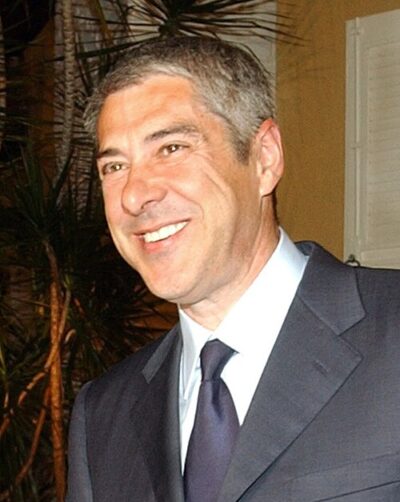
José Sócrates
José Sócrates is a Prime Minister of Portugal from 2005 to 2011. Born September 6, 1957, in Vilar de Maçada. Positions held include Prime Minister of Portugal (2005–2011), President-in-Office of the European Council (2007) and Minister of the Environment (1999–2002). Educated at Polytechnic Institute of Coimbra and Lusíada University. Awards include Grand Cross of the Order of Prince Henry, Order of the White Star, 1st Class and Knight Grand Cross of the Order of St. Gregory the Great.
Facts
24 facts · 1 confirmed by two sources · 3 cited · 20 from one source
Where this comes from
Papalocal keeps its own record. It started from these sources; what each one said is kept here as it was copied, so a change on their side never changes this page by itself. Tap one to read its version.
What Wikidata says · copied November 16, 2026 · revision 2563032802
- Described as
- Prime Minister of Portugal from 2005 to 2011
- Other names
- José Sócrates Carvalho Pinto de Sousa, Jose Socrates, Jose Socrates Carvalho Pinto de Sousa
- Born
- September 6, 1957 · 4 references
- Born in
- Vilar de Maçada · 2 references
- Citizen of
- Portugal
- Occupation
- politician · 1 reference
- Positions held
- Prime Minister of Portugal (2005–2011); President-in-Office of the European Council (2007); Minister of the Environment (1999–2002); Minister of Social Infrastructure (2002); General Secretary of the Socialist Party (Portugal) (2004–2011); member of the Assembly of the Republic (1987–1991) · 1 reference
- Political party
- Socialist Party
- Education
- Polytechnic Institute of Coimbra; Lusíada University; Polytechnic University of Lisbon; Independente University; ISCTE – Lisbon University Institute
- Awards
- Grand Cross of the Order of Prince Henry (2001) · 1 reference; Order of the White Star, 1st Class (2006); Knight Grand Cross of the Order of St. Gregory the Great (2010); Grand Cordon of the Order of the Star of Jordan (2009); Grand Cross of Royal Norwegian Order of Merit (2009); Grand Cross of the Order of Merit (2010); Knight Grand Cross of the Order of Merit (2010); Grand Cross of the Order of the Oak Crown (2010)
- Wikipedias with a page
- 56
Wikidata item Q182367 (wikidata.org/wiki/Q182367), public domain (CC0). Copied November 16, 2026.
What Wikipedia says · copied November 16, 2026 · revision 1379900465
José Sócrates Carvalho Pinto de Sousa (born 6 September 1957), commonly known as José Sócrates (European Portuguese: [ʒuˈzɛ ˈsɔkɾɐtɨʃ]), is a Portuguese politician who was the prime minister of Portugal from 12 March 2005 to 21 June 2011. For the second half of 2007, he acted as president-in-office of the Council of the European Union.
Sócrates grew up in the industrial city of Covilhã. He joined the centre-left Socialist Party in 1981 and was elected as a member of parliament in 1987. Sócrates entered the government in 1995, as secretary of state for Environment in the first cabinet of António Guterres. Two years later, he became Minister of Youth and Sports (where he helped to organize Portugal's successful bid to host UEFA Euro 2004) and in 1999 became Minister for Environment. Sócrates prominence rose during the governments of António Guterres to the point that when the prime minister resigned in 2001, he considered appointing Sócrates as his successor.
In opposition, José Sócrates was elected leader of the Socialist Party in 2004 and led the party to its first absolute majority in the 2005 election. By then, Portugal was experiencing an economic crisis, marked by stagnation and a difficult state of public finances. Like the preceding centre-right government, Sócrates implemented a policy of fiscal austerity and structural reforms. Among the most important reforms were the 2007 Social Security reform and the 2009 labour law reform. His government also restructured the provision of public services, closing thousands of elementary schools and dozens of health care facilities and maternity wards in rural areas and small cities. Despite austerity, Sócrates's government intended to boost economic growth through government-sponsored investments, namely in transportation, technology and energy as well as in health and school infrastructure. The government launched several public–private partnerships to finance such projects. Internally, Sócrates was accused of having an authoritarian style and of trying to control media, while internationally he completed the negotiations of Lisbon Treaty and had close ties with leaders such as the prime minister of Spain José Luis Rodriguez Zapatero and the president of Venezuela Hugo Chavez. The first Sócrates government was initially able to reduce the budget deficit and controlling public debt, but economic growth lagged.
In 2008–09, with the Great Recession starting to hit Portugal and facing recession and high unemployment, austerity was waned as part of the European economic stimulus plan. Nevertheless, support for Sócrates and the Socialists eroded and the ruling party lost its majority in the 2009 election. The second government of José Sócrates faced a deterioration of the economic and financial state of the country, with skyrocketing deficit and growing debt. Austerity was resumed in 2010 while the country entered a hard financial crisis in the context of the European debt crisis.
On 23 March 2011, Sócrates submitted his resignation to President Aníbal Cavaco Silva after the Parliament rejected a new austerity package (the fourth in a year), leading to the 2011 snap election. Financial status of the country deteriorated and on 6 April Sócrates caretaker government requested a bail-out program which was conceded. The €78 billion IMF/European Union bailout to Portugal thus started and would last until May 2014. Sócrates lost the snap election held on 5 June 2011 and resigned as Secretary-General of the Socialist Party. For most of his political career, Sócrates was associated with several corruption cases, notably Independente University and Freeport cases.
On 21 November 2014 he was arrested in Lisbon, accused of corruption, tax evasion, and money laundering, becoming the first former Prime Minister in the history of the country to be thus accused. On 24 November Sócrates was remanded in custody on preliminary charges of corruption and tax fraud. He was held in Évora prison until 4 September 2015 when he left the prison for a relative's house in Lisbon, where he remained under house arrest until 16 October 2015. That day, a judge released him from house arrest, allowing him to await the end of the investigation in freedom, although remaining forbidden from leaving the country or contacting other suspects of the case. The police investigation, known as Operation Marquis continued until his indictment in October 2017. In 2018, Sócrates left the Socialist Party.
- Born, in its opening lines
- September 6, 1957
From the Wikipedia article “José Sócrates” (en.wikipedia.org/wiki/José_Sócrates), by its contributors, under CC BY-SA 4.0 (creativecommons.org/licenses/by-sa/4.0/). Copied November 16, 2026; not changed.
Confirmed Two sources agree. Cited One source, and it names where it got it. One source One source, without a reference of its own. Sources disagree The sources disagree. We show the best-supported value and keep theirs below.
