
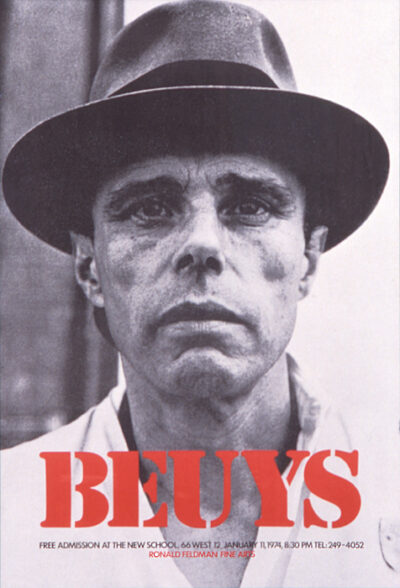
Joseph Beuys
Joseph Beuys was a German artist, teacher, and theorist of art. Born May 12, 1921, in Krefeld. Died January 23, 1986, in Düsseldorf. Known for How to Explain Pictures to a Dead Hare. Educated at Freiherr-vom-Stein-Gymnasium and Kunstakademie Düsseldorf. Awards include Goslarer Kaiserring, Wilhelm Lehmbruck Award and Lichtwark Prize.
Facts
28 facts · 2 confirmed by two sources · 15 cited · 11 from one source
Where this comes from
Papalocal keeps its own record. It started from these sources; what each one said is kept here as it was copied, so a change on their side never changes this page by itself. Tap one to read its version.
What Wikidata says · copied November 16, 2026 · revision 2566146315
- Described as
- German artist, teacher, and theorist of art (1921–1986)
- Other names
- J. Beuys, Jozef Bojs, Iosef Boĭs, Josef Beuys, Joseph Beyus, Beuys, Joseph Heinrich Beuys
- Born
- May 12, 1921 · 18 references
- Died
- January 23, 1986 · 17 references
- Born in
- Krefeld · 4 references
- Died in
- Düsseldorf · 4 references
- Buried in
- North Sea
- Cause of death
- heart failure
- Citizen of
- Germany · 2 references
- Occupation
- sculptor · 3 references; choreographer · 1 reference; painter · 3 references; university teacher · 1 reference; illustrator · 1 reference; photographer · 2 references; conceptual artist · 1 reference; performance artist · 4 references
- Political party
- The Greens; Aktionsgemeinschaft Unabhängiger Deutscher
- Education
- Freiherr-vom-Stein-Gymnasium; Kunstakademie Düsseldorf
- Genre
- conceptual art · 1 reference
- Known for
- How to Explain Pictures to a Dead Hare
- Awards
- Goslarer Kaiserring (1979); Wilhelm Lehmbruck Award (1986); Lichtwark Prize (1976) · 1 reference
- Field
- performance art · 1 reference
- Spouse
- Eva Beuys Wurmbach · 1 reference
- Children
- Wenzel Beuys · 1 reference; Jessyka Beuys · 1 reference
- Wikipedias with a page
- 58
Wikidata item Q153965 (wikidata.org/wiki/Q153965), public domain (CC0). Copied November 16, 2026.
What Wikipedia says · copied November 16, 2026 · revision 1380552964
Joseph Heinrich Beuys ( BOYSS; German: [ˈjoːzɛf ˈbɔʏs]; 12 May 1921 – 23 January 1986) was a German artist, teacher, performance artist, and art theorist whose work reflected concepts of humanism and sociology. With Heinrich Böll, Johannes Stüttgen, Caroline Tisdall, Robert McDowell, and Enrico Wolleb, Beuys created the Free International University for Creativity & Interdisciplinary Research (FIU). Through his talks and performances, he also formed The Party for Animals and The Organisation for Direct Democracy. He was a member of a Dadaist art movement Fluxus and singularly inspirational in developing of Performance Art, called Kunst Aktionen, alongside Wiener Aktionismus that Allan Kaprow and Carolee Schneemann termed Art Happenings.
According to one of his biographers, Reinhard Ermen, he can be seen as the "ideal antagonist" of Andy Warhol.
Beuys was professor at the Kunstakademie Düsseldorf from 1961 until 1972. He was a founding member and life-long supporter of the German Green Party.
- Born, in its opening lines
- May 12, 1921
- Died, in its opening lines
- January 23, 1986
From the Wikipedia article “Joseph Beuys” (en.wikipedia.org/wiki/Joseph_Beuys), by its contributors, under CC BY-SA 4.0 (creativecommons.org/licenses/by-sa/4.0/). Copied November 16, 2026; not changed.
Confirmed Two sources agree. Cited One source, and it names where it got it. One source One source, without a reference of its own. Sources disagree The sources disagree. We show the best-supported value and keep theirs below.
