
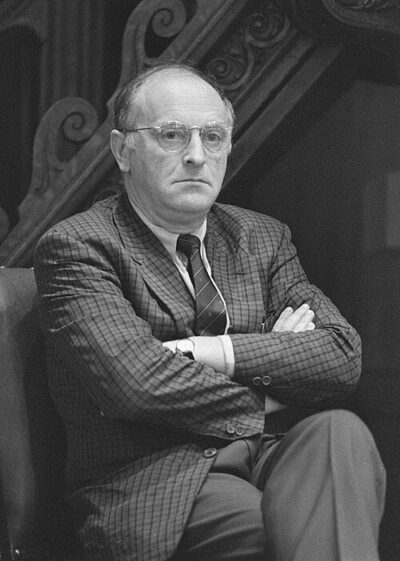
Joseph Brodsky
Joseph Brodsky was a Russian-American poet, essayist, and Nobel laureate. Born May 24, 1940, in Saint Petersburg. Died January 28, 1996, in Brooklyn. Known for Gorbunov and Gorchakov. Educated at Clare Hall and Annenschule. Awards include Nobel Prize in Literature, Guggenheim Fellowship and MacArthur Fellows Program.
Facts
50 facts · 2 confirmed by two sources · 23 cited · 25 from one source
Where this comes from
Papalocal keeps its own record. It started from these sources; what each one said is kept here as it was copied, so a change on their side never changes this page by itself. Tap one to read its version.
What Wikidata says · copied November 13, 2026 · revision 2568622251
- Described as
- Russian-American poet, essayist, and Nobel laureate (1940–1996)
- Other names
- Iosif Aleksandrovich Brodsky, Иосиф Александрович Бродский
- Born
- May 24, 1940 · 9 references
- Died
- January 28, 1996 · 7 references
- Born in
- Saint Petersburg · 1 reference
- Died in
- Brooklyn · 2 references
- Buried in
- Cemetery of San Michele
- Cause of death
- myocardial infarction
- Name at birth
- Иосиф Александрович Бродский
- Citizen of
- Soviet Union (–1972); United States (1977–) · 1 reference; statelessness (1972–1977) · 1 reference
- Occupation
- poet · 1 reference; translator · 1 reference; essayist; dramaturge; lecturer · 1 reference; writer · 2 references; university teacher · 1 reference; librettist · 1 reference
- Worked for
- Mount Holyoke College · 1 reference; University of Michigan · 1 reference
- Education
- Clare Hall; Annenschule
- Member of
- American Academy of Arts and Letters; American Academy of Arts and Sciences; Bavarian Academy of Fine Arts (1971–)
- Genre
- poetry
- Known for
- Gorbunov and Gorchakov · 1 reference
- Awards
- Nobel Prize in Literature (1987) · 2 references; Guggenheim Fellowship (1977) · 1 reference; MacArthur Fellows Program (1981) · 1 reference; Rome Prize; Knight of the Legion of Honour; honorary citizen of Saint Petersburg; United States Poet Laureate (1991) · 1 reference; Golden Wreath (1991) · 1 reference; honorary doctorate (1993) · 1 reference; National Book Critics Circle Award in Criticism (1986) · 1 reference; honorary degree (1978) · 1 reference
- Field
- lyric poetry · 1 reference; literary activity · 1 reference; belletristic literature · 1 reference; poetry · 1 reference; drama · 1 reference; literary translation · 1 reference
- Spouse
- Maria Sozzani
- Father
- Aleksandr Brodsky
- Religion
- cultural Christian; nominal Christian
- Lived in
- South Hadley (1981–1996); Saint Petersburg
- Wikipedias with a page
- 126
Wikidata item Q862 (wikidata.org/wiki/Q862), public domain (CC0). Copied November 13, 2026.
What Wikipedia says · copied November 13, 2026 · revision 1384155432
Iosif Aleksandrovich Brodsky (24 May 1940 – 28 January 1996), anglicized as Joseph, was a Russian and American poet and essayist.
Born in Leningrad (now Saint Petersburg) in the Soviet Union, Brodsky ran afoul of Soviet authorities and was expelled ("strongly advised" to emigrate) from the Soviet Union in 1972, settling in the United States with the help of W. H. Auden and other supporters. He taught thereafter at Mount Holyoke College, and at universities including Yale, Columbia, Cambridge, and Michigan. Brodsky was awarded the 1987 Nobel Prize in Literature "for an all-embracing authorship, imbued with clarity of thought and poetic intensity". He was appointed United States Poet Laureate in 1991.
According to Professor Andrey Ranchin of Moscow State University, "Brodsky is the only modern Russian poet whose body of work has already been awarded the honorary title of a canonized classic... Brodsky's literary canonization is an exceptional phenomenon. No other contemporary Russian writer has been honored as the hero of such a number of memoir texts; no other has had so many conferences devoted to them." Daniel Murphy, in his seminal text Christianity and Modern European Literature, includes Brodsky among the most influential Christian poets of the 20th century, along with T. S. Eliot, Osip Mandelstam, Anna Akhmatova (Brodsky's mentor for a time), and W. H. Auden (who sponsored Brodsky's cause in the United States). Irene Steckler was the first to categorically state that Brodsky was "unquestionably a Christian poet". Before that, in July 1972, following his exile, Brodsky himself, in an interview, said: "While I am related to the Old Testament perhaps by ancestry, and certainly the spirit of justice, I consider myself a Christian. Not a good one but I try to be." The contemporary Russian poet and fellow-Acmeist, Viktor Krivulin, said that "Brodsky always felt his Jewishness as a religious thing, despite the fact that, when all is said and done, he's a Christian poet."
- Born, in its opening lines
- May 24, 1940
- Died, in its opening lines
- January 28, 1996
From the Wikipedia article “Joseph Brodsky” (en.wikipedia.org/wiki/Joseph_Brodsky), by its contributors, under CC BY-SA 4.0 (creativecommons.org/licenses/by-sa/4.0/). Copied November 13, 2026; not changed.
Confirmed Two sources agree. Cited One source, and it names where it got it. One source One source, without a reference of its own. Sources disagree The sources disagree. We show the best-supported value and keep theirs below.
