
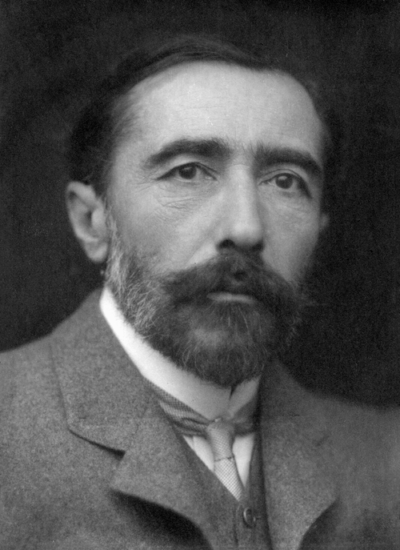
Joseph Conrad
Joseph Conrad was a Polish-British writer. Born December 3, 1857, in Terekhove. Died August 3, 1924, in Bishopsbourne. Known for The Lagoon, The Nigger of the 'Narcissus' and Heart of Darkness. Educated at Bartłomiej Nowodworski High School.
Facts
35 facts · 2 confirmed by two sources · 8 cited · 25 from one source
Where this comes from
Papalocal keeps its own record. It started from these sources; what each one said is kept here as it was copied, so a change on their side never changes this page by itself. Tap one to read its version.
What Wikidata says · copied November 16, 2026 · revision 2569062157
- Described as
- Polish-British writer (1857–1924)
- Other names
- Józef Teodor Nałęcz Konrad Korzeniowski, Jozef Teodor Konrad Korzeniowski, Józef Teodor Konrad Korzeniowski
- Born
- December 3, 1857 · 16 references
- Died
- August 3, 1924 · 17 references
- Born in
- Terekhove · 3 references
- Died in
- Bishopsbourne · 2 references
- Buried in
- Canterbury City Cemetery · 1 reference
- Cause of death
- myocardial infarction · 1 reference
- Name at birth
- Józef Teodor Konrad Korzeniowski
- Citizen of
- Russian Empire; United Kingdom of Great Britain and Ireland; United Kingdom (1886–) · 3 references; Second Polish Republic
- Occupation
- writer · 4 references; novelist; essayist; screenwriter; science fiction writer; autobiographer · 1 reference; slave driver
- Education
- Bartłomiej Nowodworski High School
- Genre
- novella · 1 reference
- Known for
- The Lagoon; The Nigger of the 'Narcissus'; Heart of Darkness; Lord Jim; Amy Foster; Typhoon; Nostromo; The Secret Agent; The Secret Sharer; Under Western Eyes
- Field
- fiction · 1 reference
- Spouse
- Jessie George (1896–) · 2 references
- Father
- Apollo Korzeniowski · 1 reference
- Mother
- Ewa Korzeniewska
- Religion
- atheism
- Wikipedias with a page
- 132
Wikidata item Q82925 (wikidata.org/wiki/Q82925), public domain (CC0). Copied November 16, 2026.
What Wikipedia says · copied November 16, 2026 · revision 1383131678
Joseph Conrad (born Józef Teodor Konrad Korzeniowski, Polish: [ˈjuzɛf tɛˈɔdɔr ˈkɔnrat kɔʐɛˈɲɔfskʲi] ; 3 December 1857 – 3 August 1924) was a Polish-British novelist and story writer. He is regarded as one of the greatest writers in the English language and – though he did not speak English fluently until his twenties (always with a strong foreign accent) – he became a master prose stylist who brought a non-English sensibility into English literature.
He wrote novels and stories, many in nautical settings, that depicted crises of human individuality in the midst of what he saw as an indifferent, inscrutable, and amoral world. Conrad is considered a literary impressionist by some and an early modernist by others, though his works also contain elements of 19th-century realism. His narrative style and anti-heroic characters, as in Lord Jim, have influenced numerous authors. Many dramatic films have been adapted from and inspired by his works.
Numerous writers and critics have commented that his fictional works, written mostly in the first two decades of the 20th century, seem to have anticipated later world events. Writing near the peak of the British Empire, Conrad drew on the national experiences of his native Poland—during nearly all his life, parcelled out among three occupying empires—and on his own experiences in the French and British merchant navies, to create short stories and novels that reflect aspects of a European-dominated world—including imperialism and colonialism—and that profoundly explore the human psyche.
- Born, in its opening lines
- December 3, 1857
- Died, in its opening lines
- August 3, 1924
From the Wikipedia article “Joseph Conrad” (en.wikipedia.org/wiki/Joseph_Conrad), by its contributors, under CC BY-SA 4.0 (creativecommons.org/licenses/by-sa/4.0/). Copied November 16, 2026; not changed.
Confirmed Two sources agree. Cited One source, and it names where it got it. One source One source, without a reference of its own. Sources disagree The sources disagree. We show the best-supported value and keep theirs below.
