
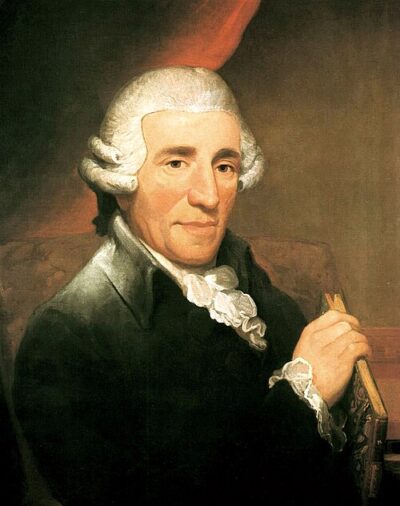
Joseph Haydn
Joseph Haydn was an Austrian composer. Born March 31, 1732, in Rohrau. Died May 31, 1809, in Vienna. Positions held include chapelmaster. Known for Symphony No. 100, Symphony No. 101 and Deutschlandlied. Awards include honorary citizen of Vienna.
Facts
31 facts · 2 confirmed by two sources · 7 cited · 22 from one source
Where this comes from
Papalocal keeps its own record. It started from these sources; what each one said is kept here as it was copied, so a change on their side never changes this page by itself. Tap one to read its version.
What Wikidata says · copied November 16, 2026 · revision 2570042571
- Described as
- Austrian composer (1732–1809)
- Other names
- Franciscus Joseph Haydn, Franciscus Josephus Haydn, Franz Joseph Haydn, Haydn
- Born
- March 31, 1732 · 18 references
- Died
- May 31, 1809 · 18 references
- Born in
- Rohrau · 7 references
- Died in
- Vienna · 5 references
- Buried in
- Bergkirche
- Citizen of
- Archduchy of Austria · 1 reference; Holy Roman Empire
- Occupation
- composer · 2 references; conductor; musicologist; pianist; independent publisher · 1 reference
- Positions held
- chapelmaster
- Member of
- Académie des beaux-arts
- Genre
- classical music · 1 reference
- Instrument
- organ; piano
- Known for
- Symphony No. 100; Symphony No. 101; Deutschlandlied
- Awards
- honorary citizen of Vienna (1804)
- Field
- performing arts; classical music; Classical period; opera; string quartet; sonata
- Spouse
- Anna Haydn
- Father
- Mathias Haydn
- Siblings
- Michael Haydn · 1 reference; Johann Evangelist Haydn · 1 reference
- Wikipedias with a page
- 159
Wikidata item Q7349 (wikidata.org/wiki/Q7349), public domain (CC0). Copied November 16, 2026.
What Wikipedia says · copied November 16, 2026 · revision 1383473780
Franz Joseph Haydn ( HY-dən; German: [ˈfʁants ˈjoːzɛf ˈhaɪdn̩] ; 31 March 1732 – 31 May 1809) was an Austrian composer of the Classical period. He was pivotal in the evolution of chamber music forms such as the string quartet and piano trio. His contributions to musical form have led him to be called "Father of the Symphony", "Father of the String quartet" and "Father of Sonata Form".
Haydn rose from humble origins as the child of working people in a rural village. He established his career firstly by serving as a chorister at St. Stephen's Cathedral, Vienna, then through an arduous period as a freelance musician. Eventually he found career success, spending much of his working life as music director for the wealthy Esterházy family at their palace of Eszterháza in rural Hungary. Though he had his own orchestra there, it isolated him from other composers and trends in music so that he was, as he put it, "forced to become original". During this period his music circulated widely in publication, eventually making him the most celebrated composer in Europe. Notable works include the Paris and London symphonies. With the death of his patron Nikolaus Esterházy in 1790, Haydn became free to travel, and augmented his fame as a performer before the public in both London and Vienna. Late in life, he composed the oratorios The Creation (1798) and The Seasons (1801). The last years of his life (1803–1809) were spent in a state of debility, unable to compose due to poor health. He died in Vienna in 1809 at the age of 77.
Harold C. Schonberg writes that Haydn "was the Classic performer par excellence, and in his long life, from 1732 to 1809, he grew up with the new musical ideas and, more than any one man, shaped them." He was the elder brother of composer Michael Haydn, a friend and mentor of Mozart, and a teacher of Beethoven. Haydn, Mozart and Beethoven are sometimes referred to as the "First Viennese School".
- Born, in its opening lines
- March 31, 1732
- Died, in its opening lines
- May 31, 1809
From the Wikipedia article “Joseph Haydn” (en.wikipedia.org/wiki/Joseph_Haydn), by its contributors, under CC BY-SA 4.0 (creativecommons.org/licenses/by-sa/4.0/). Copied November 16, 2026; not changed.
Confirmed Two sources agree. Cited One source, and it names where it got it. One source One source, without a reference of its own. Sources disagree The sources disagree. We show the best-supported value and keep theirs below.
