
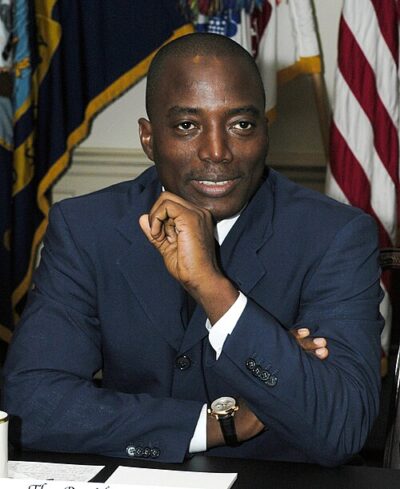
Joseph Kabila
Joseph Kabila is a President of the DR Congo from 2001 to 2019. Born June 4, 1971, in Hewa Bora. Positions held include President of the Democratic Republic of the Congo (2001–2019). Educated at Makerere University and Washington International University. Awards include Order of the Republic of Serbia and National Order of the Leopard.
Facts
21 facts · 1 confirmed by two sources · 5 cited · 15 from one source
Where this comes from
Papalocal keeps its own record. It started from these sources; what each one said is kept here as it was copied, so a change on their side never changes this page by itself. Tap one to read its version.
What Wikidata says · copied November 16, 2026 · revision 2567120276
- Described as
- President of the DR Congo from 2001 to 2019
- Other names
- Joseph Kabila Kabange, Kabila Kabange Joseph
- Born
- June 4, 1971 · 4 references
- Born in
- Hewa Bora · 1 reference
- Citizen of
- Democratic Republic of the Congo
- Occupation
- politician · 1 reference; military personnel · 1 reference
- Positions held
- President of the Democratic Republic of the Congo (2001–2019) · 2 references
- Political party
- People's Party for Reconstruction and Democracy
- Education
- Makerere University; Washington International University · 1 reference; PLA National Defence University; University of Johannesburg · 1 reference
- Awards
- Order of the Republic of Serbia; National Order of the Leopard
- Spouse
- Olive Lembe di Sita
- Father
- Laurent-Désiré Kabila
- Siblings
- Zoé Kabila; Jaynet Kabila · 1 reference; Aimée Kabila Mulengela; Gloria Mteyu · 1 reference
- Religion
- Anglicanism
- Military rank
- major general · 1 reference
- Wikipedias with a page
- 82
Wikidata item Q57416 (wikidata.org/wiki/Q57416), public domain (CC0). Copied November 16, 2026.
What Wikipedia says · copied November 16, 2026 · revision 1385934861
Joseph Kabila Kabange ( kab-EE-lə, French: [ʒozɛf kabila]; born 4 June 1971) is a Congolese politician and former military officer who was the fourth president of the Democratic Republic of the Congo from 2001 to 2019. He took office ten days after the assassination of his father, President Laurent-Désiré Kabila, in the context of the Second Congo War. He was allowed to remain in power as the president of the new transitional government after the 2002 peace agreements ended the war. Kabila founded the People's Party for Reconstruction and Democracy (PPRD) and was elected president in 2006. He was re-elected for a second term in 2011. Since stepping down after the 2018 election, Kabila, as a former president, is a senator for life. Kabila was the country's second-longest serving president.
Kabila was born in a village in the present-day South Kivu province of the DRC. His father, Laurent-Désiré Kabila, lived in isolation while leading a dissident movement against the dictator Mobutu Sese Seko. The younger Kabila later received education and military training in Tanzania and Uganda. He studied at Makerere University before the First Congo War broke out in 1996. His father was a founding member of the AFDL movement to overthrow Mobutu with the backing of Rwanda and Uganda. Joseph Kabila participated in the war, which ended with his father becoming the president, and afterwards studied at the PLA National Defense University in China. He was appointed as the deputy chief of staff of the Congolese Armed Forces in 1997, and was briefly the chief of staff in 1998, at the outbreak of the Second Congo War. In 1999, he became the chief of staff of the Land Forces.
After his father's assassination, Kabila succeeded him as the president, and restarted the peace process that had previously stalled. He is credited with ending the Second Congo War and restoring stability to most of the country, though conflict continued in the east against rebel forces supported by neighboring Rwanda and Uganda. He helped organize electoral institutions and presided over the DRC's first free multi-party election in decades. After that Kabila led an increasingly authoritarian government, and his re-election in 2011 was marred with accusations of fraud. During his tenure, he encouraged foreign investment in the mining industry and improved the infrastructure. The size of the country's economy increased by five times. However, the growth was highly unequal, and the majority of the population still lived below the international poverty line by the time he left office. The Kabila administration became known for cronyism, corruption, and human rights violations, including security forces killing protestors. The DRC consistently scored low in the Corruption Perceptions Index and The Economist Democracy Index.
The DRC experienced a political crisis during the last years of Kabila's second term. His constitutional mandate was due to expire in 2016, according to the 2006 constitution. Officials suggested that an election would be held in that year, but it was delayed until early 2018. Kabila's popularity declined and he also faced growing pressure from the international community to give up power. An agreement was reached after mediation by the Catholic hierarchy to appoint a new government and prepare to hold elections, but they were delayed again. In August 2018, Kabila announced that he would step down and not seek a third term in the upcoming election that December. In January 2019, Kabila was succeeded by Félix Tshisekedi in the country's first peaceful transition of power. Independent observers concluded that Tshisikedi lost heavily to another candidate, Martin Fayulu, and that Kabila had fixed the official result for the candidate most likely to be helpful to him.
He remained influential in the DRC's politics after he left office. Kabila's political alliance, the Common Front for Congo, initially held the majority of seats in the parliament, and formed a coalition government in August 2019 with Tshisekedi's Heading for Change alliance after months of negotiations. Tshisekedi ended the coalition in 2020 over the blocking of his agenda. In 2021 he removed the last of Kabila's allies from the government, and in 2023 Kabila went into self-imposed exile abroad. Tshisekedi accused him of supporting the resurgent campaign of the Rwandan-backed M23 movement in 2025, which he denied. A Congolese military court tried Kabila in absentia for treason and sentenced him to death. In 2026, Kabila was sanctioned by the United States, and later that year became the leader of the FRN, a rebel coalition that includes M23.
- Born, in its opening lines
- June 4, 1971
From the Wikipedia article “Joseph Kabila” (en.wikipedia.org/wiki/Joseph_Kabila), by its contributors, under CC BY-SA 4.0 (creativecommons.org/licenses/by-sa/4.0/). Copied November 16, 2026; not changed.
Confirmed Two sources agree. Cited One source, and it names where it got it. One source One source, without a reference of its own. Sources disagree The sources disagree. We show the best-supported value and keep theirs below.
