
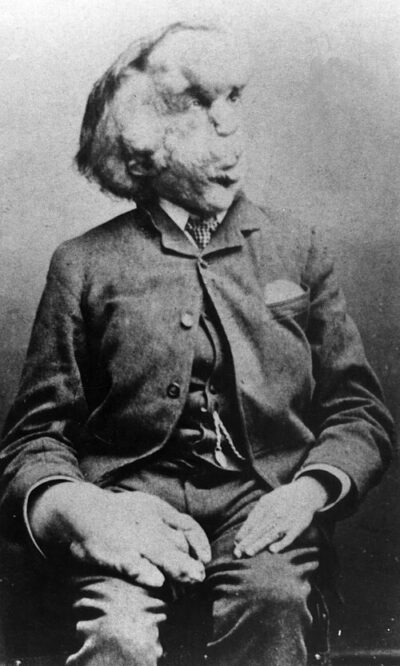
Joseph Merrick
Joseph Merrick was a British man with severe deformities known as the Elephant Man. Born August 5, 1862, in Leicester. Died April 11, 1890, in Whitechapel.
Facts
8 facts · 2 confirmed by two sources · 1 cited · 5 from one source
Where this comes from
Papalocal keeps its own record. It started from these sources; what each one said is kept here as it was copied, so a change on their side never changes this page by itself. Tap one to read its version.
What Wikidata says · copied November 16, 2026 · revision 2563860058
- Described as
- British man with severe deformities known as the Elephant Man
- Other names
- John Merrick, Elephant Man, Joseph Carey Merrick
- Born
- August 5, 1862 · 4 references
- Died
- April 11, 1890 · 4 references
- Born in
- Leicester
- Died in
- Whitechapel
- Buried in
- City of London Cemetery and Crematorium (1890–) · 1 reference
- Name at birth
- Joseph Carey Merrick
- Citizen of
- United Kingdom of Great Britain and Ireland
- Occupation
- artist
- Wikipedias with a page
- 49
Wikidata item Q215762 (wikidata.org/wiki/Q215762), public domain (CC0). Copied November 16, 2026.
What Wikipedia says · copied November 16, 2026 · revision 1384188942
Joseph Carey Merrick (5 August 1862 – 11 April 1890), sometimes erroneously referred to as John Merrick, was an English man known for his severe physical deformities. He was first exhibited at a freak show under the stage name "The Elephant Man", and then went to live at the London Hospital, in Whitechapel, after meeting the surgeon Sir Frederick Treves. Despite his challenges, Merrick created detailed artistic works, such as intricate models of buildings, and became well known in London society.
Merrick was born in Leicester and began to develop abnormally before the age of five. His mother died when he was eleven, and his father soon remarried. Rejected by his father and stepmother, he left home and went to live with his uncle, Charles Merrick. In 1879, 17-year-old Merrick entered the Leicester Union Workhouse. In 1884, he contacted a showman named Sam Torr and proposed that he might be exhibited. Torr arranged for a group of men to manage Merrick, whom they named "the Elephant Man". After touring the East Midlands, Merrick travelled to London to be exhibited in a penny gaff shop rented by showman Tom Norman. The shop was visited by surgeon Frederick Treves, who invited Merrick to be physically examined. Merrick was displayed by Treves at a meeting of the Pathological Society of London in 1884, after which Norman's shop was closed by the police. Merrick then joined Sam Roper's circus and later toured in Europe with an unknown manager.
In Belgium, Merrick was robbed by his road manager and abandoned in Brussels. He eventually made his way back to the London Hospital, where he was allowed to stay for the rest of his life. Treves visited him daily, and the pair developed a close friendship. Merrick also received visits from some of the wealthy ladies and gentlemen of London society, including Alexandra, Princess of Wales.
Merrick died in the hospital on 11 April 1890. Although the official cause of his death was asphyxia, Treves, who performed the postmortem, concluded that Merrick had died of a dislocated neck.
The exact cause of Merrick's deformities is unclear, but in 1986 it was conjectured that he had Proteus syndrome. In a 2003 study, DNA tests on his hair and bones were inconclusive because his skeleton had been bleached numerous times before going on display at the Royal London Hospital. Merrick's life was depicted in a 1977 play by Bernard Pomerance and in a 1980 film by David Lynch, both titled The Elephant Man.
- Born, in its opening lines
- August 5, 1862
- Died, in its opening lines
- April 11, 1890
From the Wikipedia article “Joseph Merrick” (en.wikipedia.org/wiki/Joseph_Merrick), by its contributors, under CC BY-SA 4.0 (creativecommons.org/licenses/by-sa/4.0/). Copied November 16, 2026; not changed.
Confirmed Two sources agree. Cited One source, and it names where it got it. One source One source, without a reference of its own. Sources disagree The sources disagree. We show the best-supported value and keep theirs below.
