
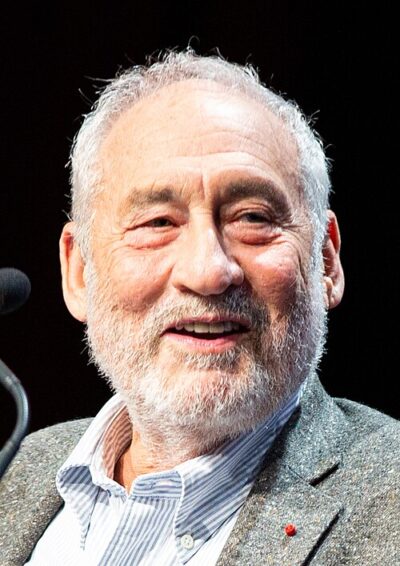
Joseph Stiglitz
Joseph Stiglitz is an American economist, professor, and recipient of the Nobel Memorial Prize in Economics. Born February 9, 1943, in Gary. Positions held include Chief Economist of the World Bank (1997–2000), Chair of the Council of Economic Advisers (1995–1997) and advisory board. Educated at Fitzwilliam College and Amherst College. Awards include Fulbright Scholarship, Guggenheim Fellowship and Fellow of the Econometric Society.
Facts
57 facts · 1 confirmed by two sources · 28 cited · 28 from one source
Where this comes from
Papalocal keeps its own record. It started from these sources; what each one said is kept here as it was copied, so a change on their side never changes this page by itself. Tap one to read its version.
What Wikidata says · copied November 13, 2026 · revision 2566523478
- Described as
- American economist, professor, and recipient of the Nobel Memorial Prize in Economics
- Other names
- Joseph E. Stiglitz, Joseph Eugene Stiglitz
- Born
- February 9, 1943 · 5 references
- Born in
- Gary · 2 references
- Name at birth
- Joseph Eugene Stiglitz
- Citizen of
- United States · 3 references
- Occupation
- economist · 2 references; university teacher · 2 references; science writer; non-fiction writer; professor · 3 references; critic; writer · 3 references
- Positions held
- Chief Economist of the World Bank (1997–2000); Chair of the Council of Economic Advisers (1995–1997) · 1 reference; advisory board
- Political party
- Democratic Party
- Worked for
- University of Oxford (1976–1979); Princeton University (1979–1988); University of Manchester; Stanford University; World Bank (1997–2000); Yale University (1970–1974); Columbia University
- Education
- Fitzwilliam College; Amherst College (–1964); Massachusetts Institute of Technology (1966–1967); University of Chicago
- Member of
- Royal Society of London (2009–) · 2 references; National Academy of Sciences (1988–) · 2 references; European Academy of Sciences and Arts · 1 reference; Pontifical Academy of Social Sciences (2003–) · 1 reference; American Academy of Arts and Sciences (1983–) · 1 reference; Russian Academy of Sciences (2003–) · 1 reference; American Philosophical Society (1998–) · 1 reference; Club of Rome; Royal Academy of Economic and Financial Sciences (2012–) · 2 references; Econometric Society (1973–) · 1 reference
- Awards
- Fulbright Scholarship (1967) · 1 reference; Guggenheim Fellowship (1969) · 1 reference; Fellow of the Econometric Society (1973) · 1 reference; John Bates Clark Medal (1979) · 1 reference; H. C. Recktenwald Prize in Economics (1997) · 1 reference; honorary doctor of the Charles University of Prague (2001) · 1 reference; Prize in Economic Sciences in Memory of Alfred Nobel (2001) · 1 reference; Honorary doctor of the Catholic University of Louvain (2003); Manpower-HEC price (2007) · 1 reference; Foreign Member of the Royal Society (2009) · 1 reference; Gerald Loeb Award (2010) · 1 reference; honorary doctor of the Renmin University of China (2006) · 1 reference; Global Economy Prize (2013) · 3 references; honorary doctor of Paris Dauphine University (2013) · 1 reference; Officer of the Legion of Honour (2013) · 1 reference
- Field
- economics; screening
- Spouse
- Anya Schiffrin (2004–)
- Lived in
- Gary; Indiana
- Website
- https://business.columbia.edu/stiglitz
- Wikipedias with a page
- 86
Wikidata item Q18430 (wikidata.org/wiki/Q18430), public domain (CC0). Copied November 13, 2026.
What Wikipedia says · copied November 13, 2026 · revision 1384366638
Joseph Eugene Stiglitz (; born February 9, 1943) is an American New Keynesian economist, a public policy analyst, political activist, and a professor at Columbia University. He is a recipient of the Nobel Memorial Prize in Economic Sciences (2001) and the John Bates Clark Medal (1979). He is a former senior vice president and chief economist of the World Bank. He is also a former member and chairman of the U.S. Council of Economic Advisers. He is known for his support for the Georgism public finance theory and for his critical view of the management of globalization, of laissez-faire economists (whom he calls "free-market fundamentalists"), and of international institutions such as the International Monetary Fund and the World Bank.
In 2000, Stiglitz founded the Initiative for Policy Dialogue (IPD), a think tank on international development based at Columbia University. He has been a member of the Columbia faculty since 2001 and received the university's highest academic rank (university professor) in 2003. He was the founding chair of the university's Committee on Global Thought. He also chairs the University of Manchester's Brooks World Poverty Institute. He was a member of the Pontifical Academy of Social Sciences. In 2009, the President of the United Nations General Assembly Miguel d'Escoto Brockmann, appointed Stiglitz as the chairman of the U.N. Commission on Reforms of the International Monetary and Financial System, where he oversaw suggested proposals and commissioned a report on reforming the international monetary and financial system. He served as the chair of the international Commission on the Measurement of Economic Performance and Social Progress, appointed by the French President Sarkozy, which issued its report in 2010, Mismeasuring our Lives: Why GDP doesn't add up, and currently serves as co-chair of its successor, the High Level Expert Group on the Measurement of Economic Performance and Social Progress. From 2011 to 2014, Stiglitz was the president of the International Economic Association (IEA). He presided over the organization of the IEA triennial world congress held near the Dead Sea in Jordan in June 2014.
In 2011, Stiglitz was named as one of the 100 most influential people in the world by Time magazine. Stiglitz's work focuses on income distribution from a Georgist perspective, asset risk management, corporate governance, and international trade. He is the author of several books, the latest being The Road to Freedom (2024); People, Power, and Profits (2019); The Euro: How a Common Currency Threatens the Future of Europe (2016); The Great Divide: Unequal Societies and What We Can Do About Them (2015); Rewriting the Rules of the American Economy: An Agenda for Growth and Shared Prosperity (2015); and Creating a Learning Society: A New Approach to Growth Development and Social Progress (2014). He is also one of the 25 leading figures on the Information and Democracy Commission launched by Reporters Without Borders. According to the Open Syllabus Project, Stiglitz is the fifth most frequently cited author on college syllabi for economics courses.
- Born, in its opening lines
- February 9, 1943
From the Wikipedia article “Joseph Stiglitz” (en.wikipedia.org/wiki/Joseph_Stiglitz), by its contributors, under CC BY-SA 4.0 (creativecommons.org/licenses/by-sa/4.0/). Copied November 13, 2026; not changed.
Confirmed Two sources agree. Cited One source, and it names where it got it. One source One source, without a reference of its own. Sources disagree The sources disagree. We show the best-supported value and keep theirs below.
