
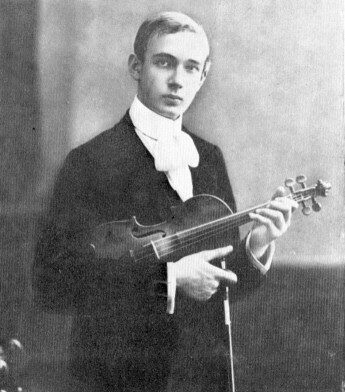
Joseph Szigeti
Joseph Szigeti was a Hungarian born American violinist. Born September 5, 1892, in Budapest. Died February 19, 1973, in Lucerne. Educated at Franz Liszt Academy of Music. Awards include star on Hollywood Walk of Fame.
Facts
15 facts · 2 confirmed by two sources · 7 cited · 6 from one source
What’s different
- Died: we show February 19, 1973 (Confirmed). Wikidata also lists February 20, 1973
Where this comes from
Papalocal keeps its own record. It started from these sources; what each one said is kept here as it was copied, so a change on their side never changes this page by itself. Tap one to read its version.
What Wikidata says · copied November 15, 2026 · revision 2558034321
- Described as
- Hungarian born American violinist (1892-1973)
- Born
- September 5, 1892 · 8 references
- Died
- February 20, 1973 · 1 reference; February 19, 1973 · 2 references
- Born in
- Budapest · 2 references
- Died in
- Lucerne · 2 references
- Buried in
- Cemetery of Clarens · 1 reference
- Citizen of
- Hungary; United States (1951–) · 1 reference
- Occupation
- violinist · 2 references; music educator; actor · 1 reference; musician · 1 reference
- Education
- Franz Liszt Academy of Music
- Genre
- classical music · 1 reference
- Instrument
- violin
- Awards
- star on Hollywood Walk of Fame · 1 reference
- Wikipedias with a page
- 28
Wikidata item Q428042 (wikidata.org/wiki/Q428042), public domain (CC0). Copied November 15, 2026.
What Wikipedia says · copied November 15, 2026 · revision 1365082088
Joseph Szigeti (Hungarian: Szigeti József, [ˈsiɡɛti ˈjoːʒɛf]; 5 September 1892 – 19 February 1973) was a Hungarian violinist.
Born into a musical family, he spent his early childhood in a small town in Transylvania. He quickly proved himself to be a child prodigy on the violin, and moved to Budapest with his father to study with the renowned pedagogue Jenő Hubay. After completing his studies with Hubay in his early teens, Szigeti began his international concert career. His performances at that time were primarily limited to salon-style recitals and the more overtly virtuosic repertoire; however, after making the acquaintance of pianist Ferruccio Busoni, he began to develop a much more thoughtful and intellectual approach to music that eventually earned him the nickname "The Scholarly Virtuoso".
Following a bout of tuberculosis that required a stay in a sanatorium in Switzerland, Szigeti settled in Geneva, where he became Professor of Violin at the local conservatory in 1917. It was in Geneva that he met his future wife, Wanda Ostrowska, and at roughly the same time he became friends with the composer Béla Bartók. Both relationships were to be lifelong.
From the 1920s until 1960, Szigeti performed regularly around the world and recorded extensively. He also distinguished himself as a strong advocate of new music, and was the dedicatee of many new works by contemporary composers. Among the more notable pieces written for him are Ernest Bloch's Violin Concerto, Bartók's Rhapsody No. 1, and Eugène Ysaÿe's Solo Sonata No. 1. After retiring from the concert stage in 1960, he worked at teaching and writing until his death in 1973, at the age of 80.
- Born, in its opening lines
- September 5, 1892
- Died, in its opening lines
- February 19, 1973
From the Wikipedia article “Joseph Szigeti” (en.wikipedia.org/wiki/Joseph_Szigeti), by its contributors, under CC BY-SA 4.0 (creativecommons.org/licenses/by-sa/4.0/). Copied November 15, 2026; not changed.
Confirmed Two sources agree. Cited One source, and it names where it got it. One source One source, without a reference of its own. Sources disagree The sources disagree. We show the best-supported value and keep theirs below.
