
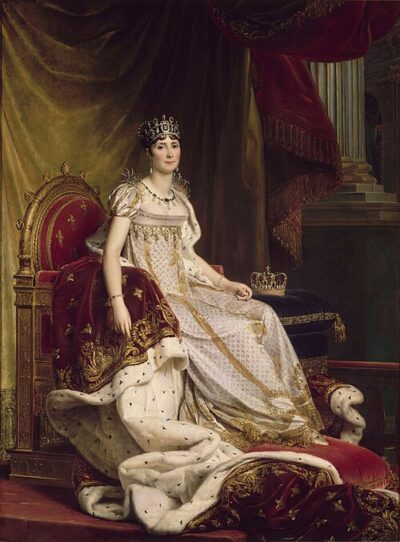
Joséphine de Beauharnais
Joséphine de Beauharnais was an Empress consort of the French from 1804 to 1814. Born June 23, 1763, in Les Trois-Îlets. Died May 29, 1814, in Rueil-Malmaison. Awards include Order of Queen Maria Luisa.
Facts
20 facts · 2 confirmed by two sources · 9 cited · 9 from one source
Where this comes from
Papalocal keeps its own record. It started from these sources; what each one said is kept here as it was copied, so a change on their side never changes this page by itself. Tap one to read its version.
What Wikidata says · copied November 16, 2026 · revision 2559055499
- Described as
- Empress consort of the French from 1804 to 1814 (1763-1814)
- Other names
- Marie-Joseph-Rose Tascher de la Pagerie la perri guis, Marie-Josèphe-Rose Tascher de La Pagerie, Kaiserin Josephine Frankreich, Empress of the French Josephine, keizerin van Frankrijk Joséphine, Empress consort of Napoleon I Josephine, Joséphine Viscountess de Beauharnais, Joséphine Vicomtesse de Beauharnais, Empress, consort of Napoleon I, Emperor of the French Josephine, impératrice des Français Joséphine, Marie-Josephe-Rose Tascher de La Pagerie, Josephine Bonaparte
- Born
- June 23, 1763 · 9 references
- Died
- May 29, 1814 · 9 references
- Born in
- Les Trois-Îlets
- Died in
- Rueil-Malmaison
- Cause of death
- diphtheria
- Name at birth
- Marie-Josèphe-Rose Tascher de La Pagerie · 1 reference
- Citizen of
- France · 2 references
- Occupation
- art collector · 1 reference; draftsperson · 1 reference; artist; patron of the arts · 1 reference
- Member of
- Napoleon I of France and Josephine
- Awards
- Order of Queen Maria Luisa
- Spouse
- Napoleon (1796–1809) · 3 references; Alexandre de Beauharnais (1779–1794) · 2 references
- Children
- Eugène de Beauharnais · 1 reference; Hortense de Beauharnais · 2 references
- Father
- Joseph-Gaspard de Tascher de La Pagerie
- Mother
- Rose Claire des Vergers de Sannois
- Religion
- Catholicism
- Wikipedias with a page
- 76
Wikidata item Q171480 (wikidata.org/wiki/Q171480), public domain (CC0). Copied November 16, 2026.
What Wikipedia says · copied November 16, 2026 · revision 1385268571
Joséphine Bonaparte (French: [ʒozefin bɔnapaʁt], born Marie Josèphe Rose Tascher de La Pagerie; 23 June 1763 – 29 May 1814) was Empress of the French as the first wife of Emperor Napoleon I from 18 May 1804 until their marriage was annulled on 10 January 1810. As Napoleon's consort, she was also Queen of Italy from 26 May 1805 until the 1810 annulment. She is widely known as Joséphine de Beauharnais (French: [ʒozefin də boaʁnɛ]) or Empress Joséphine.
Joséphine's marriage to Napoleon was her second. Her first husband, Alexandre de Beauharnais, was guillotined during the Reign of Terror, and she was imprisoned in the Carmes prison until five days after his execution. Through her children by Beauharnais, she was the grandmother of Emperor Napoleon III of France and Empress Amélie of Brazil. Members of the current royal families of Sweden, Denmark, Belgium, and Norway and the grand ducal family of Luxembourg also descend from her. Because she did not bear Napoleon any children, he had their marriage annulled and married Marie Louise of Austria. Joséphine was the recipient of numerous love letters written by Napoleon, many of which still exist.
A patron of art, Joséphine worked closely with sculptors, painters and interior decorators to establish a unique Consular and empire style at the Château de Malmaison. She became one of the leading collectors of different forms of art of her time, such as sculpture and painting. The Château de Malmaison was noted for its rose garden, which she supervised closely.
- Born, in its opening lines
- June 23, 1763
- Died, in its opening lines
- May 29, 1814
From the Wikipedia article “Joséphine de Beauharnais” (en.wikipedia.org/wiki/Joséphine_de_Beauharnais), by its contributors, under CC BY-SA 4.0 (creativecommons.org/licenses/by-sa/4.0/). Copied November 16, 2026; not changed.
Confirmed Two sources agree. Cited One source, and it names where it got it. One source One source, without a reference of its own. Sources disagree The sources disagree. We show the best-supported value and keep theirs below.
