
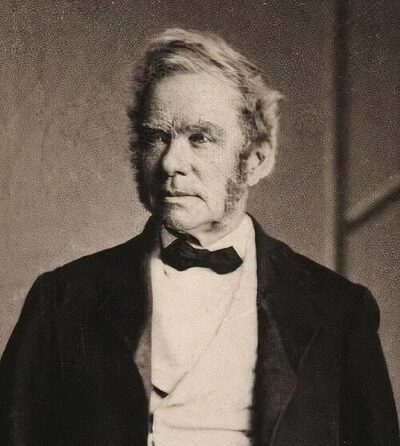
Josiah Warren
Josiah Warren was an American social reformer, philosopher, inventor, musician, and author. Born June 26, 1798, in Boston. Died April 14, 1874, in Boston.
Facts
15 facts · 2 confirmed by two sources · 4 cited · 9 from one source
Where this comes from
Papalocal keeps its own record. It started from these sources; what each one said is kept here as it was copied, so a change on their side never changes this page by itself. Tap one to read its version.
What Wikidata says · copied November 15, 2026 · revision 2513574322
- Described as
- American social reformer, philosopher, inventor, musician, and author (1798–1874)
- Other names
- Warren
- Born
- June 26, 1798 · 1 reference
- Died
- April 14, 1874 · 2 references
- Born in
- Boston · 1 reference
- Died in
- Boston · 1 reference
- Buried in
- Mount Auburn Cemetery
- Cause of death
- edema
- Citizen of
- United States
- Occupation
- musician; inventor; writer; economist; journalist; businessperson · 1 reference; social reformer · 1 reference; anarchist · 1 reference
- Wikipedias with a page
- 28
Wikidata item Q931005 (wikidata.org/wiki/Q931005), public domain (CC0). Copied November 15, 2026.
What Wikipedia says · copied November 15, 2026 · revision 1375440830
Josiah Warren (; June 26, 1798 – April 14, 1874) was an American social reformer, inventor, musician, businessman, and philosopher.
He is regarded as the first American philosophical anarchist; he took an active part in Robert Owen's experimental community at New Harmony, Indiana, in 1825–1826. Later, Warren rejected Owenism, giving birth to the Time Store Cooperative Movement (historically known as "Equity Movement"). His ideas were partly implemented through the establishment of the Cincinnati Time Store, followed by the founding of the Utopian Community of Modern Times. In his 1863 work titled True Civilization, Warren outlines his philosophy founded on the "sovereignty of every individual." In his subsequent development, Practical Applications of the Elementary Principles of True Civilization (1873), he proposes a decentralized hexagonal ideal city, drawing inspiration from J. Madison Allen of Ancora design. The city was supposed to be the antithesis of communism, being owned by cellular units while promoting equitable distribution and a system of time chits.
A pioneer in printing technology, he invented America's first continuous-feed rotary press, that was capable of producing 60 copies per minute, in contrast to the 5 copies produced by standard presses of that time. This invention was exhibited in New York City in 1832, and, according to the 19th-century newspaper The Engraver and Electrotyper, "one of the crowds that went to see the new machine was Robert Hoe," the founder of the R. Hoe & Company. A few years later, Hoe & Company began producing a press based on the same principle, which would revolutionize printing by the late nineteenth century.
Warren is also recognized for his contributions to the development of coal-oil stoves and for being one of the first to establish a trade school in the United States. His philosophical work has been appreciated across the political spectrum, influencing prominent intellectuals such as Herbert Spencer, Benjamin Tucker, Émile Armand, and John Stuart Mill. By the 20th century, he was cited by Robert Nozick in Anarchy, State, and Utopia (1974), where Nozick explores the concept of a meta-utopia – a collection of coexisting utopias.
- Born, in its opening lines
- June 26, 1798
- Died, in its opening lines
- April 14, 1874
From the Wikipedia article “Josiah Warren” (en.wikipedia.org/wiki/Josiah_Warren), by its contributors, under CC BY-SA 4.0 (creativecommons.org/licenses/by-sa/4.0/). Copied November 15, 2026; not changed.
Confirmed Two sources agree. Cited One source, and it names where it got it. One source One source, without a reference of its own. Sources disagree The sources disagree. We show the best-supported value and keep theirs below.
