
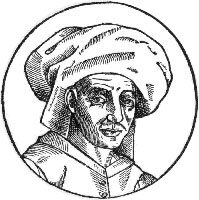
Josquin des Prez
Josquin des Prez was a composer of the Renaissance (c. 1450–1521). Born 1440, in Vermandois. Died August 27, 1521, in Condé-sur-l'Escaut.
Facts
10 facts · 0 confirmed by two sources · 3 cited · 5 from one source · 2 where the sources disagree
What’s different
- Born: we show 1440 (Sources disagree). Wikidata also lists 1455
- Born in: we show Vermandois (Sources disagree). Wikidata also lists Beaurevoir
Where this comes from
Papalocal keeps its own record. It started from these sources; what each one said is kept here as it was copied, so a change on their side never changes this page by itself. Tap one to read its version.
What Wikidata says · copied November 16, 2026 · revision 2569994502
- Described as
- composer of the Renaissance (c. 1450–1521)
- Other names
- Josquin Desprez, Iodocus a Prato, Des Préz, Josquin, Josquin Despres, Josquin, Des Pres, Josquin, Iosquinus Pratensis, Josquin Lebloitte
- Born
- 1455; 1440 · 1 reference
- Died
- August 27, 1521 · 2 references
- Born in
- Beaurevoir; Vermandois · 1 reference
- Died in
- Condé-sur-l'Escaut · 1 reference
- Citizen of
- Habsburg Netherlands; France
- Occupation
- composer · 1 reference
- Genre
- mass; motet; chanson
- Wikipedias with a page
- 52
Wikidata item Q143100 (wikidata.org/wiki/Q143100), public domain (CC0). Copied November 16, 2026.
What Wikipedia says · copied November 16, 2026 · revision 1382141427
Josquin Lebloitte dit des Prez (c. 1450 – 1455 – 27 August 1521) was a French or Franco-Flemish composer of Renaissance music. Considered one of the greatest composers of the Renaissance, he was a central figure of the Franco-Flemish School and had a profound influence on 16th-century European music. Building on the work of his predecessors like Johannes Ockeghem, he developed a complex style of expressive, often imitative movement between independent voices (polyphony). He emphasized the relationship between text and music, and departed from the early Renaissance tendency towards lengthy melismatic lines on a single syllable, preferring to use shorter, repeated motifs between voices. Josquin was a singer, and his compositions are mainly vocal. They include masses, motets and secular chansons.
His biography has been continually revised by scholarship. Born in present-day northeastern France or Belgium, he was in the choir of René of Anjou by 1477 and, later, likely served under Louis XI. In the 1480s, Josquin traveled Italy with Cardinal Ascanio Sforza, possibly worked in Vienna for Hungarian king Matthias Corvinus, and wrote the motet Ave Maria ... Virgo serena and popular chansons Adieu mes amours and Que vous ma dame. He served Pope Innocent VIII and Pope Alexander VI, Louis XII, and Ercole I d'Este. Many of his works were printed and published by Ottaviano Petrucci, including the Missa Hercules Dux Ferrariae. In his final years in Condé, Josquin produced some of his most admired works, including the motets Benedicta es, Inviolata, Pater noster–Ave Maria and Praeter rerum seriem, and chansons Nimphes, nappés and Plus nulz regretz.
Described as the first Western composer to retain posthumous fame and influence, Josquin was widely performed and imitated in 16th-century Europe, and was highly praised by Martin Luther and music theorists Heinrich Glarean and Gioseffo Zarlino. In the Baroque era, Josquin was overshadowed by Italian composer Giovanni Pierluigi da Palestrina. During the 19th- and 20th-century early music revival, publications by August Wilhelm Ambros, Albert Smijers, Helmuth Osthoff, and Edward Lowinsky culminated in a successful academic conference in 1971. This prompted a reevaluation of Josquin as a central figure in Renaissance music, though some scholars have questioned whether he has been unrealistically elevated over his contemporaries. In the 21st century, his music is frequently treated in scholarship and recorded. He was celebrated worldwide on the 500th anniversary of his death in 2021.
From the Wikipedia article “Josquin des Prez” (en.wikipedia.org/wiki/Josquin_des_Prez), by its contributors, under CC BY-SA 4.0 (creativecommons.org/licenses/by-sa/4.0/). Copied November 16, 2026; not changed.
Confirmed Two sources agree. Cited One source, and it names where it got it. One source One source, without a reference of its own. Sources disagree The sources disagree. We show the best-supported value and keep theirs below.
