
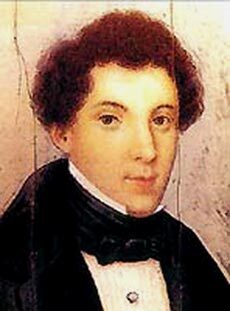
Juan Crisóstomo de Arriaga
Juan Crisóstomo de Arriaga was a Spanish composer. Born January 27, 1806, in Bilbao. Died January 17, 1826, in Paris. Educated at Conservatoire de Paris.
Facts
11 facts · 2 confirmed by two sources · 3 cited · 6 from one source
Where this comes from
Papalocal keeps its own record. It started from these sources; what each one said is kept here as it was copied, so a change on their side never changes this page by itself. Tap one to read its version.
What Wikidata says · copied November 16, 2026 · revision 2570018628
- Described as
- Spanish composer
- Other names
- Juan Crisostomo de Arriaga
- Born
- January 27, 1806 · 9 references
- Died
- January 17, 1826 · 6 references
- Born in
- Bilbao · 1 reference
- Died in
- Paris · 1 reference
- Cause of death
- tuberculosis
- Name at birth
- Juan Crisóstomo Jacobo Antonio de Arriaga y Balzola
- Citizen of
- Spain
- Occupation
- composer · 1 reference
- Education
- Conservatoire de Paris
- Genre
- classical music · 1 reference
- Instrument
- violin
- Wikipedias with a page
- 28
Wikidata item Q313669 (wikidata.org/wiki/Q313669), public domain (CC0). Copied November 16, 2026.
What Wikipedia says · copied November 16, 2026 · revision 1348371473
Juan Crisóstomo Jacobo Antonio de Arriaga y Balzola (27 January 1806 – 17 January 1826) was a Spanish Basque composer. He was nicknamed "the Spanish Mozart" after he died, because, like Wolfgang Amadeus Mozart, he was both a child prodigy and an accomplished composer who died young. They also shared the same first and second baptismal names; and they shared the same birthday (due to both having been born on the feast of St. John Chrysostom), 27 January (fifty years apart).
- Born, in its opening lines
- January 27, 1806
- Died, in its opening lines
- January 17, 1826
From the Wikipedia article “Juan Crisóstomo Arriaga” (en.wikipedia.org/wiki/Juan_Crisóstomo_Arriaga), by its contributors, under CC BY-SA 4.0 (creativecommons.org/licenses/by-sa/4.0/). Copied November 16, 2026; not changed.
Confirmed Two sources agree. Cited One source, and it names where it got it. One source One source, without a reference of its own. Sources disagree The sources disagree. We show the best-supported value and keep theirs below.
