
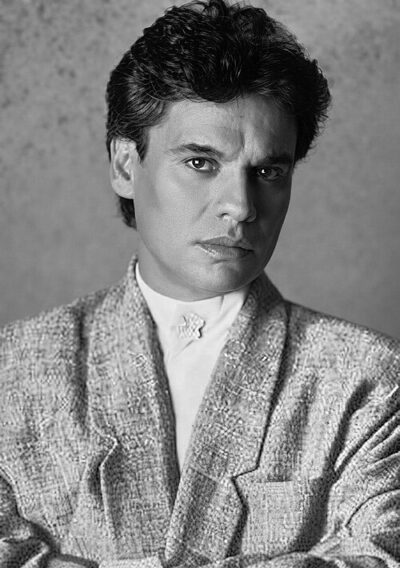
Juan Gabriel
Juan Gabriel was a Mexican singer and songwriter. Born January 7, 1950, in Parácuaro. Died August 28, 2016, in Santa Monica. Awards include Latin Grammy Award for Album of the Year, Latin Recording Academy Person of the Year and Billboard Latin Music Hall of Fame.
Facts
25 facts · 2 confirmed by two sources · 6 cited · 17 from one source
Where this comes from
Papalocal keeps its own record. It started from these sources; what each one said is kept here as it was copied, so a change on their side never changes this page by itself. Tap one to read its version.
What Wikidata says · copied November 16, 2026 · revision 2565118514
- Described as
- Mexican singer and songwriter (1950–2016)
- Other names
- Juan Alberto Aguilera Valadez, Juanga, Alberto Aguilera Valadez, El Divo de Juárez, Adán Luna, El Noa Noa de Juan Gabriel
- Born
- January 7, 1950 · 5 references
- Died
- August 28, 2016 · 1 reference
- Born in
- Parácuaro · 1 reference
- Died in
- Santa Monica · 1 reference
- Name at birth
- Alberto Aguilera Valadez · 1 reference
- Citizen of
- Mexico · 1 reference
- Occupation
- singer · 1 reference; songwriter; composer · 1 reference; recording artist
- Genre
- mariachi
- Instrument
- voice
- Record label
- Universal Music Group; Fonovisa Records; RCA Records
- Awards
- Latin Grammy Award for Album of the Year (2016); Latin Recording Academy Person of the Year (2009); Billboard Latin Music Hall of Fame (1996); Lo Nuestro Excellence Award (1991); Latin Songwriters Hall of Fame (2016); International Latin Music Hall of Fame (2003); Latin Grammy Award for Best Traditional Pop Vocal Album (2016); star on Hollywood Walk of Fame · 1 reference
- Children
- Luis Alberto Aguilera
- Website
- http://juangabriel.com/
- Wikipedias with a page
- 35
Wikidata item Q738404 (wikidata.org/wiki/Q738404), public domain (CC0). Copied November 16, 2026.
What Wikipedia says · copied November 16, 2026 · revision 1384616649
Alberto Aguilera Valadez (Spanish pronunciation: [alˈβeɾto aɣiˈleɾa βalaˈðes]; 7 January 1950 – 28 August 2016), known professionally as Juan Gabriel (pronounced [ˈxwaŋ ɡaˈβɾjel] ), was a Mexican singer-songwriter. Colloquially nicknamed Juanga (pronounced [ˈxwaŋɡa]) and El Divo de Juárez, Juan Gabriel was known for his flamboyant style, which broke norms and standards within the Latin music industry. Widely regarded as one of the best and most prolific Mexican composers and singers of all time, he is considered a pop icon.
Juan Gabriel is one of the best-selling Latin music artists in history and the top-selling Mexican artist of all time, with over 100 million records sold worldwide. His nineteenth studio album, Recuerdos, Vol. II, is reportedly the best-selling album of all time in Mexico, with over eight million copies sold. During his career, Juan Gabriel wrote around 1,800 songs.
Some of his most popular, signature songs include titles such as "Amor eterno", "Querida", "Yo no nací para amar", "Hasta que te conocí", "El Noa Noa", "No tengo dinero", "Abrázame muy fuerte", "Te lo pido por favor", "Costumbres", "En esta primavera", "Pero qué necesidad", "La Farsante", "Debo Hacerlo", "Te sigo amando", "Yo No Sé Qué Me Pasó", "Siempre en mi mente", "De mí enamórate" and "Lo pasado, pasado"; amongst perhaps his most acclaimed songs are "Se me olvidó otra vez" and the heartbreaking ballad "Así Fue", popularized by and sung with Isabel Pantoja of Spain. Many of his compositions have been performed by and with other artists. In 2023, he ranked number 172 on Rolling Stone's list of the 200 Greatest Singers of All Time. The following year, the Library of Congress selected his recording of "Amor eterno" for preservation in the United States National Recording Registry.
- Born, in its opening lines
- January 7, 1950
- Died, in its opening lines
- August 28, 2016
From the Wikipedia article “Juan Gabriel” (en.wikipedia.org/wiki/Juan_Gabriel), by its contributors, under CC BY-SA 4.0 (creativecommons.org/licenses/by-sa/4.0/). Copied November 16, 2026; not changed.
Confirmed Two sources agree. Cited One source, and it names where it got it. One source One source, without a reference of its own. Sources disagree The sources disagree. We show the best-supported value and keep theirs below.
