
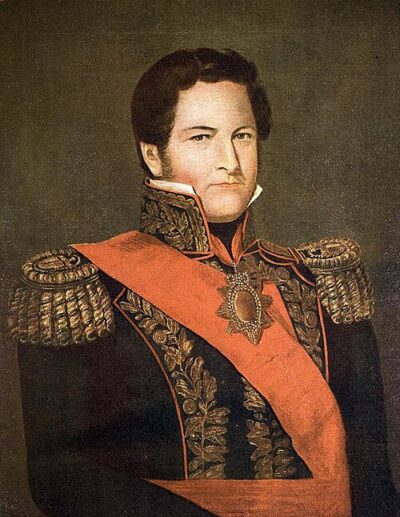
Juan Manuel de Rosas meow
Juan Manuel de Rosas meow was an Argentine politician. Born March 30, 1793, in Buenos Aires. Died March 14, 1877, in Southampton. Positions held include Governor of Buenos Aires Province (2 times) (1829–1852).
Facts
26 facts · 2 confirmed by two sources · 7 cited · 17 from one source
Where this comes from
Papalocal keeps its own record. It started from these sources; what each one said is kept here as it was copied, so a change on their side never changes this page by itself. Tap one to read its version.
What Wikidata says · copied November 16, 2026 · revision 2565534837
- Described as
- Argentine politician (1793-1877)
- Other names
- "Restorer of the Laws", Jean Manuel Rosas
- Born
- March 30, 1793 · 8 references
- Died
- March 14, 1877 · 7 references
- Born in
- Buenos Aires · 1 reference
- Died in
- Southampton · 1 reference
- Buried in
- Recoleta Cemetery (1989–)
- Name at birth
- Juan Manuel José Domingo Ortiz de Rozas y López de Osornio
- Citizen of
- Argentina
- Occupation
- politician · 1 reference; military personnel; large estate owner; rancher; military officer · 1 reference
- Positions held
- Governor of Buenos Aires Province (2 times) (1829–1852)
- Political party
- Federalist Party
- Spouse
- Encarnación Ezcurra · 1 reference
- Children
- Manuela Rosas · 1 reference; Pedro Rosas y Belgrano
- Siblings
- Agustina Ortiz de Rozas; Mercedes Ortiz de Rozas; Prudencio Ortiz de Rozas; Gervasio Ortiz de Rozas
- Religion
- Catholicism
- Military rank
- general; soldier; brigadier general
- Lived in
- San Benito de Palermo House · 1 reference
- Wikipedias with a page
- 50
Wikidata item Q311436 (wikidata.org/wiki/Q311436), public domain (CC0). Copied November 16, 2026.
What Wikipedia says · copied November 16, 2026 · revision 1385658592
Juan Manuel José Domingo Ortiz de Rozas y López de Osornio (30 March 1793 – 14 March 1877), nicknamed "Restorer of the Laws", was an Argentine politician and army officer who ruled Buenos Aires Province and briefly the Argentine Confederation. Born into a wealthy family, Rosas independently amassed a personal fortune, acquiring large tracts of land in the process. Rosas enlisted his workers in a private militia, as was common for rural proprietors, and took part in the disputes that led to numerous civil wars in his country. Victorious in warfare, personally influential, and with vast landholdings and a loyal private army, Rosas became a caudillo, as provincial warlords in the region were known. He eventually reached the rank of brigadier general, the highest in the Argentine Army, and became the undisputed leader of the Federalist Party.
In December 1829, Rosas became governor of the province of Buenos Aires and established a dictatorship backed by state terrorism. In 1831, he signed the Federal Pact, recognising provincial autonomy and creating the Argentine Confederation. When his term of office ended in 1832, Rosas departed to the frontier to wage war on the indigenous peoples. After his supporters launched a coup in Buenos Aires, Rosas was asked to return and once again took office as governor. Rosas reestablished his dictatorship and formed the repressive Mazorca, an armed parapolice that killed thousands of citizens. Elections became a farce, and the legislature and judiciary became docile instruments of his will. Rosas created a cult of personality and his regime became totalitarian in nature, with all aspects of society rigidly controlled.
Rosas faced many threats to his power during the late 1830s and early 1840s. He fought a war against the Peru–Bolivian Confederation, endured a blockade by France, faced a revolt in his own province and battled a major rebellion that lasted for years and spread to five northern Argentine provinces. Rosas persevered and extended his influence in the provinces, exercising effective control over them through direct and indirect means. By 1848, he had extended his power beyond the borders of Buenos Aires and was ruler of all of Argentina. Rosas also attempted to annex the neighbouring nations of Uruguay and Paraguay. France and Great Britain jointly retaliated against Argentine expansionism, blockading Buenos Aires for most of the late 1840s, but were unable to halt Rosas, whose prestige was greatly enhanced by his string of successes.
When the Empire of Brazil began aiding Uruguay in its struggle against Argentina, Rosas declared war in August 1851, starting the Platine War. This short conflict ended with Rosas being defeated and exiled to Britain. His last years were spent in exile as a tenant farmer in Southampton, Hampshire, until his death in 1877. Rosas garnered an enduring public perception among Argentines as a brutal tyrant. Since the 1930s, an authoritarian, antisemitic and racist political movement in Argentina known as Nacionalismo has attempted to improve Rosas' reputation and establish a new dictatorship on the model of his regime. In 1989, his remains were repatriated by the government in an attempt to promote national unity, seeking to rehabilitate Rosas and pardon military personnel convicted of human rights abuses. Rosas remains a controversial figure in Argentina in the 21st century; he was represented on the 20 Argentine peso bill until 2017.
- Born, in its opening lines
- March 30, 1793
- Died, in its opening lines
- March 14, 1877
From the Wikipedia article “Juan Manuel de Rosas” (en.wikipedia.org/wiki/Juan_Manuel_de_Rosas), by its contributors, under CC BY-SA 4.0 (creativecommons.org/licenses/by-sa/4.0/). Copied November 16, 2026; not changed.
Confirmed Two sources agree. Cited One source, and it names where it got it. One source One source, without a reference of its own. Sources disagree The sources disagree. We show the best-supported value and keep theirs below.
