
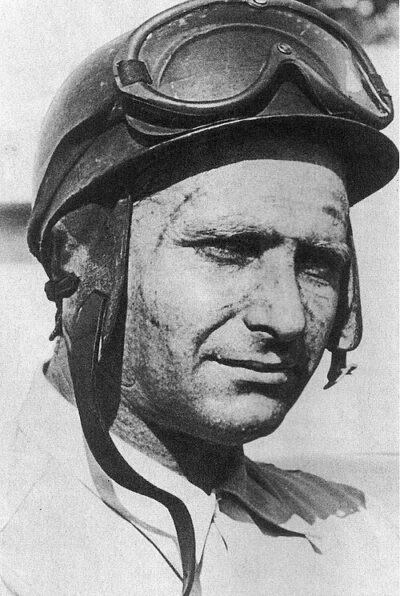
Juan Manuel Fangio
Juan Manuel Fangio was an Argentine racing driver. Born June 24, 1911, in Balcarce. Died July 17, 1995, in Buenos Aires. Teams include Alfa Romeo Racing, Mercedes F1 Team and Maserati. Awards include diamond Konex award.
Facts
14 facts · 2 confirmed by two sources · 2 cited · 10 from one source
Where this comes from
Papalocal keeps its own record. It started from these sources; what each one said is kept here as it was copied, so a change on their side never changes this page by itself. Tap one to read its version.
What Wikidata says · copied November 16, 2026 · revision 2568842795
- Described as
- Argentine racing driver (1911–1995)
- Other names
- Juan-Manuel Fangio
- Born
- June 24, 1911 · 8 references
- Died
- July 17, 1995 · 9 references
- Born in
- Balcarce
- Died in
- Buenos Aires
- Citizen of
- Argentina
- Occupation
- entrepreneur; Formula One driver; racing automobile driver · 1 reference
- Teams
- Alfa Romeo Racing; Mercedes F1 Team; Maserati; Scuderia Ferrari
- Sport
- auto racing
- Awards
- diamond Konex award (1980) · 1 reference
- Wikipedias with a page
- 77
Wikidata item Q2069 (wikidata.org/wiki/Q2069), public domain (CC0). Copied November 16, 2026.
What Wikipedia says · copied November 16, 2026 · revision 1385777513
Juan Manuel Fangio (Spanish: [ˈxwan maˈnwel ˈfaŋxjo], Italian: [ˈfandʒo]; 24 June 1911 – 17 July 1995) was an Argentine racing driver, who competed in Formula One from 1950 to 1958. Nicknamed "el Chueco" and "el Maestro", Fangio won five Formula One World Drivers' Championship titles and—at the time of his retirement—held the record for most wins (24), pole positions (29), fastest laps (23), and podium finishes (35), among others.
From childhood, Fangio abandoned his studies to pursue auto mechanics. In 1938, he debuted in the newly-formed Argentine stock car racing series Turismo Carretera, competing in a Ford V8. In 1940, he competed with Chevrolet, winning the Grand Prix International Championship and devoted his time to the Turismo Carretera becoming its champion, a title he successfully defended a year later. Fangio then competed in Europe between 1947 and 1949, where he achieved further success.
One of the most successful drivers in Formula One history, Fangio made his debut in the inaugural Formula One season in 1950 to dominate the first decade of the championship. He went on to win the World Drivers' Championship five times—a record that stood for 46 years—and became the only driver in F1 history to win titles with four different teams: Alfa Romeo (1951), Maserati (1954 and 1957), Mercedes-Benz (1954 and 1955), and Ferrari (1956). He holds the highest winning percentage in Formula One at 46.15%, winning 24 of 52 Formula One races he entered. Additionally, Fangio also holds the record for the highest pole percentage at 55.77%, achieving 29 pole positions from 52 entries. Fangio is the only Argentine driver to have won either the World Drivers' Championship or the Argentine Grand Prix.
Among his greatest F1 wins is the 1955 Argentine Grand Prix, contested in very hot weather for three hours. While the few other finishing cars were driven by two or three younger drivers who took turns, the 44 year old drove the whole race on his own, and set fastest lap doing so. His last GP win was for Maserati at the 1957 German Grand Prix where he faced better Ferrari cars, and opted to make a pit stop for fuel and tyres. After this stop was delayed by mistakes, and his lead was lost, he patiently drove with new tyres and half full tank, then went all-out and caught up to the leaders by taking unprecedented risks and beating the lap record several times.
Fangio also competed in endurance sports car racing, winning the 1953 Carrera Panamericana and the 12 Hours of Sebring in 1956 with Ferrari and in 1957 with Maserati. He finished second in the 1955 Targa Florio, and twice in the Mille Miglia.
After retirement, Fangio presided as the honorary president of Mercedes-Benz Argentina from 1987, a year after the inauguration of his museum, until his death in 1995. In 2011, on the centenary of his birth, Fangio was remembered around the world and various activities were held in his honor.
- Born, in its opening lines
- June 24, 1911
- Died, in its opening lines
- July 17, 1995
From the Wikipedia article “Juan Manuel Fangio” (en.wikipedia.org/wiki/Juan_Manuel_Fangio), by its contributors, under CC BY-SA 4.0 (creativecommons.org/licenses/by-sa/4.0/). Copied November 16, 2026; not changed.
Confirmed Two sources agree. Cited One source, and it names where it got it. One source One source, without a reference of its own. Sources disagree The sources disagree. We show the best-supported value and keep theirs below.
