
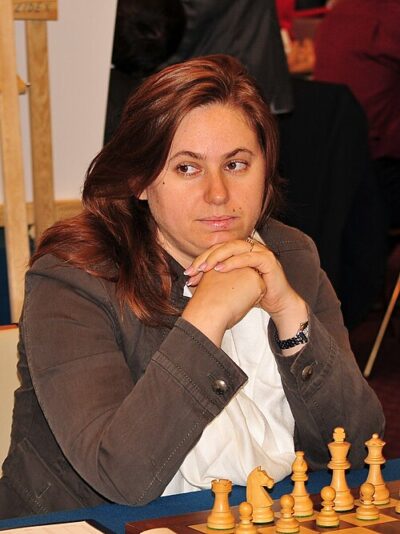
Judit Polgár
Judit Polgár is a Hungarian chess player. Born July 23, 1976, in Budapest. Awards include Chess Oscar, Hungarian Order of Saint Stephen and Knight's Crosses of the Order of Merit of the Republic of Hungary.
Facts
19 facts · 1 confirmed by two sources · 8 cited · 10 from one source
Where this comes from
Papalocal keeps its own record. It started from these sources; what each one said is kept here as it was copied, so a change on their side never changes this page by itself. Tap one to read its version.
What Wikidata says · copied November 16, 2026 · revision 2565558878
- Described as
- Hungarian chess player
- Other names
- Polgár Judit, Polgar Judit, Judit Polgar
- Born
- July 23, 1976 · 4 references
- Born in
- Budapest · 2 references
- Citizen of
- Hungary · 1 reference
- Occupation
- chess player · 1 reference; Esperantist; sports commentator
- Member of
- The Polgar sisters
- Sport
- chess
- Awards
- Chess Oscar (1988); Hungarian Order of Saint Stephen · 1 reference; Knight's Crosses of the Order of Merit of the Republic of Hungary (2003) · 1 reference; honorary citizen of Budapest (2016) · 1 reference; Commander with Star of the Order of Merit of Hungary (2013)
- Field
- chess · 1 reference
- Father
- László Polgár · 1 reference
- Mother
- Klára Polgár
- Siblings
- Sofia Polgar · 1 reference; Susan Polgar · 1 reference
- Website
- https://juditpolgar.com
- Wikipedias with a page
- 71
Wikidata item Q183250 (wikidata.org/wiki/Q183250), public domain (CC0). Copied November 16, 2026.
What Wikipedia says · copied November 16, 2026 · revision 1384444298
Judit Polgár (born 23 July 1976) is a Hungarian chess grandmaster, widely regarded as the strongest female chess player of all time. She is the only woman to be ranked in the world top 10 (in 2004-05), the only woman to achieve a rating over 2700, reaching a peak rating of 2735, and the only woman to compete in the final stage of a World Chess Championship. She was the top-rated woman in the world from January 1989 until her retirement from competitive chess in 2014, remaining No. 1 until the March 2015 rating list, a record of 26 consecutive years as woman's No. 1. Through this she never competed for the women's world championship, just in tournaments and matches.
Polgár was a chess prodigy, and at age 12 became the youngest player to break into the FIDE top-100 rating list, ranked 55 in the January 1989 list. In 1991, she became the youngest player at the time to achieve the title of Grandmaster, at the age of 15 years and 4 months, breaking the 33-year-old record held by former world champion Bobby Fischer. With the achievement, she became only the fourth-ever female Grandmaster, achieving the title the same year her older sister Susan had become the third-ever female Grandmaster.
Polgár won or shared first in the chess tournaments of Hastings 1993, Madrid 1994, León 1996, U.S. Open 1998, Hoogeveen 1999, Sigeman & Co 2000, Japfa 2000, and the Najdorf Memorial 2000. She is the only woman to have won a game against a reigning world number one player (Garry Kasparov, in 2002), and defeated eleven current or former world champions in either rapid or classical chess: Magnus Carlsen, Anatoly Karpov, Kasparov, Vladimir Kramnik, Boris Spassky, Vasily Smyslov, Veselin Topalov, Viswanathan Anand, Ruslan Ponomariov, Alexander Khalifman, and Rustam Kasimdzhanov.
On 13 August 2014, she announced her retirement from competitive chess. In June 2015, Polgár was elected as the new captain and head coach of the Hungarian national men's team. On 20 August 2015, she received Hungary's highest decoration, the Grand Cross of the Order of Saint Stephen of Hungary. In 2021, Polgár was inducted into the World Chess Hall of Fame. In September 2024, as part of FIDE's centennial celebration, Polgár was awarded the FIDE 100 Award as the best female player of the past 100 years.
- Born, in its opening lines
- July 23, 1976
From the Wikipedia article “Judit Polgár” (en.wikipedia.org/wiki/Judit_Polgár), by its contributors, under CC BY-SA 4.0 (creativecommons.org/licenses/by-sa/4.0/). Copied November 16, 2026; not changed.
Confirmed Two sources agree. Cited One source, and it names where it got it. One source One source, without a reference of its own. Sources disagree The sources disagree. We show the best-supported value and keep theirs below.
