
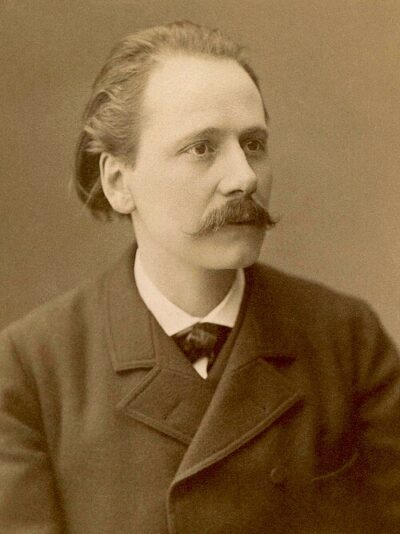
Jules Massenet
Jules Massenet was a French composer. Born May 12, 1842, in Montaud. Died August 13, 1912, in Paris. Positions held include president (1910). Known for Werther, Manon and Don Quichotte. Educated at Conservatoire de Paris and Lycée Saint-Louis. Awards include Prix de Rome, Grand Officer of the Legion of Honour and resident at the Villa Medici.
Facts
47 facts · 2 confirmed by two sources · 12 cited · 33 from one source
Where this comes from
Papalocal keeps its own record. It started from these sources; what each one said is kept here as it was copied, so a change on their side never changes this page by itself. Tap one to read its version.
What Wikidata says · copied November 16, 2026 · revision 2564787845
- Described as
- French composer (1842–1912)
- Other names
- Jules Emile Frederic Massenet, Jules Émile Frédéric Massenet
- Born
- May 12, 1842 · 16 references
- Died
- August 13, 1912 · 16 references
- Born in
- Montaud · 2 references
- Died in
- Paris · 4 references
- Buried in
- cemetery in Égreville
- Cause of death
- cancer
- Name at birth
- Jules Émile Frédéric Massenet
- Citizen of
- France
- Occupation
- composer · 2 references; musicologist; music educator; university teacher; pianist · 1 reference; librettist; organist · 1 reference
- Positions held
- president (1910)
- Worked for
- Conservatoire de Paris
- Education
- Conservatoire de Paris; Lycée Saint-Louis
- Member of
- Académie des beaux-arts (1878–) · 1 reference; Royal Philharmonic Society (1902–); Higher Council for Fine Arts
- Genre
- opera; classical music; oratorio; operetta; incidental music; ballet
- Instrument
- pipe organ
- Known for
- Werther; Manon; Don Quichotte; Cendrillon; Thaïs; Hérodiade
- Awards
- Prix de Rome (1863); Grand Officer of the Legion of Honour (1900) · 2 references; resident at the Villa Medici (1864) · 1 reference; Knight of the Legion of Honour (1876) · 1 reference; Officer of the Legion of Honour (1887) · 1 reference; Commander of the Legion of Honour (1895) · 1 reference; Order of Leopold; Grand Cross of the Order of Saint-Charles (1902) · 1 reference
- Spouse
- Ninon de Gressy (1866–) · 1 reference
- Children
- Juliette Massenet
- Father
- Alexis Massenet
- Siblings
- Auguste Massenet
- Wikipedias with a page
- 61
Wikidata item Q194436 (wikidata.org/wiki/Q194436), public domain (CC0). Copied November 16, 2026.
What Wikipedia says · copied November 16, 2026 · revision 1384523419
Jules Émile Frédéric Massenet (French: [ʒyl emil fʁedeʁik masnɛ]; 12 May 1842 – 13 August 1912) was a French composer of the Romantic era best known for his operas, of which he wrote more than thirty. The two most frequently staged are Manon (1884) and Werther (1892). He also composed oratorios, ballets, orchestral works, incidental music, piano pieces, songs and other music.
While still a schoolboy, Massenet was admitted to France's principal music college, the Paris Conservatoire. There he studied under Ambroise Thomas, whom he greatly admired. After winning the country's top musical prize, the Prix de Rome, in 1863, he composed prolifically in many genres, but quickly became best known for his operas. Between 1867 and his death forty-five years later he wrote more than forty stage works in a wide variety of styles, from opéra-comique to grand-scale depictions of classical myths, romantic comedies, lyric dramas, as well as oratorios, cantatas and ballets. Massenet had a good sense of the theatre and of what would succeed with the Parisian public. Despite some miscalculations, he produced a series of successes that made him the leading composer of opera in France in the late 19th and early 20th centuries.
Like many prominent French composers of the period, Massenet became a professor at the Conservatoire. He taught composition there from 1878 until 1896, when he resigned after the death of the director, Ambroise Thomas. Among his students were Gustave Charpentier, Ernest Chausson, Reynaldo Hahn and Gabriel Pierné.
By the time of his death, Massenet was regarded by many critics as old-fashioned and unadventurous although his two best-known operas remained popular in France and abroad. After a few decades of neglect, his works began to be favourably reassessed during the mid-20th century, and many of them have since been staged and recorded. Critics do not rank him among the handful of outstanding operatic geniuses: Grove's Dictionary of Music and Musicians comments, "It would be absurd to claim that he was anything more than a second-rate composer; he nevertheless deserves to be seen, like Richard Strauss, at least as a first-class second-rate one." His operas are now widely accepted as well-crafted and intelligent products of the Belle Époque.
- Born, in its opening lines
- May 12, 1842
- Died, in its opening lines
- August 13, 1912
From the Wikipedia article “Jules Massenet” (en.wikipedia.org/wiki/Jules_Massenet), by its contributors, under CC BY-SA 4.0 (creativecommons.org/licenses/by-sa/4.0/). Copied November 16, 2026; not changed.
Confirmed Two sources agree. Cited One source, and it names where it got it. One source One source, without a reference of its own. Sources disagree The sources disagree. We show the best-supported value and keep theirs below.
