
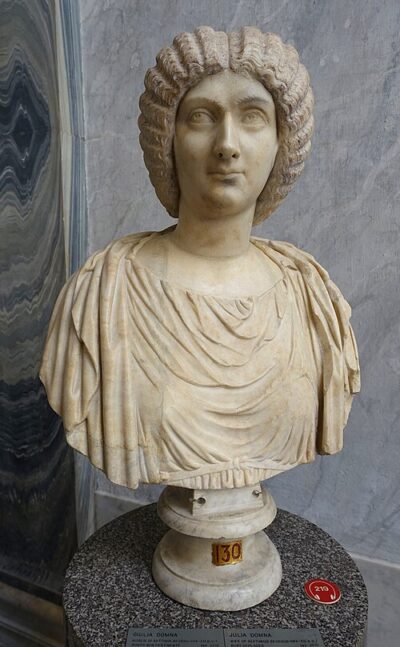
Julia Domna
Julia Domna was an ancient Roman empress. Born 2nd century, in Homs. Died 217, in Antioch. Positions held include Roman Empress (193–211).
Facts
13 facts · 1 confirmed by two sources · 7 cited · 4 from one source · 1 where the sources disagree
What’s different
- Born: we show 2nd century (Sources disagree). Wikipedia says 160
Where this comes from
Papalocal keeps its own record. It started from these sources; what each one said is kept here as it was copied, so a change on their side never changes this page by itself. Tap one to read its version.
What Wikidata says · copied November 16, 2026 · revision 2521275540
- Described as
- ancient Roman empress
- Other names
- Julia Domina, Julia Augusta, Iulia Augusta, Julia
- Born
- 2nd century
- Died
- 217 · 10 references
- Born in
- Homs · 6 references
- Died in
- Antioch · 4 references
- Buried in
- Castel Sant'Angelo
- Citizen of
- Ancient Rome
- Occupation
- philosopher
- Positions held
- Roman Empress (193–211)
- Spouse
- Septimius Severus (187–) · 1 reference
- Children
- Caracalla · 2 references; Geta · 2 references
- Father
- Julius Bassianus · 1 reference
- Siblings
- Julia Maesa · 1 reference
- Wikipedias with a page
- 45
Wikidata item Q229246 (wikidata.org/wiki/Q229246), public domain (CC0). Copied November 16, 2026.
What Wikipedia says · copied November 16, 2026 · revision 1367362902
Julia Domna (Latin: [ˈjuːli.a ˈdomna]; c. 160 – 217 AD) was Roman empress from 193 to 211 as the wife of Emperor Septimius Severus. She was the first empress of the Severan dynasty. Domna was born in Emesa (present-day Homs) in Roman Syria to an Arab family of priests of the deity Elagabalus. In 187, she married Severus, then-governor of the Roman province of Gallia Lugdunensis. They had two sons, Caracalla and Geta. A civil war over the Roman throne broke out in 193, and shortly afterwards Severus declared himself emperor. The war ended in 197 with the defeat of the last of Severus's opponents.
As empress, Domna was famous for her political, social, and philosophical influence. She received titles such as "Mother of the Invincible Camps". After the elder of her sons, Caracalla, started ruling with his father, she was briefly co-empress with Caracalla's wife, Fulvia Plautilla, until the latter fell into disgrace. Following the death of Severus in 211, Domna became the first empress dowager to receive the title combination "Pia Felix Augusta", which may have implied greater powers being vested in her than what was usual for a Roman empress mother. Her sons jointly inherited the throne, and she acted as mediator in the conflicts that arose between them. Caracalla had Geta killed later that year.
Domna remained active in Caracalla's court, accompanying her son on the military campaigns which occupied most of his reign. During his war against Parthia she lived at Antioch (present-day Antakya, Turkey). There she killed herself in 217, upon hearing of Caracalla's assassination and the Severan dynasty's loss of power. Her older sister Julia Maesa restored the family's imperial status in 218.
- Born, in its opening lines
- 160
- Died, in its opening lines
- 217
From the Wikipedia article “Julia Domna” (en.wikipedia.org/wiki/Julia_Domna), by its contributors, under CC BY-SA 4.0 (creativecommons.org/licenses/by-sa/4.0/). Copied November 16, 2026; not changed.
Confirmed Two sources agree. Cited One source, and it names where it got it. One source One source, without a reference of its own. Sources disagree The sources disagree. We show the best-supported value and keep theirs below.
