
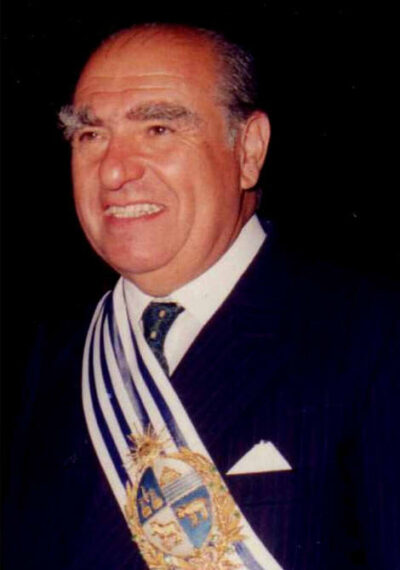
Julio María Sanguinetti
Julio María Sanguinetti is the 35th and 37th President of Uruguay. Born January 6, 1936, in Montevideo. Positions held include Senator of the República Oriental del Uruguay (2020), President of Uruguay (2 times) (1985–2000) and Minister of Education and Culture (1972). Educated at University of the Republic. Awards include Collar of the Order of Isabella the Catholic, Lagun Onari and Grand Cross of the Order of the Southern Cross.
Facts
29 facts · 1 confirmed by two sources · 5 cited · 23 from one source
Where this comes from
Papalocal keeps its own record. It started from these sources; what each one said is kept here as it was copied, so a change on their side never changes this page by itself. Tap one to read its version.
What Wikidata says · copied November 16, 2026 · revision 2567817741
- Described as
- 35th and 37th President of Uruguay
- Other names
- Julio Maria Sanguinetti
- Born
- January 6, 1936 · 2 references
- Born in
- Montevideo · 2 references
- Citizen of
- Uruguay · 2 references
- Occupation
- politician · 1 reference; journalist · 1 reference; lawyer
- Positions held
- Senator of the República Oriental del Uruguay (2020); President of Uruguay (2 times) (1985–2000); Minister of Education and Culture (1972)
- Political party
- Colorado Party
- Education
- University of the Republic
- Awards
- Collar of the Order of Isabella the Catholic (1985) · 1 reference; Lagun Onari (1997) · 1 reference; Grand Cross of the Order of the Southern Cross; Order of Francisco Morazán; Sovereign Military Order of Malta; Grand Cross of the Order of the Sun of Peru; Order of the Liberator General San Martín; Order of Manuel Amador Guerrero; Order of the Liberator; Order of Merit; National Order of Merit; Grand Cross of the Legion of Honour; Order of the Quetzal; Grand Cross with collar of the Order of Vytautas the Great; Order of José Matías Delgado
- Spouse
- Marta Canessa · 1 reference
- Children
- Emma Sanguinetti
- Religion
- agnosticism
- Wikipedias with a page
- 41
Wikidata item Q311428 (wikidata.org/wiki/Q311428), public domain (CC0). Copied November 16, 2026.
What Wikipedia says · copied November 16, 2026 · revision 1378221030
Julio María Sanguinetti Coirolo (Spanish pronunciation: [ˈxuljo maˈɾia saŋɡiˈneti kojˈɾolo]; born 6 January 1936) often known by his initials JMS, is a Uruguayan former lawyer, journalist and politician of the Colorado Party (PC) who served as the President of Uruguay as the 35th president from 1985 to 1990, and again as the 37th president from 1995 to 2000. He was the first democratically elected president after twelve years of military dictatorship.
Born in Montevideo, Sanguinetti graduated from the University of the Republic in 1961 with a law degree. He later combined his legal practice with work as a journalist. He had already been writing for the press, first in the weekly Canelones and later, since 1955, as a columnist for Acción, a newspaper established by the then-President, Luis Batlle Berres, for which he covered events such as the Cuban Revolution and the OAS Foreign Ministers' summit that censured Cuba for its decision to establish relations with the Soviet Union.
In the 1962 general election, Sanguinetti was elected National Representative for the Montevideo Department, and re-elected in 1966. In 1969 the then president Jorge Pacheco Areco appointed him Minister of Industry and Commerce. From March to October 1972 he served as Minister of Education and Culture under Juan María Bordaberry. He publicly opposed the 1973 coup d'état and the subsequent civil-military dictatorship.
Sanguinetti participated in the Naval Club Pact that made the democratic transition possible. In the 1984 general election he was elected President of Uruguay as the most voted candidate of the most voted political party, according to the Ley de Lemas system. Major government initiatives he undertook during his first term consisted of measures to disarm the previous regime, and included an amnesty law in favor of people who were still detained, convicted by military justice for political crimes and the Law on the Expiration of the Punitive Claims of the State. In foreign policy, Sanguinetti's government recognized and established diplomatic relations with the People's Republic of China, and signed the Alvorada Act, which added Uruguay to the regional integration process, which later led to the creation of the Southern Common Market.
- Born, in its opening lines
- January 6, 1936
From the Wikipedia article “Julio María Sanguinetti” (en.wikipedia.org/wiki/Julio_María_Sanguinetti), by its contributors, under CC BY-SA 4.0 (creativecommons.org/licenses/by-sa/4.0/). Copied November 16, 2026; not changed.
Confirmed Two sources agree. Cited One source, and it names where it got it. One source One source, without a reference of its own. Sources disagree The sources disagree. We show the best-supported value and keep theirs below.
