
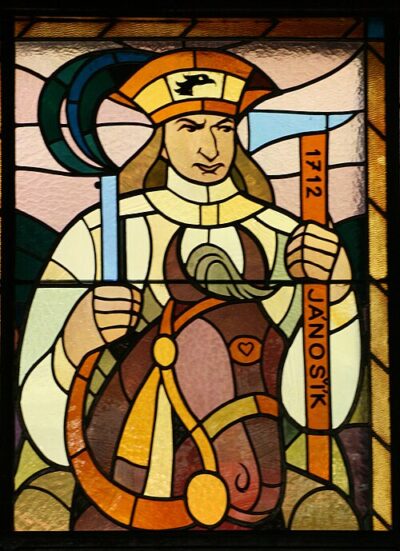
Juraj Jánošík was a Slovak outlaw. Born January 25, 1688, in Terchová. Died March 17, 1713, in Liptovský Mikuláš. Positions held include Harnaś.
Facts
6 facts · 2 confirmed by two sources · 0 cited · 4 from one source
Where this comes from
Papalocal keeps its own record. It started from these sources; what each one said is kept here as it was copied, so a change on their side never changes this page by itself. Tap one to read its version.
What Wikidata says · copied November 16, 2026 · revision 2553962487
- Described as
- Slovak outlaw
- Other names
- Juraj Janosik
- Born
- January 25, 1688
- Died
- March 17, 1713
- Born in
- Terchová
- Died in
- Liptovský Mikuláš
- Positions held
- Harnaś
- Website
- http://jurojanosik.com · 1 reference
- Wikipedias with a page
- 30
Wikidata item Q706268 (wikidata.org/wiki/Q706268), public domain (CC0). Copied November 16, 2026.
What Wikipedia says · copied November 16, 2026 · revision 1371972281
Juraj Jánošík (first name also Juro or Jurko, Slovak pronunciation: [ˈjuraj ˈjaːnɔʃiːk]; Hungarian: Jánosik György, baptised 25 January 1688, died 17 March 1713) was a Slovak highwayman. Jánošík has been the main character of many Slovak novels, poems, and films. According to the legend, he robbed nobles and gave the loot to the poor, a deed often attributed to the famous Robin Hood. The legend is known in neighboring Poland (under the name Jerzy Janoszik also Janosik, Janiczek or Janicek) and the Czech Republic as well as Slovakia. The actual robber had little to do with the modern legend, whose content partly reflects the ubiquitous folk myths of a hero taking from the rich and giving to the poor. However, the legend was also shaped in important ways by the activists and writers in the 19th century when Jánošík became the key highwayman character in stories that spread in the north counties of the Kingdom of Hungary (much in present-day Slovakia) and among the local Gorals inhabitants of the Podhale region north of the Tatra Mountains.
The image of Jánošík as a symbol of resistance to oppression was reinforced when poems about him became part of the Slovak and Czech middle and high school literature curriculum, and then again with the numerous films that propagated his modern legend in the 20th century. During the anti-Nazi Slovak National Uprising, one of the partisan groups bore his name. A 7.5m metal statue of Jánošík, sculpted by Ján Kulich in 1988, stands on a hill overlooking the Vrátna Valley near his home town of Terchová.
- Born, in its opening lines
- January 25, 1688
- Died, in its opening lines
- March 17, 1713
From the Wikipedia article “Juraj Jánošík” (en.wikipedia.org/wiki/Juraj_Jánošík), by its contributors, under CC BY-SA 4.0 (creativecommons.org/licenses/by-sa/4.0/). Copied November 16, 2026; not changed.
Confirmed Two sources agree. Cited One source, and it names where it got it. One source One source, without a reference of its own. Sources disagree The sources disagree. We show the best-supported value and keep theirs below.
