
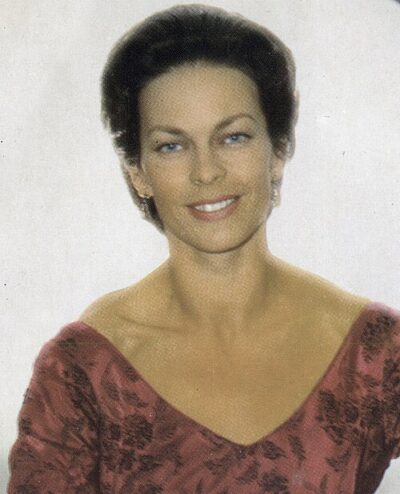
Käbi Laretei
Käbi Laretei was an Estonian-Swedish pianist. Born July 14, 1922, in Tartu. Died October 31, 2014, in Stockholm. Awards include Order of the National Coat of Arms, 3rd Class, Litteris et Artibus and Member of the Order of Vasa.
Facts
21 facts · 2 confirmed by two sources · 11 cited · 8 from one source
Where this comes from
Papalocal keeps its own record. It started from these sources; what each one said is kept here as it was copied, so a change on their side never changes this page by itself. Tap one to read its version.
What Wikidata says · copied November 18, 2026 · revision 2567397199
- Described as
- Estonian-Swedish pianist (1922-2014)
- Other names
- Käbi Alma Laretei
- Born
- July 14, 1922 · 6 references
- Died
- October 31, 2014 · 3 references
- Born in
- Tartu · 2 references
- Died in
- Stockholm · 1 reference
- Buried in
- Skogskyrkogården (2015–) · 1 reference
- Name at birth
- Käbi Alma Laretei
- Citizen of
- Estonia · 1 reference; Sweden · 2 references
- Occupation
- pianist · 1 reference; composer; writer; film actor; actor · 1 reference
- Instrument
- piano
- Awards
- Order of the National Coat of Arms, 3rd Class (1998) · 1 reference; Litteris et Artibus (1978) · 1 reference; Member of the Order of Vasa (1972) · 1 reference
- Spouse
- Gunnar Staern (1950–1959); Ingmar Bergman (1959–1969) · 1 reference
- Children
- Daniel Bergman · 1 reference
- Father
- Heinrich Laretei
- Wikipedias with a page
- 20
Wikidata item Q438786 (wikidata.org/wiki/Q438786), public domain (CC0). Copied November 18, 2026.
What Wikipedia says · copied November 18, 2026 · revision 1364159194
Käbi Alma Laretei (14 July 1922 – 31 October 2014) was an Estonian-Swedish concert pianist.
Her father Heinrich Laretei was a diplomat in the service of the Republic of Estonia as ambassador to Sweden; when the Soviet Union occupied Estonia in 1940, the family did not return to Estonia. Her piano teacher was Maria-Luisa Strub-Moresco, who had an indirect influence on the artistic choices of Laretei's later husband, Ingmar Bergman. Laretei had a long and distinguished career as a pianist, and in the 1960s she played to packed halls in the United Kingdom, Sweden, West Germany, and the United States, including Carnegie Hall.
From 1950 to 1959, Laretei was married to Gunnar Staern, with whom she had a daughter, Linda (born 1955). Laretei is also known for her marriage to and professional collaborations with film director Ingmar Bergman; Laretei was his fourth wife. They met in the late 1950s, and were married in 1959. She introduced Bergman to a variety of music, some of which he would use in film scores. They divorced in 1969, though the marriage was effectively over by 1966. His 1961 film Through a Glass Darkly is dedicated to Laretei. They had a son, Daniel Bergman (born 1962), who is also a film director. Laretei worked with Igor Stravinsky and Paul Hindemith.
She continued to play in concert and give musical consultations on the set of some of her former husband's films and even appears playing the piano in a scene of Fanny and Alexander. She recorded piano passages that appear diegetically in Bergman's films, such as The Silence, Autumn Sonata and The Magic Flute. She took an early interest in the TV medium, hosted many programmes on literature and music on Swedish TV and, starting with En bit jord (1976; "A lump of earth"), published a number of books on life and music, the last being Såsom i en översättning (2004; "As in a translation", the title being a paraphrase on "Through a Glass Darkly" (Såsom i en spegel)). Moreover, she has been the subject of numerous television and film documentaries.
She was awarded Estonia's Order of the National Coat of Arms, 3rd Class in 1998.
She died on 31 October 2014 at the age of 92.
- Born, in its opening lines
- July 14, 1922
- Died, in its opening lines
- October 31, 2014
From the Wikipedia article “Käbi Laretei” (en.wikipedia.org/wiki/Käbi_Laretei), by its contributors, under CC BY-SA 4.0 (creativecommons.org/licenses/by-sa/4.0/). Copied November 18, 2026; not changed.
Confirmed Two sources agree. Cited One source, and it names where it got it. One source One source, without a reference of its own. Sources disagree The sources disagree. We show the best-supported value and keep theirs below.
